Biodiversity Net Gain is what happens when we mistake the measure of a thing for the thing itself. Schools become league tables, hospitals become waiting-time targets, digital culture becomes engagement statistics; eventually a living landscape too becomes a number in a spreadsheet. The problem is not measurement. Of course we should measure ecological damage and recovery. The problem begins when the metric acquires sufficient authority to make unlike things appear interchangeable: sever this habitat here, manufacture enough units there, apply the approved multipliers and, with a little actuarial magic, destruction becomes a net gain. This is the trap we find ourselves in in Elmbridge right now as the council faces the combined pressures of developers gobbling up land and a government keen to release the handbrake on planning controls.
But nature is not fungible. A landscape is an accumulation of relationships between soil, water, species, seasons and time, some understood and many not. Its value may lie precisely in its continuity, its position between other habitats, or in things the metric measures badly or hasn’t noticed at all. Hugh Warwick’s objection to the old claim that Britain has plenty of countryside applies equally here: acreage tells you very little about the significance of the particular acreage you are proposing to lose. BNG can tell us something useful about a scheme. The absurdity begins when a positive score is allowed to tell us the scheme is therefore good. The score is not the game.
There was a time when childhood was understood as gloriously provisional: children were shy, loud, frightened, obsessive, contradictory little creatures who tried on selves as casually as pirate hats and princess dresses, and nobody mistook Tuesday’s fixation for metaphysical truth; now a particular strain of Western parenting, steeped in the therapeutic vocabulary of adults who have spent twenty years processing their own trauma, attachment styles, burnout, boundaries, neurodivergence and “authentic selves,” treats every childish wobble as evidence, every discomfort as diagnosis, every preference as revelation.
The intention advertises itself as compassion; the effect is often narcissistic projection. Anxious adults, terrified of getting parenting wrong, cannot tolerate the possibility that a feeling might simply be a feeling, that sadness may be sadness, awkwardness awkwardness, boredom the perfectly rational response to a sterile classroom, fractured attention the predictable consequence of a house full of glowing screens engineered to destroy it.
So the external world recedes and the label advances: the temporary becomes structural, the situational essential, the feeling the self. Nothing may remain small. The lonely afternoon becomes a discourse, the difficult term a framework, the passing phase an identity requiring affirmation, management and an expanding priesthood of consultants, influencers, therapists, trainers and administrators.
It is an oddly airless form of child-centredness in which the child is forever being interpreted by adults unable to stop interpreting themselves. Childhood was once permitted to be messy, wasteful, embarrassing and magnificently wrong; now we are in danger of mistaking the rehearsal for the performance, embalming every experiment in the language of permanent identity and calling it listening. Children are not tiny adults waiting to have their hidden essence decoded. They are unfinished people, and one of the great privileges of childhood is being allowed to become somebody else.
You never really pay full price at PizzaExpress. When I was nineteen it felt like a nice meal out. Now someone checks for a voucher before anyone orders, and paying the price printed on the menu feels reckless, incompetent. The pizza may thankfully be much as it was. What has changed is what customers think it ought to cost.
Le Col, late of this parish, had a version of this problem. Complete a Strava challenge, get money off. A challenge this summer offered 30% off full-price kit. It was clever: cyclists were already on Strava, already inclined to chase a target, and the reward sent them to the shop. It also gave them a reason to wait. Once you have bought a jersey with a code, the price without one becomes a penalty for being impatient.
Personally I never really bought into Le Col, although I could see its appeal. Yanto Barker had raced professionally, the kit looked good, and you could believe that someone who had spent years in the saddle might have useful opinions about where to put a seam. Its former operating company entered administration in June. The offers alone cannot explain that, but they leave whoever carries the name forward with an awkward job: persuading riders that the price on the label is a real one.
Rapha is different for me. I remember what it felt like when it arrived on the scene. It made road cycling and courier-style urban commuting look stylish while keeping the suffering, odd rituals and long history intact. The clothes, photography and writing belonged together. For a British company to take that idea across Europe, Grand Tours and into the US was quite something. Rapha helped establish the visual language that newer brands now work within.
Today its website still calls the clothes “the world’s finest”. That is an extraordinary thing to ask a customer to continue to accept. There was a time when I might have let the boast pass on design grounds alone. Rapha made some of the kit everyone else seemed to be reacting to. Now many of us would look through the range and struggle to see what earns a claim of superiority across all of it, perhaps in some areas of technology and some of design, but universally?
The UK men’s shop alone currently shows 467 product listings. Alongside jerseys and bib shorts are shoes, sunglasses, hoodies, bikepacking bags, bar tape and a bookstore. There is nothing inherently wrong with a broad range, and the number includes many perfectly sensible products for different sorts of riding. But breadth changes the nature of the claim. “The finest” sounds rather different when it has to stretch from a racing skinsuit to a pair of casual trousers.
Rapha’s own account of itself still sounds like the brand I admired: demanding rides, clothes tested by professionals, stories told through photography and film, a club that at least says it “makes cycling sociable” though is almost certainly a fierce clique of try hards Much of that work is real. But I don’t think a professional rider testing one collection settles the quality of everything in the shop, or that a well-made film tells me which of several near identical jerseys is worth its price. The story has become larger and more confident while my reasons for believing every part of it have become less clear.
It is also a far more familiar sight on the road. That is success of a type, of course. Rapha opened up a particular idea of cycling to a lot of people, myself included. But a brand that once made you feel you had found something can’t depend on that feeling indefinitely. The product has to carry more of the weight once the badge is commonplace and demographically diverse.
MAAP and Pas Normal Studios now occupy some of the space Rapha once owned. They run offers too, so this isn’t a claim that their pricing is pure or every garment better. Their advantage, to my eye, is that each has a more recognisable point of view. MAAP can be loud and restless; Pas Normal can look like the entire club has agreed on a dress code without telling anyone else, a cycling murmuration. I don’t admire every choice, but I can usually see the choice being made.
Rapha says it is reducing its reliance on promotions. That is a difficult thing to do when customers have learnt the sale calendar, and its latest financial figures offer little comfort yet. Fran Millar also set about reducing the number of product launches and putting more attention back on the kit. She has since stepped down as chief executive, with further cuts planned. Unlike the ambulance chasers on LinkedIn, I wouldn’t use the accounts to declare her approach a failure. Recovering those full-price customers takes longer than ending a succession of sales.
Le Col shows the pricing problem in its most obvious form: too many opportunities to buy at a discount can make the advertised price hard to believe. Rapha has a more daunting task. It has to decide which parts of a large, successful brand still justify the claims made on its behalf, and which are there because a large business kept telling its team to keep finding new things it could sell.
On the Rapha homepage today, the invitation to shop the new collection sits alongside an offer to bundle and save up to 20%. I can understand both messages. I’m less sure they belong to the same idea of “the world’s finest”.
AI: Ai naturally helped me get some wider context on what’s been going on and checking some details. I wrote the piece.
I’ve had a busy few months which, from a financial perspective at least, has been no bad thing. The downside is that the writing has rather suffered in frequency. Oddly though, I find the opposite happens in my head. When work is busy I seem to notice more. Every train journey, client meeting, conversation and aimless wander through London gets mentally filed under “there’s probably a piece in that.” The vast majority stay there.
During quieter periods, visibility anxiety has an unfortunate habit of convincing me that almost every observation deserves to become a LinkedIn post. I don’t think I publish complete nonsense, but there is probably a regression to the mean. Which is all to say that this was one of the ideas that escaped the notebook. You can decide whether it should have.
I’ve always liked the contrast between elite athletes and their coaches. You see someone with the physique of a middle-aged middle manager calmly explaining to a twenty-two-year-old Olympic hopeful why their hips are opening half a degree too early. It feels faintly absurd but of course the coach isn’t there to run the race. They’re there because they’ve developed the judgement over time and perhaps their own career to notice things the athlete no longer can.
I occasionally wonder whether writing about luxury is a bit like that. Unlike some of LinkedIn’s more glamorous commentators, I’m not bouncing between Aman resorts, Formula One paddocks and yacht launches in Como. My natural habitat remains Esher, the quiet south Cornish coast, RHS Chelsea and occasionally Regent Street if I’m feeling particularly in need of retail.
Then again, most athletics coaches aren’t still running the 110m hurdles.
A few weeks ago I found myself walking through Belgravia. It’s one of the few places in London where almost every version of wealth seems to coexist. You see extraordinary money, of course, but what I noticed wasn’t the value of it but it was that everyone appeared to be speaking slightly different ‘languages’.
A Ferrari slipped past me on Audley Street. I didn’t know what it was, as is typical it carried no model badge. On Burlington and Bond Street there are shops where the bags in the window carry no logo or at least logos so small as to be unreadable from a distance.
And then, a few streets later, came a Rolls-Royce Cullinan in a vulgar magenta with the kind of chrome accents that wouldn’t be out of place on a 50s Cadillac.
None of the people owning these goods, I suspect, would consider themselves to have anything other than luxury tastes and certainly not bad taste. They would consider themselves discerning. Yet each are signalling entirely different things.
To return to Ferrari. I’ve always found it fascinating that a company capable of building a bright red, mid-engined supercar, loud enough to be described as “an operatic rhinoceros trapped inside a tumble dryer”, draws the line at six scripted letters across the boot line. Reader, it is many things, but subtle isn’t one of them.
And yet somebody inside Ferrari decided that “296 GTB” didn’t need telegraphing. If you know, you know. If you don’t, a badge ain’t going to change you.
Porsche on the other hand seems to have reached the opposite conclusion. Their model names have that daft run-on suffixing , but worse than that is their love of decals and special edition badging and stitching. Range Rover briefly lost its mind too. During my time around the brand it seemed every derivative acquired another flourish of nomenclature until the back of the car resembled one of those late-90s PCs covered in stickers announcing Intel Inside and “Designed for Microsoft Office.” BMW, meanwhile, has scattered M badges across the range with the enthusiasm of a toddler decorating a birthday card.
None of which makes them wrong, but it does make me wonder whether luxury itself is beginning to diverge. There is one version wants to be recognised and another that only needs to be recognised by the right people.
At this point somebody with a proper strategy background and much cleverer than me would probably invoke Pierre Bourdieu, so I’ll save them the trouble. Bourdieu argued that status isn’t simply about money, but rather what he called cultural capital: the accumulation of taste, knowledge and judgement that subtly tells other people where you belong.
Owning an expensive watch tells me you have money. Recognising an expensive watch that almost nobody else notices tells me something rather different. One is a demonstration of wealth, the other a demonstration of fluency. Unfortunately, Instagram rather complicated the whole affair.
Online, luxury became something performed for people scrolling past in fractions of a second. In this environment logos and monograms work brilliantly. A Louis Vuitton bought in Tenerife because everyone back home will recognise it. The Balenciaga hoodie bought on Vinted because the logo is more important than the drop-season, also works.
At the opposite end of the wealth spectrum, exactly the same instinct produces superyachts like shopping centres and watches that look capable of summoning a medevac. Different bank balances, remarkably similar behaviour.
The trouble is, cameras are hopeless at photographing ambiguity and judgement; design lines and proportions rarely survive a thumbnail. Neither does impeccable tailoring nor hospitality that is anticipatory and personal rather than performative. My vision of luxury might be a beautifully balanced Hoek yacht easing through Scandinavian waters while the owner wears a twenty-year-old jumper because they genuinely couldn’t care less. I covet the brands and experiences that show curation and restraint.
And before anyone starts sharpening the comments, I don’t think one version is morally superior to the other. Vulgarity, after all, is culturally relative. To the Emirati collector, a two-tone Phantom with intricate marquetry might represent extraordinary craftsmanship and generosity. To a Nordic architect it may feel grotesque. Neither is objectively right, they they’re simply speaking different aesthetic languages.
Diagnostically, I wonder whether we simply misunderstand the people buying these things. Which speaks to my own scepticism and misgivings of traditional personas in luxury.
Male. Fifty-four. £250m family office. Owns homes in London and Verbier.
Fine.
Now tell me whether he commissions a floating palace with a cinema, helipad and c., or spends the next decade restoring a Swan 65 because the joinery is beautiful and he likes crossing the North Sea under sail. Those are completely different people in a way that doesn’t show up demographically but culturally.
Traditional segmentation along these lines has remarkably little to say about such distinctions because it’s looking in entirely the wrong place. So, as I jumped on the train home that warm evening in London, I jotted down a few thoughts that tried to unpick why I still see brands spending a great deal of time asking who customers are: their age, income, their geography and profession, perhaps so anchored in media buying. Whereas I believe in this sector the more insightful question is something else entirely. Who do they imagine they’re speaking to?
Because somewhere between that clean-lined Ferrari and the bling-trimmed Cullinan, it occurred to me that luxury isn’t one language or culture at all. It’s a collection of dialects.
Back when I was a full-time employee I can distinctly remember, like many of us I assume, looking at my calendar and thinking: this cannot all be essential.
The client work was demanding, but it was real. Framing problems. Untangling clumsy journeys. Making regulated systems usable. That part didn’t trouble me. It was what I always wanted to believe I was actually being paid to do.
The Sunday night dread was never about the difficulty of the UX tasks I had to do; it was about the prospect of defending a button placement to three people whose job titles I didn’t fully understand.
That feeling was neither rare nor dramatic. It was simply ambient.
David Graeber called them “bullshit jobs.” His argument was broad. Mine is narrower. Most knowledge roles contain a necessary core wrapped in a layer of activity that grows over time. Reviews of reviews. Meetings about alignment. Artefacts written, designed and built to signal diligence in output. Essentially, as Clarkson used to say “I did a thing!“.
None of it looks absurd taken in isolation. Together, it grows.
For more than twenty years I worked five days a week in agency life. The rhythm was typically conventional: full calendars, visible participation, institutional choreography. It signalled seriousness. It was still frequently fun around the margins. It also created drag.
In late 2024 I left, and as I found my new life as a freelancer I was able to cut the week to <5 paid days.
I didn’t change the nature of the work but I have changed the size of the container.
The client conversations still happen. The user experience architecture still happens. The thinking still happens. What has (mostly) disappeared are the rituals that demonstrated I was thinking. Those pre-reads, two hour workshops on alignment. Status updates with no status updates. The sorts of meetings that PMs get all excited about or shitty with you when they can’t move their Trello/GANT along a notch.
The surprising part was how little of that missing activity altered the outcome.
On the other days I study human–AI interaction (more on this in the weeks and months to come) and I work at our allotment. Recently I completed the task of laying a hedge in a centuries-old craft. Laying hedge is slow and slightly brutal on the hands. You cut partway through the stem, bend it, weave it into the next. At the end of the afternoon there’s a line you can lean against. If it fails, you can see the weak point, and if you can’t, a sheep probably can.
There is no meeting about the hedge. It either stands or it doesn’t.
That contrast isn’t noodling pastoral escapism. It simply highlights something about knowledge work: when outcomes are abstract and time is fixed, activity expands to reassure everyone involved. AI now presses on that reassurance.
A large share of white-collar work involves drafting, structuring, summarising and formatting. My wife and brother are both lawyers and I can see it in the sheer volume of their workload. These tasks will become faster with machine learning and ai modelling. One person can carry more of them. That has and will create slack.
The exact percentage (whether 40% or otherwise) is less important than the recurring personal question: “If we stopped doing this, what would actually fall apart?” Most people can answer that for at least part of their own week.
The difficulty isn’t identifying what’s surplus work. It’s that that surplus seems to underwrite role hierarchy, salary bands, and the whole shared fiction of the full week. Remove it and you have to redesign more than diaries.
Cutting my own week didn’t change the work I did. It changed what was visible. Once you notice how much of a calendar exists to justify itself, it’s difficult to stop noticing.
AI: Just a bit of Grammarly used to tidy up the copy and some ChatGPT to surface some references and generate a (rubbish) image because algorithms.
There’s a very British idea, popularised for a certain generation by mid-00s Top Gear, that you simply shouldn’t be seen running. While Clarkson would hurl a Ferrari at the Alps and Hammond would squeal, James May absolutely wouldn’t “leg it” through a station on television. The joke only worked because it sat on an older social rule: hurrying is vulgar; being in control is a virtue; arriving on time is the outward sign of having your life vaguely together.
It isn’t wholly true, of course. Any weekday at rush hour will show you people going like stabbed rats through the barriers to catch the seemingly only service to Guildford in the next hour. But the sentiment matters, because it explains what a station clock is really for. It isn’t there to decorate the concourse and look great on design renders. It’s there to let you preserve one’s dignity while still making the train.
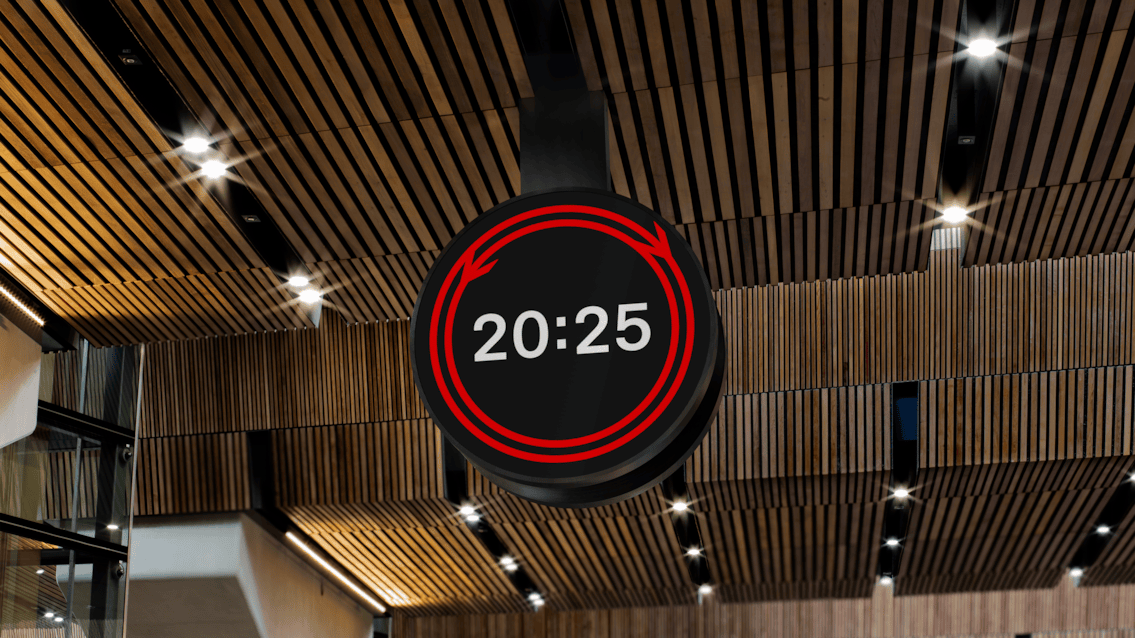
And that’s why the new national railway clock redesign (unveiled in October 2025) is such an interesting failure. On the surface it’s excellent: it uses Rail Alphabet 2, Margaret Calvert’s updated typeface, digitised by Henrik Kubel, and it’s been delivered by Design Bridge and Partners as the first national update in decades. It’s legible, high contrast, and properly British in the best sense: quietly authoritative. The hands and numerals look like they belong to an infrastructure system rather than a lifestyle brand.
Then you look for the seconds.
In the new design, the traditional seconds hand is replaced by an animated version of the double-arrow logo. It splits and moves around the rim on two red tracks, meeting at the 12 and the 6 every 30 seconds. It’s clever. It’s kinetic. It’s also a very specific choice about what kind of information the most visible clock in the system should prioritise.
The new national railway clock redesign
It’s worth being precise about the scope of the complaint here. Seconds haven’t been abolished from the railway. In stations, they can still be available in places where they truly matter operationally, on platform screens and in platform contexts. The issue is that the big “master” clocks, that is to say the concourse clock, the exterior clock, the one you can see from across the hall, have chosen to make seconds less instantly legible, right at the point where humans make their first, most consequential decisions.
Because a station clock isn’t décor. It’s a contract between passenger and system.
A public clock in a transit hub is the final arbiter between the system’s schedule and your autonomy. When there’s a tight connection, when platform numbers change, when the train is somewhere over there with the doors open and you’re deciding whether to jog or accept defeat with dignity, the clock is the one thing that’s meant to be beyond interpretation. You don’t need it to have a vibe. You need it to be right—and to be readable at a glance, from a distance, while moving.
The traditional sweeping seconds hand gives you linear, active information. It’s not just “the time”; it’s the rate at which your margin is shrinking. You can glance once and know, without thinking, whether you have 75 seconds of brisk walking or 15 seconds of that un-British sprint.
The new clock asks something different of you. The seconds are still there, technically, but they’re encoded as movement you have to read. A person now has to decode a logo’s behaviour under pressure in a concourse already full of stimuli: screens, announcements, people drifting into your path with a wheelie case, the whole theatre of urgent politeness. Where a seconds hand was a data point, the animated mark becomes a small task. That task is a cost. And in a station, costs are paid in stress.
The 17:22 Runner
Consider the 17:22 runner at Waterloo: you hit the concourse at 17:20:45, bag strap slipping, the smell of victuals you don’t have time to buy, and you need one piece of information: how much time is left before your decision becomes irreversible. Not an approximate sense of now. Not a calm impression of punctuality. A countdown.
A conventional clock gives you that instantly because you already know how to read it. An animated rim cue forces you to observe the rate of change. That’s fine when you’re admiring the clock from a distance; it’s unhelpful when you’re trying to decide whether running will be safe, or even worth the social embarrassment. Uncertainty multiplies stress. It also drives worse choices. People misjudge, dash late, squeeze through doors, and take risks because the system refused to hand them the most basic ingredient of rational behaviour: precise time, early enough to act on it.
“Yes, but John the platform shows seconds” isn’t the rebuttal people think it is. By the time you’re on the platform, you’ve already committed. The concourse is where you decide whether you even have a chance, which route through the station you’ll take, whether to stop and check a board, whether to abandon the sprint and save yourself the indignity. The master clock is the one you can see before you commit to direction. That’s precisely why it matters that this clock has become interpretive.
A clock that makes you watch it for longer is a clock that’s failed its job.
Inclusive design, and the point where it gets misapplied
The public defence for removing a traditional seconds hand has been framed in inclusive design terms: reduce visual clutter; lower cognitive load; create a calmer centrepiece in a visually noisy environment; consult accessibility experts; ensure legibility for neurodivergent and visually impaired passengers. Some of that is solid. High contrast, proportion, and type are genuine wins. Rail Alphabet 2 looks built for this.
But inclusive design doesn’t mean deleting information. It means structuring it.
In UX terms, the answer to noise is hierarchy: make core information dominant and secondary information available without demanding attention. A well-designed seconds hand is background data until it becomes foreground data. You can ignore it when you’ve got slack time; you can rely on it when you don’t. The design choice here replaces a familiar, instantly legible secondary signal with an abstract one that requires interpretation at exactly the moment users least want interpretation.
Even if you accept the intention, the interaction cost is being paid by the wrong person. The domestic traveller with plenty of time and a Soduku in Swindon can enjoy the calm. The time-poor traveller (often the one juggling childcare, shift work, awkward connections) and the general friction of British public life, gets the burden of decoding.
It seems this is the recurring pattern in modern service design: smoothing the interface for people with margin and pushing the remaining complexity onto those without it.
Precision as theatre: the Swiss counterpoint
If you want proof that precision can be humane rather than harsh, Switzerland has already done the case study for you. The SBB clock is iconic for a reason. Its red seconds hand completes a circuit in 58.5 seconds and pauses for 1.5 at the 12. That movement isn’t decoration. It’s a synchronisation signal for dispatch1 and a trust signal for passengers. It tells you, without a word, that the system is coherent and the public time is shared.
The Swiss obsess over the second because they understand the relationship between granularity and trust. The more precisely a system can tell you what’s happening, the less you have to fill the gaps with anxiety. Precision reduces drama.
The British redesign moves in the opposite direction. It doesn’t deny time; it aestheticises it. It turns the master clock into something closer to a brand artefact: an, admittedly handsome, graphic identity with a reassuring rhythm. The result is a timepiece that feels contemporary while quietly stepping back from its core civic purpose.
Active information to passive vigilance
There’s a useful parallel in the removal of old split-flap departure boards. The clack of the tiles was a kind of haptic affordance; it announced itself. It pulled your attention at the moment something changed. Modern digital screens are silent and passive. They don’t summon you; you have to keep checking them. The burden of vigilance moves from the system to the person.
This clock is part of the same drift. By replacing an instantly readable seconds hand with motion you must interpret, the clock becomes less of an arbiter and more of a piece of wall art. It undeniably looks better and increases cohesiveness across the rail estate. It works worse at the moments that actually matter.
Seconds still exist elsewhere in the network. That’s the point. The railway has kept precision where it’s operationally necessary, then softened it where it’s socially authoritative. Calm should be the outcome of a system that runs with surgical precision. It shouldn’t be manufactured by making the most public-facing clock in the building slightly less precise, slightly less immediate, and slightly more about how the railway would like time to feel.
AI: I used AI for the tags, the excerpt, and a light sub-edit. The ideas, references, observations, and anecdotes are mine.
The hand only restarts when it receives an electrical “minute pulse” from a central master clock. This ensures that every clock across the entire Swiss network (from Geneva to St. Gallen) synchronises the turn of the minute to the exact same millisecond. It’s a happy accident that this technical constraint has left to a better end result for users. ↩︎
I love driving, and when I’m out with my son – mostly around suburban Surrey and onto the A- and M- road network – we talk about what the future looks like with self-driving L4 and L5 cars. Will it make journeys quicker? Will we be safer, calmer, more efficient with the bots driving us around? What will the road network look like with enhanced and standardised signage, markings and adapted junctions. It’s nerdy but it’s fun to talk about this stuff and question how a lot of the almost sci-fi might work in practice.
But if you want to understand what L5 autonomy actually means. You can’t start on a motorway. You have to start on a Cornish lane that was ‘designed’ in the reign of Henry VIII by a (let’s assume) man who’s only measurement was ‘avoid straight lines’ and who’s only measurement system was a stick of some agreed length.
My go-to example is the run from a nice Roseland peninsula spot to a tiny fishing village. It’s stunning in the way Cornwall so often is: scenery that makes you consider leaving real life behind – and roads that immediately remind you why you can’t. The lanes are absurdly narrow, bordered by stone hedges that are unyielding fortifications, meeting another car or tractor here is less ‘driving’ than an improvised referendum on who’s reversing today and how much they value their paintwork, tyres and helmsmanship.
This is useful because the autonomy conversation still starts in the wrong places, with the wrong visuals. It starts with wide West Coast roads, clear lines, predictable junctions and a general sense that the built environment is a cooperative partner in the project of motion. In California, “self-driving looks like this” tends to mean something very rational: geometry, visibility, lanes you could land a small plane on and junctions laid out with acres of asphalt and a basic respect for human comprehension.
Naturally, Cornwall is not like this. Cornwall – and plenty of rural Britain – is a place where the road network seems to have been draped over the topography by monks.
The autonomy world has a dull phrase that explains how it expects the world to be: Operational Design Domain (ODD) – the conditions a system is designed to operate within. If you’re keen it’s SAE J3016. The phrase is clinically unsexy, which is part of its charm. It keeps the conversation out of the breathless nonsense that blooms around new technology.
It also implies something people in the industry – notably the people selling you cars – dislike admitting: autonomy is geographical. It exists only where the environment cooperates. And, dear reader, Cornwall does not cooperate, not due to budgets or intransigence – simply because of history.
To illustrate, let’s take a lane standoff: Two human drivers meet head-on and resolve it using social protocols that are not codified. There’s the micro-creep forward, a pause that signals “I’m thinking” or the eye contact that says “I know, this is ridiculous but I’m not reversing into a bramble hedge and a fence post for your Audi Q7”. There’s local knowledge about a passing place behind you that doesn’t look like one unless you’ve been raised on these lanes and have developed the spatial instincts of a maze rat. Then there’s a moral arithmetic too: you’re closer to the wider bit; you’re in the smaller car; you’ve got five people in the back; you look like you’re here for the week and have brought three paddleboards.
Now swap both of these cars for L5 ones and you hit the awkward truth: this route isn’t asking for better navigation, it’s asking for social negotiation. In this context it’s easy to say: the vehicles will simply communicate, agree a plan, one will reverse. The other will wait. Like a pair of Nordic adults having a calm, consensual conversation about responsibility.
Except you’re on a lane with hedges made of rock and 5G signal as powerful as a hamster’s yawn. Even if future communication standards are enhanced, a system that is predicated on connectivity in order to behave sanely in every lane it might find itself in, it’s not “drive anywhere”, it’s “drive where the network hasn’t gone for a lie-down in the sun”.
So assume the vehicles have no helpful network. They must now reason locally. Each one must remember where it has been: the last few hundred metres, where it can reverse, where the lane widens, where sightlines recede, where the verge turns into ‘wet grass hiding a half-metre ditch’. That rolling spatial memory must be table stakes for any serious autonomy.
But memory only gives you so many options. The trouble starts when both vehicles are doing the same thing at the same time, under uncertainty, with no shared authority. If both decide to be cautious (and there are good reasons legally and ethically why they would) you can get a stalemate that looks faintly ridiculous to the human passengers and is, in engineering terms, entirely rational. Two polite robots facing each other, neither wanting to be the first to commit to a manoeuvre that might be unsafe, both waiting for clarity that never arrives. It’s Britain but with fewer apologies and more deadlock.
Now, add the more realistic scenario in the nearer term: one vehicle is automated and the other is driven by a human, a 65-year-old local in a Twingo who’s reversed more cars than you’ve had hot dinners and is perfectly prepared to perform the full choreography of rural right-of-way: gesticulation, eyebrow work, and a hand wave that means “you go”, except it also means “I’m going,” and possibly “you London berk, what are you doing down here?”.
A machine can of course see a hand move. It can classify posture. It can assign probabilities to intent. None of that makes the gesture binding. It must rely only on certainties: where the car is, and what it’s actually doing. The moment you treat informal human signals as authoritative, you’re building a system that can be socially steered into unsafe decisions, which is an inviting prospect for every bored teenager and every slightly unhinged delivery driver in Britain.
So, the automated vehicle does what safety-critical systems do when faced with ambiguity: it becomes conservative. It waits. It yields. It declines to commit until the world becomes clearer and signals replace noise. That’s sensible. It’s also exactly how one ends up with a driverless taxi parked in a single-track lane while the rest of Cornwall ages around it.
There’s another detail we humans grasp instantly: the hidden queue. When you decide to reverse, you’re not only deciding for yourself. You’re making an anxious decision for whatever is behind you, unseen beyond the bend. This is why a simple standoff can turn into a fun village event. A human driver will check mirrors, listen for tyres on gravel, remember the vehicle that turned off behind them a few minutes back and estimate whether this reversal will trigger a chain reaction. A driverless vehicle can’t conjure knowledge of what’s behind the bend unless it can perceive it directly or receive it from sensors elsewhere. To solve this elegantly you need awareness beyond what any single vehicle has. At which point you’re edging toward traffic coordination rather than autonomy: the road as a managed system rather than a stage set for individual decision-making.
This isn’t just a Cornwall problem, rather obviously. Rural Sweden has winter roads with passing places and visibility that vanishes in a sneeze. Japan has mountain villages where lanes are carved by an ancient, determined stream. Rural Ireland is essentially Cornwall with different biscuits. The recurring theme is that it’s the environment that sets the terms. Places built around informal human negotiation are awkward customers for systems that require explicit rules and verifiable intent.
So what happens, what can I tell my son will happen? The answer is mundane. It’s a patchwork. Autonomy that operates confidently on roads that are legible and well-maintained, and then becomes limited, constrained or frankly unavailable in places where the geometry and social protocol defeats it. Sometimes there will be upgrades: defined passing places treated as an asset, clearer priority rules at pinch points, better delineation. Maybe even codified behaviour – a three-flash signal ‘I will yield’, as an example. Sometimes the answer will be operational: remote support when a vehicle gets stuck, or routing that avoids the lane because it cannot guarantee progress. Sometimes the answer will be more bluntly: this road requires a human driver.
None of this betrays the vision, it’s simply what happens when technology meets the world as it actually is: layered, improvised, nuanced and historically messy, full of little social contracts that nobody codified because they didn’t need to.
Cornwall in this sense does us a favour. It stops us pretending and evangelising that autonomy is simple a question of sensors and clever computing. It reminds us that driving is a cultural practice. Some parts of the network are (beautifully) engineered systems. Others are negotiated spaces with hedges and drivers with grudges. Level 5 will thrive where the world behaves like the former. Where it behaves like the latter we’ll either change the road, constrain the autonomy, or just accept that the medieval cart track remains one of the last places a human is still the best interface.
AI: I used AI for the tags, the excerpt, image generation, and a light sub-edit. The ideas, references, observations, and anecdotes are mine.
People talk about the joys of parenting. First steps, packed lunches, school performances, the weird drawings you pretend to understand. What they rarely mention is the dread. The background hum of terror that flickers on whenever a child coughs a few too many times. Or sleeps oddly still. Or says their leg “feels funny.” That quiet panic sitting in the corner of the room like damp on a November afternoon.
It’s not fashionable to admit this. You don’t see it on Reels. Especially when the culture is busy telling child-free adults to live their truth, offering thoughtful monologues about staying free and unencumbered. Greg James did exactly that recently — perfectly sane, perfectly kind reflections about whether parenthood is the right path for him. He talked warmly about being an uncle, getting on with kids, imagining he’d be a good dad. All very decent.
But nothing prepares you for the way your insides rearrange themselves once you’re responsible for someone small. You can like children, adore your nephew, help with homework, coach, babysit, buy the really good Lego — but I honestly believe there’s a gear that only unlocks when the child is yours. The quiet, unasked-for dread that trails you through the supermarket aisles and the commute. The catastrophic thinking that sprints ten steps ahead at the first sniffle or tummy ache. The sense that the universe has handed you a priceless vase made of exquisitely fragile glass and told you to “relax.”
I’ve lost hours to it. Days, if I’m honest. A single offhand story about a young lad collapsing on a football pitch — the first sign of a major tumour — and I’ve carried it around like a stone in my coat pocket for two years. I don’t know the family. I don’t need to. The narrative lodged itself anyway, ready to surface whenever my son rubs his head or our daughter looks paler than usual. Health anxiety works like a Google search with SafeSearch off: one stray suggestion and you’re already halfway to the bleakest possible conclusion.
It’s the availability heuristic, of course, but knowing the term doesn’t blunt the feeling. Same with turbulence. You can memorise every statistic about aviation safety and still grip the armrest like an Edwardian widow the moment the plane shudders. Parenting has that same quality. Logic quietly steps out for air.
You try to counter it. Rituals. Breathing techniques. The practical stuff. You read thoughtful columnists finding comfort in the rhythms of Christian worship (not belief exactly, more a kind of inherited spiritual muscle memory from school services, weddings, funerals) and you wonder if you’ve missed something. I’m not a man of faith, not in the sturdy, reassuring sense, and every so often that old question returns: how could any benevolent force allow the worst things that happen to children? I know there are theological answers. They don’t sit easily. They feel like plaster over a crack that goes straight through the brickwork.
Recently we were back in a hospital waiting room with one child for something we’re told is routine, an abundance of caution, probably nothing. But the body doesn’t care about disclaimers. It has already sprinted ahead, cataloguing every dreadful story it can dredge up. I don’t resent the responsibility. I resent the helplessness. The lack of agency. The fact that all the care, all the planning, the good diets and parkruns, all the love and vigilance in the world don’t grant any guarantees.
Waiting, with all the worry in the world and a child who’s already bored.
What surprises me is how little this gets mentioned. Parents will talk about sleepless nights with toddlers, about juggling schedules, about the occasional primal scream behind a closed door (par for the course on parenting social media) but the terror stays unspoken. Maybe it feels melodramatic to name it? Maybe naming it makes it real. Maybe everyone assumes they’re the only one who thinks like this, when in reality every parent in the GP’s waiting room is conducting their own private risk assessment.
Still, beneath the panic, there’s a quieter truth. The fear exists because the love exists. It isn’t noble. It isn’t poetic. It’s just the cost of being wired into a relationship with no off-switch. Fragile adults raising even more fragile children, and nothing — be it logic or optimism — changes the basic terms.
But the edges can be softened. Some people reach for faith. Others learn to zoom out, pull the camera back to 0.5 and get the wide angle; the school run, the lunches, the scuffed shoes by the door. Some develop attentional control: noticing a catastrophic thought without sending the cavalry after it. And some simply get better at living alongside the dread in the same way you live alongside the awareness that life, in all its glory, is temporary.
What helps, oddly enough, is admitting the feeling exists at all. Saying it plainly. Not for sympathy, just to release the valve. The terror doesn’t vanish, but it loses some of its force. It becomes something you can look at in daylight rather than a shape pressing at the edges of the mind.
When we walked into the hospital, I felt all of it again, the dread, the borrowed anecdotes, the tabloid tragedies, the absurd certainty that one raised consultant’s eyebrow can become catastrophe. And yet, watching him twizzle his hair while he read his book, bored already, asking whether we can get a McDonald’s afterwards, the fear hushed. Not gone. Just quieter. That’s the closest thing to optimism I can manage right now: the idea that joy still insists on showing up, even on the days when the worry is thick enough to taste.
Perhaps that’s the whole reflective acceptance of parenting, neither dread, nor love, nor helplessness in isolation, but the odd equilibrium where all of it sits together, swirling, while your child smiles an asks if they can have a burger.
Ai: Ai took my original draft and helped me tighten up some of the more ragged bits. Then I used it to sort out some tags, an excerpt and generate an image to accompany the piece. Yes, it might have suggested some em dashes —. The thoughts are understandably entirely mine.
Private education has become the de jour punchbag of British politics — an easy morality play in which centuries of institutions are tried and condemned by a handful of badly-behaved, and dare I say it spiteful, ministers. The private school caricature bears no resemblance to the sector, the people who work in it, or most absurdly, the children inside it.
Strip away the theatrics and the picture sharpens. British independent schools are a globally admired export1; they pull in huge amounts of talent and investment, employ thousands, and act as civic anchors in their communities. They share facilities, teachers, expertise, and pastoral support with neighbouring state schools because, dear reader, that is how most of them actually see their role. That is to say, one not of gated enclaves of inherited privilege but as part of a wider educational ecosystem.
One suspects the loudest objectors often haven’t set foot inside one, and certainly many of the people I see happily reposting and sharing the ill-informed social meeeja posts. Go to an Open Day. Spend any time with the pupils and the Edwardian stage villains dissolve. They are in fact courteous, switched-on, socially literate children being taught in stable, well-governed environments with real pastoral depth. Imagining otherwise does not pass for analysis; it is a displacement activity for people who prefer class warfare to contact. For that is almost exclusively what this is.
Frighteningly easy to fell, and impossible to forgive ourselves once the sky is empty.
The VAT wheeze exposes how unserious and skewed the debate has become. We are told it will “raise standards”, yet private healthcare (which naturally also relieves pressure on a stretched public service) remains exempt2. Taxing private schools (or more accurately, penalising the parents of private school kids) is a policy crafted to look righteous from a podium, not one that will strengthen a single physics department or fund a SEND unit. Revenue-raising in sheep’s clothing rarely delivers either revenue or sanctity. This is, evidentially, not an argument of economics, it is one of politics and if your argument for improving state schools is “make private schools worse”, you’ve already admitted you don’t believe the state sector can ever be good enough on its own terms.
We are never more ideological than when we discuss single-sex education. The data on boys is brutal: later maturation, slower executive function, a decade-plus of academic trailing3. Boys’ schools, especially prep and 13+ (in a private system that understands this) were built around those facts, not wishful thinking. The better outcomes they produce are not sorcery; they are the predictable return on taking development seriously. Preferring co-ed may feel ethically cleaner, but cleanliness is not evidence and pretending all variation is moral failure is not progressive, it’s simply lazy.
I say this as a father of an eleven-year-old boy in the single-sex private system and a two-and-a-half-year-old daughter who, with luck, will thrive in the girls’ system. I am not blind to the privilege. I am also a single sex grammar-school state boy still active on its alumni committee; my sister is a deputy head in a co-ed state primary; my nephews are all co-ed state educated. My perspective is broad because my life is. I respect the best of both sectors and the staff who hold them together.
Yet I recognise too the extreme social awkwardness of admitting any of this. In 2016-18 I was frequently “the only Tory in your feed” and rounded upon by an overwhelmingly left-liberal consensus. But I quietly like seeing parents, who cannot say publicly that their child is privately educated without being cast as the villain in someone else’s passion play, softly liking posts and commenting below the line. Most make brutal financial and lifestyle sacrifices; we and my fellow cohort parents are not oligarchs hoarding caviar futures. Demonising them (us) is the political equivalent of comfort eating.
Which brings me to a Premier League analogy. Of course many would say the PL is too rich and powerful, most fans want the big clubs to send more money downwards, and quite right too; the pyramid would be healthier for it. But the VAT policy is not a bigger solidarity payment or a fairer split of the TV billions. It is engineered to make independent schools unviable for anyone who isn’t oligarch-rich, to empty the boarding houses, shutter the smaller places, vanish the bursaries, and then declare victory when the waiting lists disappear. Be under no illusion, that is the agenda, not redistribution but rather demolition in a hair shirt, a moralising war on parents who refuse to accept whatever the local state dishes up.
Our education debate treats excellence as provocation and variation as injustice. A confident country would study what works, invest in repairing and replenishing what is weak, and stop pretending resentment is policy (cf. Netherland, Denmark4). We all want a state sector so good that private becomes a preference, not a necessity. That won’t happen by dismantling what already works. It will happen by humility, graft, training, retention, stability and by recognising that imitation, not demolition, is what lifts the whole.
AI disclosure: As always, the thesis and the writing is mine. I use Ai as a sub-editor to align my pieces with my typical style and tidy up the most ragged bits. I also used it to generate the image, the excerpt for the post and suggest the keyword tags. I quite obviously use Google to find relevant facts to support my arguments.
According to the ISC 2025 Census, 25,526 non-British pupils with overseas parents generated > £1.1 billion in fees alone (with ancillary spending pushing the total past £1.3–1.5 billion), while 115 British-branded campuses abroad now educate nearly 100k foreign pupils who never touch UK soil yet pay dearly for the privilege. This isn’t marketing puff; it is the reason Dulwich College Seoul can charge £35k a year and still turn families away, and why successive governments have treated the sector as one of Britain’s last unambiguous soft-power wins. ↩︎
In 2025 GCSEs girls outperformed boys by 6.2 percentage points at grade 4+ (70.5% vs 64.3%) and the gap has persisted, essentially unchanged in shape and scale, for well over fifteen years and is just starting to narrow. Neurodevelopmental trajectories show boys’ prefrontal cortex peaking roughly two years later than girls’, with commensurate delays in executive functions (i.e. inhibitory control, attention regulation, emotional self-management) that matter most between 11 and 16. ↩︎
The Netherlands has done exactly this. Apparently (thanks Google) its Constitution mandates equal public funding for public and private schools alike, so two-thirds of Dutch pupils now attend independently run institutions while the entire system remains among the world’s highest-performing and most equitable. There’s no resentment, no demolition, just the quiet confidence of a country that studies what works and copies it. Denmark’s century-old friskoler tradition operates on the same principle and delivers the same result: genuine plurality, higher average standards, and not a single politician wasting breath on punishing parents who dare to choose. ↩︎
The things that keep men standing are usually the things no one notices until they’re empty.
We hear it almost every week on social media and in the press: if only men talked more. As if silence were the root cause of everything.
But men do talk. We’ve never had more campaigns, workshops, football-ground ads, celebrity confessions, podcasts, or workplace check-ins. Awareness is not the bottleneck. You can’t fling a flat white in Shoreditch without hitting someone making a documentary or orchestrating a campaign about “men opening up”.
And yet, the suicide rate for men peaks not in youth, but in midlife, forty-five to fifty-four. These are the supposedly settled years, when family and career should provide sufficient ballast. Instead, it’s the cliff edge.
The parallel with childhood in the smartphone era is hard to miss. Just as children have lost the structures of boredom, awkwardness, and unmediated friendship, adults are losing the structures of duty, craft, and continuity. Those same forces, phones, performative identity, secular drift – are hollowing both ends of life. Middle-aged despair and nostalgia for a lost childhood are two sides of the same cultural erosion.
Part of it is the work itself. Men who once called themselves carpenters, miners, or postmen now call themselves contractors on three apps. This loss isn’t simply one of continuity or economics, it’s ontological. When the trades and institutions that once anchored male identity dissolved, nothing replaced them. Progress rightly broadened women’s roles but left men’s scaffolding to rust.
What I think is missing isn’t another awareness week or a better hashtag, it’s structure. That reliable, unglamorous web of roles and obligations that demand consistent presence and usefulness. Structure, I truly believe, creates the conditions for grit, stoicism, resilience; the quality required to face life’s chaos without disintegrating.
Four Pillars
Stable roles: work or duties that confer identity beyond the next contract.
Shared obligations: being the one who brings the kit, runs the line, sets out the chairs.
Continuity: clubs of all kinds, parishes, allotments, institutions that outlast individual seasons.
Recognition in absence: places where you’re noticed if you don’t show up.
Now, these aren’t nostalgic tokens. They’re the mechanisms of accountability and friction. Friction builds strength. It stops people flapping when real adversity hits. Talking helps, but talk without structure is vapour: empathy without scaffolding.
Having purpose then is not an insight, it’s an act. A sequence of embodied, useful gestures that prove one’s value to others. It’s a personal responsibility, not something to be delegated to an app, a therapist, or a men’s shed. Those are just the supports, not substitutes. They matter most and are useful augmentations only when attached to the rhythm of an ordinary, useful life.
Because purpose lives in function, not in show. So, until we rebuild those structures of continuity and obligation, the well-meaning chorus of “men just need to talk more” will keep echoing across empty ground, like a gossamer-thin corporate wellness seminar where everyone nods sagely at the flipchart, fills out a feedback form, and goes straight back to crying in the gents.
AI and disclosures: This piece used AI to surface relevant psychology references to support my personal thesis. I also used it for the tags, excerpt, and a little sub-editing. The writing, and personal reflections were all mine and informed in part through close personal experience with these matters.