Tag Archives: brand strategy

Belgravia, Overheard

I’ve had a busy few months which, from a financial perspective at least, has been no bad thing. The downside is that the writing has rather suffered in frequency. Oddly though, I find the opposite happens in my head. When work is busy I seem to notice more. Every train journey, client meeting, conversation and aimless wander through London gets mentally filed under “there’s probably a piece in that.” The vast majority stay there.

During quieter periods, visibility anxiety has an unfortunate habit of convincing me that almost every observation deserves to become a LinkedIn post. I don’t think I publish complete nonsense, but there is probably a regression to the mean. Which is all to say that this was one of the ideas that escaped the notebook. You can decide whether it should have.

I’ve always liked the contrast between elite athletes and their coaches. You see someone with the physique of a middle-aged middle manager calmly explaining to a twenty-two-year-old Olympic hopeful why their hips are opening half a degree too early. It feels faintly absurd but of course the coach isn’t there to run the race. They’re there because they’ve developed the judgement over time and perhaps their own career to notice things the athlete no longer can.

I occasionally wonder whether writing about luxury is a bit like that. Unlike some of LinkedIn’s more glamorous commentators, I’m not bouncing between Aman resorts, Formula One paddocks and yacht launches in Como. My natural habitat remains Esher, the quiet south Cornish coast, RHS Chelsea and occasionally Regent Street if I’m feeling particularly in need of retail.

Then again, most athletics coaches aren’t still running the 110m hurdles.

A few weeks ago I found myself walking through Belgravia. It’s one of the few places in London where almost every version of wealth seems to coexist. You see extraordinary money, of course, but what I noticed wasn’t the value of it but it was that everyone appeared to be speaking slightly different ‘languages’.

A Ferrari slipped past me on Audley Street. I didn’t know what it was, as is typical it carried no model badge. On Burlington and Bond Street there are shops where the bags in the window carry no logo or at least logos so small as to be unreadable from a distance.

And then, a few streets later, came a Rolls-Royce Cullinan in a vulgar magenta with the kind of chrome accents that wouldn’t be out of place on a 50s Cadillac.

None of the people owning these goods, I suspect, would consider themselves to have anything other than luxury tastes and certainly not bad taste. They would consider themselves discerning. Yet each are signalling entirely different things.

To return to Ferrari. I’ve always found it fascinating that a company capable of building a bright red, mid-engined supercar, loud enough to be described as “an operatic rhinoceros trapped inside a tumble dryer”, draws the line at six scripted letters across the boot line. Reader, it is many things, but subtle isn’t one of them.

And yet somebody inside Ferrari decided that “296 GTB” didn’t need telegraphing. If you know, you know. If you don’t, a badge ain’t going to change you.

Porsche on the other hand seems to have reached the opposite conclusion. Their model names have that daft run-on suffixing , but worse than that is their love of decals and special edition badging and stitching. Range Rover briefly lost its mind too. During my time around the brand it seemed every derivative acquired another flourish of nomenclature until the back of the car resembled one of those late-90s PCs covered in stickers announcing Intel Inside and “Designed for Microsoft Office.” BMW, meanwhile, has scattered M badges across the range with the enthusiasm of a toddler decorating a birthday card.

None of which makes them wrong, but it does make me wonder whether luxury itself is beginning to diverge. There is one version wants to be recognised and another that only needs to be recognised by the right people.

At this point somebody with a proper strategy background and much cleverer than me would probably invoke Pierre Bourdieu, so I’ll save them the trouble. Bourdieu argued that status isn’t simply about money, but rather what he called cultural capital: the accumulation of taste, knowledge and judgement that subtly tells other people where you belong.

Owning an expensive watch tells me you have money. Recognising an expensive watch that almost nobody else notices tells me something rather different. One is a demonstration of wealth, the other a demonstration of fluency. Unfortunately, Instagram rather complicated the whole affair.

Online, luxury became something performed for people scrolling past in fractions of a second. In this environment logos and monograms work brilliantly. A Louis Vuitton bought in Tenerife because everyone back home will recognise it. The Balenciaga hoodie bought on Vinted because the logo is more important than the drop-season, also works.

At the opposite end of the wealth spectrum, exactly the same instinct produces superyachts like shopping centres and watches that look capable of summoning a medevac. Different bank balances, remarkably similar behaviour.

The trouble is, cameras are hopeless at photographing ambiguity and judgement; design lines and proportions rarely survive a thumbnail. Neither does impeccable tailoring nor hospitality that is anticipatory and personal rather than performative. My vision of luxury might be a beautifully balanced Hoek yacht easing through Scandinavian waters while the owner wears a twenty-year-old jumper because they genuinely couldn’t care less. I covet the brands and experiences that show curation and restraint.

And before anyone starts sharpening the comments, I don’t think one version is morally superior to the other. Vulgarity, after all, is culturally relative. To the Emirati collector, a two-tone Phantom with intricate marquetry might represent extraordinary craftsmanship and generosity. To a Nordic architect it may feel grotesque. Neither is objectively right, they they’re simply speaking different aesthetic languages.

Diagnostically, I wonder whether we simply misunderstand the people buying these things. Which speaks to my own scepticism and misgivings of traditional personas in luxury.

Male.
Fifty-four.
£250m family office.
Owns homes in London and Verbier.

Fine.

Now tell me whether he commissions a floating palace with a cinema, helipad and c., or spends the next decade restoring a Swan 65 because the joinery is beautiful and he likes crossing the North Sea under sail. Those are completely different people in a way that doesn’t show up demographically but culturally.

Traditional segmentation along these lines has remarkably little to say about such distinctions because it’s looking in entirely the wrong place. So, as I jumped on the train home that warm evening in London, I jotted down a few thoughts that tried to unpick why I still see brands spending a great deal of time asking who customers are: their age, income, their geography and profession, perhaps so anchored in media buying. Whereas I believe in this sector the more insightful question is something else entirely. Who do they imagine they’re speaking to?

Because somewhere between that clean-lined Ferrari and the bling-trimmed Cullinan, it occurred to me that luxury isn’t one language or culture at all. It’s a collection of dialects.

Tagged , , , , , , , , ,

Predictive Luxury: When the Algorithm Decides You’re Worth It

The paradox of modern luxury is that the more precisely it knows us, the less we seem to want it.
AI-driven personalisation flatters our taste so efficiently that desire itself begins to flatten. You open an app and there it is – the jacket you’d half-imagined, or the playlist that mirrors your mood before you’ve named it. The system anticipates, arranges, and completes. It feels frictionless, even generous.

But when everything fits this neatly, what’s left to reach for? Desire once depended on a perceptible gap, the space between wanting and getting. Now that gap has been optimised away. We no longer aspire; we’re simply anticipated.

Behind that easy charm sits a machinery, an industry, of prediction. Every scroll, hover, and hesitation becomes a confession. From these micro-gestures, the algorithm builds a probabilistic portrait: accurate enough to sell to, not to know.

This is predictive luxury – the luxury of convenience. It packages aspiration for the mass-affluent, translating status into data. The product is still expensive, but the experience is engineered for scale: “exclusive” taste delivered by statistical consensus. What once required discernment now arrives pre-approved.

To be clear, this isn’t curation. It’s correlation. Your discernment becomes the weighted average of everyone who clicked before you. Luxury houses once guarded their ateliers; now they guard their datasets. What was once stitched by hand is now inferred by pattern.

The shift sounds harmless until you notice what it removes.
Aspiration (the slow, self-defining kind) relies on uncertainty. We learned our taste through trial, boredom, and even embarrassment. Those edges are gone. There’s no risk in going to the restaurant where the algorithm has all but booked you the table. The algorithm keeps our preferences in a holding pattern, replaying what we’ve already confirmed, always within one standard deviation of safety.

The Predictive Plateau: a system that sells us the most probable choice, not the most interesting one. Left unchecked, it narrows the collective palate. As I argued in Luxury UX: Beyond Veneer, lasting equity comes from structure and restraint, not surface gloss. The real risk for luxury brands isn’t technological obsolescence but aesthetic homogeneity, a market trained to prefer the median.

Prediction is never neutral. Behind every act of personalisation sits a hierarchy of visibility, whom the machine believes is worth showing first. The more data you surrender, the clearer your silhouette in its model; those who resist become statistical ghosts.

There’s a quiet economics to this. By automating inequality, the algorithm devalues any form of wealth it cannot quantify or identify. The ultimate luxury, then, is to disappear from the data entirely, to operate through introductions, word of mouth, and private networks. The truly exclusive product is the one the algorithm cannot find, let alone recommend.

And yet there’s still one lever left: intentionality. The deliberate pause before purchase. The refusal to click “similar items”. The act of finding something the algorithm couldn’t possibly have foreseen. In a world of predictive luxury, this is not passive rebellion but an active aesthetic stance, a luxury of choice by will.

The smartest brands will design for this intentionality, not against it. They’ll reintroduce or retain friction as a feature: the waitlist, the mandatory consultation, the garment that demands to be felt. These are not inefficiencies but signals of depth, proof that the experience values attention over automation.

For all its precision, predictive luxury leaves a vacuum at the top. Once algorithms have colonised the middle (the mass-affluent market chasing “smart” recommendations), genuine exclusivity must move elsewhere. Increasingly, it drifts back to what machines can’t do: interpretation, eccentricity, the unrepeatable judgement of people who know.

That’s where true luxury now lives, in human-centred unpredictability. The ultra-wealthy and the culturally literate aren’t rejecting technology; they’re augmenting it. Data may light the runway, but the finale still belongs to the artisan, the editor, the quietly idiosyncratic expert who can surprise you in ways no model can.

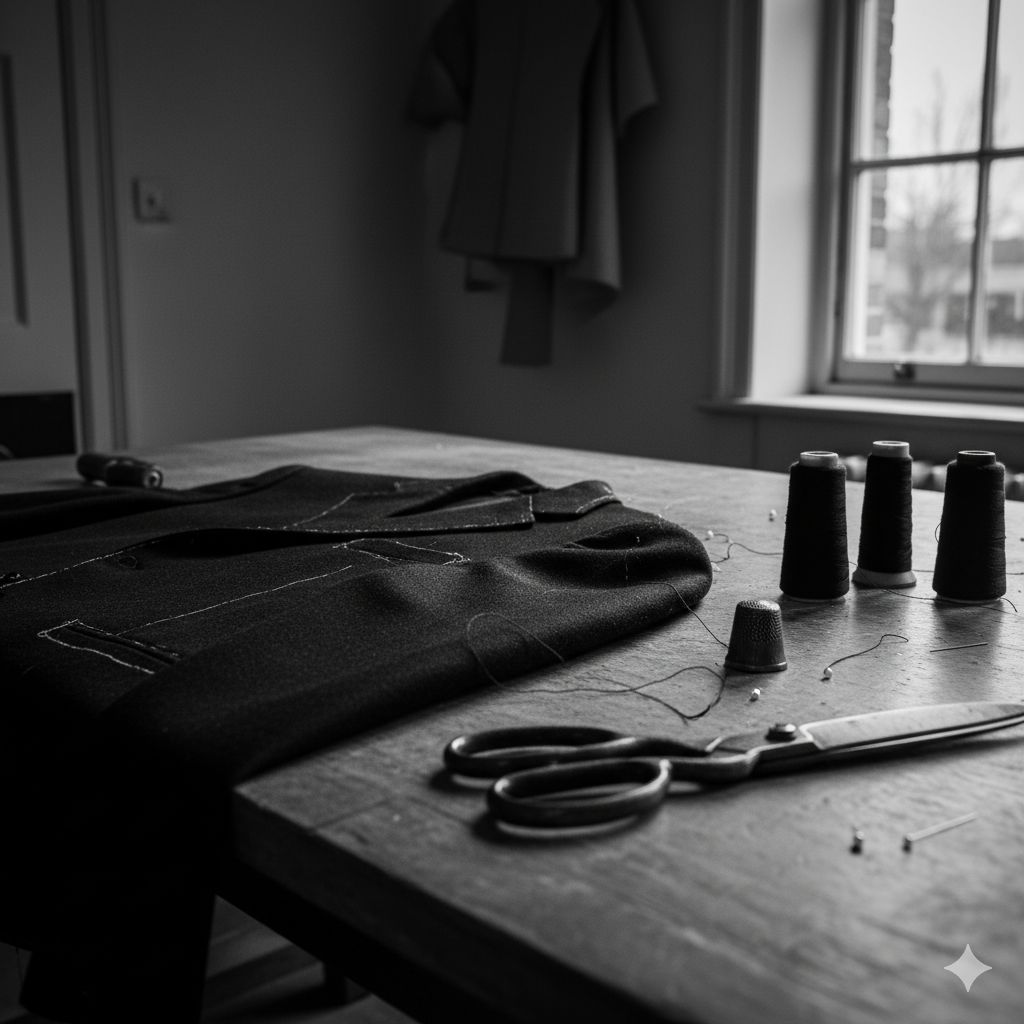
Close-up of a tailor’s worktable lit by soft natural light, showing thread spools, scissors, and a half-finished jacket with a visible imperfect seam — an image symbolising human craftsmanship and intentional imperfection in contrast to algorithmic precision.

British luxury has long understood this. Our best exports – Savile Row, Bentley Mulliner, McQueen, Hockney, Grayson Perry – thrive on that narrow line between discipline and disobedience. Their genius isn’t efficiency but editing: knowing when to break symmetry, when to leave the imperfect seam that proves a hand was there. The imperfect seam is a brand’s deliberate investment in unscalable production – the final, physical proof of value when all scalable processes have been commoditised. Curation, as I’ve argued before, isn’t collection. It’s the art of choosing what not to automate.

The challenge for brands now is to build value not through correlation but through judgement. To shift from efficiency to experience, from prediction to anti-prediction. Their next digital frontier isn’t better personalisation; it’s deliberate unpredictability, the algorithm that refuses to close the loop. Designing such friction isn’t romantic contrarianism; it’s the only sustainable strategy for generating new forms of scarcity, and with them, price elasticity.

Because in an economy obsessed with knowing what comes next, the rarest thing a brand can offer is the pleasure of not knowing, of being surprised, seen, and momentarily off-script. That’s the new exclusivity. That’s predictive luxury, undone.

Acknowledgements: This piece was partly inspired by Antonia Hock’s recent post on invisibility and the next era of ultra-luxury.

AI: This piece was refined with AI, for the image prompt, tags, excerpt, and a little sub-editing. The ideas, references, and rhythm are mine. You can still see my hand.

Tagged , , , , , , , , , , , , , , , , , , ,