Tag Archives: ux

Christmas Shopping Observations, Part Two

What happens when the system finally learns to listen.

Last week in Part One, I described why Christmas shopping feels hostile, why even the most basic purchase turns into a strange performance of archaeology, jargon and filters masquerading as understanding. The real problem wasn’t the products but the machinery. The fiction that a PLP grid is somehow an acceptable translation layer between human intent and retail stock.

This week is the other half of the story: the thing that replaces it.

Because the truth is, we’ve spent twenty years designing for systems that never deserved that level of obedience. We pretended the homepage was the grand entrance, the digital lobby with its scented candles and seasonal banners. We treated it like the flagship store: polished, high-stakes, endlessly debated at internal stakeholder meetings. Meanwhile, almost no one arrived through it, or if they did, they were there for a split second. Most people dropped in sideways, via Google, a WhatsApp link, an email, or a moment of panic at 11 p.m. The homepage was the UX and UI theatre we performed for ourselves and our clients.

Agentic systems make that fiction impossible to sustain. They don’t care about your reception desk and your neatly prioritised way finding. They don’t even see it. They take what you mean, “something thoughtful, about forty quid, she hates clutter, nothing scented” and drop you straight into the one, tiny corner of the site where the decision will live or die. A place that, inconveniently, most retailers still treat as a functional afterthought: the product-detail page.

A minimalist Scandinavian study at dusk, softly lit by a small desk lamp. Snow falls outside the window. On the wooden desk sits an open laptop showing a clean product page with only a few curated gift suggestions. A small, neatly wrapped present rests beside it, suggesting a calm, intentional shopping experience rather than the usual frantic grid of options.
A glimpse of the future: no endless grids, no filters, no festive panic, just a system that actually starts where you are.

The PDP becomes the real front door because in an agentic journey the start isn’t a place, it’s a sentence.

This is where that old inventory-obsessed model buckles. Catalogue commerce was built on the premise that customers begin at the top and drill down. Agentic commerce begins at intent and works sideways. The sitemap is your fiction, not theirs. The system no longer needs your categories. It needs your clarity.

Be under no illusion though, this ain’t easy. This only works if the agent can explain itself. When a system gives you two options instead of two hundred, you need to know why. Not academically, emotionally. Why this jacket and not the other one? Why this feels like her. Why this fits your mental model of who she is. The explanation is the reassurance loop. Without it, the whole thing becomes another opaque machine; efficient, yes, but untrustworthy in all the ways that matter.

And then there’s the serendipity problem. Efficiency is addictive, but clinical. If we strip out every detour, we drain the pleasure along with the friction. The answer isn’t a return to the grid; it’s controlled looseness. A suggestion or two just off-axis. Something adjacent. Not twelve rows of “you may also like” tat, just enough to keep the experience human. Discovery without the search-and-filter trauma.

None of this is a theoretical exercise for me. I genuinely spent years trying to push natural-language intent into car retail at JLR, long before the technology was mature enough to meet the ambition. I saw how people really shopped: not by wheelbase or trim code, but by anxiety, context, and use-case. “Capable in the mud.” “Seven-seater that doesn’t look ridiculous.” “Can get all the family crap in it for Cornwall, without a roof box.” All perfectly rational human requests – treated as nonsense by the old machinery. The ideas weren’t wrong. They were simply early.

Now the technology has finally caught up. And with it, the entire structure of how we design retail subtly shifts. From catalogue to conversation. From homepage theatre to product truth. From filters to language. From the warehouse to the person.

None of this saves Christmas, of course. But it does save us from the annual pantomime of pretending that people enjoy buying gifts and products more generally through a system that refuses to understand how they think or consume any of the deeper context that matters. The future isn’t more choice. It isn’t more filters. It isn’t even more intelligence.

It’s fit.

Fit between intent and suggestion.
Fit between the context you’re in and the thing you’re shown.
Fit between the human messiness of December and the machinery that finally stops treating you like a clumsy clinical user story.

Christmas shopping isn’t a test of skill. It’s a test of whether the system knows how to listen. And for the first time in a long time, it might.

AI: This piece was assisted with Ai. I used it for the tags, the post excerpt, image generation and some sub-editing. Ideas, references, and anecdotes are all mine.

Tagged , , , , , , , , , , , , , , , , , , , ,

Christmas Shopping Observations, Part One.

Why Christmas shopping feels hostile, and why ‘catalogue commerce’ makes it worse.

December always brings the same rituals. Sitting in front of a website with a sense of mild dread. The kind one reserves for using a train station toilet, or getting into the coffee queue after parkrun. The intended tasks isn’t difficult or unpleasant in theory, just buy something thoughtful for someone you care about, but Christmas shopping always manages to feel like cognitive trench warfare. Retailers would have it as “the season of gifting”, the rest of us call it, problem solving with a shot glass of Baileys.

So, for some context, let’s go back to a couple of of weeks ago when I was trying to get myself a replacement down jacket. A bit like when I was trying to get Jo some new Asics, this wasn’t an extravagant task. It wasn’t even particularly interesting. Just a bit of a like-for-like replacement for a much-abused Rab. All I needed was a sub expedition-grade jacket. Black, simple. I know my sizes, I know I needed about 850+ fill power and I was ambivalent about much else. I had a shortlist of brands I like. But dozens of models, filters that are inconsistent across brands, categories that mean nothing to people outside of the industry and a product hierarchy that is the baffling output of a Content Management System (CMS) that’s been operated by a chimp1.

I wasn’t searching as much as performing archaeology. Sifting through layers and brushing off the irrelevant collateral.

A narrow, snow-dusted street in Stockholm’s Gamla Stan on a muted December afternoon. Warm ochre buildings rise on either side as bundled-up shoppers walk away from the camera. Soft shop-window lights and minimalist Christmas displays glow against the cold, creating a calm, human-scale contrast to typical frantic holiday retail.
The Christmas shopping we think we’re doing, before the dropdown menus, filters, and “Gifts for Her” pages slap us back into reality.


In design terms this is what we might call the Gulf of Execution, or as my colleagues and I at Dare liked to call the Experience Gap: the distance between what a human means and what the system is willing to accept. My intent was simple – “warm, minimalist natural down for standing around on platforms, by sports pitches and walking to the pub” – but the interface insisted I drop that down into a dialect of drop-down, checkboxes and jargonist euphemisms. A human request translated into machine-and-catalogue syntax. Little wonder the whole thing feels like a joyless chore.

And Christmas retail only amplifies this.

Every major high street site trots out its annual performance of “Gifts for Her”, a festival of generic filler: candles, scarves, bath sets, socks. The occasional novelty gift set embossed with typography that looks like it was designed at 4pm on a Friday whilst sucking on a fetid vape. It’s all indexed by price bands: “Under £10”, “Under £50”, “Over £250” – as if women are primarily sorted by budget code rather than, say, personality or taste.

No mother wants another hand cream selection.
No thirty-something woman wants coordinated gloves.
No partner wants to receive something that clearly began life as a procurement exercise.

The whole structure is built around the warehouse, not the person. It’s inventory logic masquerading as emotional intelligence. And the moment you notice it, you can’t unsee it: most “gift guides” reveal almost nothing about the recipient and everything about that the retailer wants to shift.

This is the failure baked-into catalogue commerce. It doesn’t matter which brand you pick; the underlying assumption is the same: that human desire can be expressed through filters, and that personality cab be captured in a category label. It’s tidy, rational and optimised. It’s also completely blind as to what makes shopping human in the first place.

Because real gift-buying begins long before the visit to the website. It begins in the cluttered contradictory emotional territory that sits just outside the browser window: What does she already have? What does she love? What has she told me about? What will she pretend to love? What feels thoughtless? What feels too much? What feels like you didn’t think at all (Hint: anything at Boots that comes in a gift box)? Retail ignores all of this and forces you straight into the grid (what we call the Product Listings Page (PLP) ), as if the process were orderly. Spoiler alert, it never is.

This is why Christmas shopping feels hostile. It’s not that the options are universal bad, just that the interface tries to convince you it understands and reflects your mental model when it plainly does not. Handing you a hundred variants of the same filler and expecting conversion gratitude. Somewhere between the filters, the categories and the bath sets you sense the truth: this isn’t built for you. It’s built to organise the warehouse.

Don’t worry though, there’s a better story coming, and the technology to enable it is finally here. But this isn’t the piece for solutions, it’s about naming the problem plainly as it is and without the retail gloss.

Next time I’ll get on to the other half of the picture: the system-level shift that’s going to quietly rewrite the entire experience from how we search to where the journey really begins.

For now its enough to acknowledge the obvious: Christmas shopping isn’t about solving and indecisiveness problem for dumb consumers. It’s a broken model designed around systems that are not built to reflect how people think, feel or choose, especially in December.

Part Two: How agentic solves this, and more.

AI: This piece was assisted with Ai. I used it for the tags, excerpt, the image generation and some very light sub-editing. The ideas, references, and anecdotes were all mine.

  1. Plot twist. I ended up with the Shackleton Ronne. I browsed online for weeks. I did huge amounts of research and comparison and then I went to the wonderful store on Piccadilly and spoke to a great sales assistant there who worked with me to ensure it was absolutely the right fit and will see me out for prob 5-10 years of use. ↩︎

Tagged , , , , , , , , , , , , , , , , , , , ,

Ghosts in the Picture Book

The other day, I was reading a children’s book with our daughter when I saw it: a corded telephone. Black, wall-mounted, with a dangling spiral wire. The sort of phone that last rang in anger sometime around the Blair years.

Roger Hargreaves's; Little Miss Neat picks up vintage style corded black telephone.
The Telephone rang. Little Miss Neat picked it up.

A few mornings later, it happened again, Baby Club on the BBC, all primary colours and soft clapping, and there, on the play mat , was a car. Not one she’d ever recognise. A boxy saloon. Straight-edged. Round headlights. The kind of thing you’d find idling outside a golf club in 1987.

What’s odd isn’t that these images exist, they’re charming, even lovingly drawn. It’s that they still feel like the default. Most phones today are glass bricks. Most cars look like they’ve been inflated rather than put together in a factory.

But when we illustrate for children, we reach back, not to what they know, but to what we remember. This isn’t a developmental crisis. Children don’t need realism to read meaning.

Jean Mandler’s research (thank you ‘Ai research team’) showed they use schematic categories, “car,” “dog,” “phone”, not photoreal recall.

Furthermore, Ellen Winner proved they can grasp symbolism early on (i.e. hey don’t need realism to understand things). So, no one’s confused. That’s not the point. The point is that these images persist, long after their referents have disappeared. The floppy disk still means save. A film reel still means video. A telephone still curls like a question mark.

We say it’s just design shorthand, but it isn’t. It’s something stickier.

These are the ghosts of our interfaces, icons of touchpoints no child will ever touch.

Gunther Kress‘ observations describe how meaning doesn’t update on command. It drags history behind it and changing the meaning of symbols requires overcoming an awful lot of cultural inertia. And children’s media, shaped entirely by adults, ends up as a kind of curated hauntology: a world that looks nothing like theirs, but everything like ours did, right around the time we were their age.

They swipe past rotary phones, expect Santa to come down a chimney no longer connected to a fireplace, draw little square cars with four doors and no raised suspension. It’s sentimental and not remotely sinister but it does mean they grow up consuming artefacts of use they’ll never need.

And maybe that’s fine. Maybe it’s like castles in fairy tales. But it’s hard not to feel the ache of it, that their books are filled with our objects, our past, our cultural residue.

Perhaps more concerningly, they’re not learning to navigate the world as it is. They’re learning to decode the leftovers of how we once did.

So I find myself wondering now what a picture book drawn from today would look like. Would the car even be recognisable? Would anyone bother sketching a glass rectangle phone? Or would the page just show a toddler, alone, swiping at the air, waiting for something to respond.

AI: This piece used AI to help me research the psychology references and summarise their observations. I used it for the tags, excerpt, and a little sub-editing. The ideas, references, and anecdotes were all mine.

Tagged , , , , , , , , , , , , , , , ,

Why UK Kids Can’t Have Bank Accounts Before Six – And Why That’s Silly

A close-up, hyper-realistic photo shows a wooden piggy bank with a coin slot on its back and a coin partially inserted. The piggy bank is positioned next to a smartphone displaying a children's banking app with icons for savings goals and coin graphics. To the right of the phone is a neatly folded stack of pastel-colored baby clothes, including a small pair of knitted booties, with a Vinted parcel label and barcode clearly visible. The scene is illuminated by soft, natural light, creating a muted, editorial feel.

Here’s a sentence that shouldn’t exist: our two-year-old has a savings pot inside her eleven-year-old brother’s bank account.

Not because we’re trying to confuse HMRC or because we’ve discovered some fintech hack that’s too good to share. Simply because no UK bank will give her an account until she turns six, and when she does, it will still be hamstrung by limits that assume every child’s money arrives in neat, predictable chunks from a parent’s allowance.

The set-up is simple. We sell her old clothes and toys on Vinted. It’s honest, traceable money, every transaction recorded by a platform that has its own anti–money laundering checks baked in. The items avoid landfill. The proceeds go to her future self. It’s the kind of wholesome circular economy PR departments love to posture about. And yet the only way to park that money somewhere with her name on it (sort of) is to create a ‘pot’ inside her brother’s Rooster account.

This is not a problem the Financial Conduct Authority asked the banks to solve. There is no specific regulation that says under-sixes cannot have a bank account. This is a product design decision, dressed up in safeguarding logic. NatWest’s own Rooster service told me:

We’ve had to introduce limits, with these limits created and set at what we believe is a generous amount for a child’s pocket money app… We recommend that you make fewer larger top-ups in the month, and then boost the money over as often as you like.Katie, 15.AUG.25

The logic, if you squint, is that transaction caps stop laundering. But laundering what, exactly? In our case: a baby’s outgrown sleepsuits. The “10 loads a month” cap on Rooster is not cumulative-value–driven (the actual pound-limit is much higher). It’s a blunt instrument, applied as though fewer transactions automatically means less risk.

In reality, this isn’t about AML at all. It’s about the convenience of enforcing one simple rule across the board rather than designing for the messy reality of modern family finances:

  • Parents with irregular incomes.
  • Blended households with multiple contributors.
  • Ad-hoc earnings from resale platforms.
  • Grandparents who send £5 here and there for birthdays or because they saw a cute jumper in M&S.

Under the current design, the system doesn’t distinguish between proceeds from a second-hand pushchair and proceeds from illicit activity. The compliance blanket is thrown equally over both.

The result: we’ve built a workaround. Her ‘earnings’ from Vinted go into his account, into her pot, under our management. One day, in about four years, we’ll withdraw the lot and hand it to her. Which is absurd, not least because we’ll have to move it in fewer than ten transactions to avoid tripping the same rules all over again.

If we were serious about aligning banking with real life, we’d have:

  1. A from-birth, save-only account – visible in the parent’s banking app, locked against spending, able to receive small, traceable contributions from approved sources.
  2. Transaction rules shaped by value and source, not arbitrary counts.
  3. A seamless graduation path at age six to a junior current account with a card and spending controls.

The point is not to hand toddlers contactless cards. It’s to start building the habits, and the visibility, early. Money in, money saved, money safe. The actual ‘banking’ part should be the least absurd bit of that equation.

This piece was written and fact checked by me and then sub-edited with the assistance of AI. The image was rendered by Gemini and excerpt, ALT tag were AI generated.

Tagged , , , , , , , , , , , , , , ,

You’ve Booked the Flight. Now Feed the Cat.

Or, What a Ryanair journey map taught me about real UX.

There’s a type of interface that shows up on Dribbble every few months: flight check-ins, boarding passes, baggage-tracking dashboards. Always slick. Always serene. The UI equivalent of cucumber water.

Most of them start at Choose your seat and end at Enjoy your flight. Which is tidy. But also nonsense.

A few years ago, I worked on a project for Ryanair. I drew out a journey map (with pens, natch), not the polished, stakeholder-pleasing kind, but something closer to the real emotional terrain of travel. One that began well before the confirmation screen. One that started, in fact, with the cat.

Because booking a flight isn’t a clean beginning. By the time anyone taps “Book now,” they’ve already trawled five sites, tried to align half-term dates with the one cousin who replies to group chats, checked weather reports, and googled “Do I need a visa for Croatia?” even though they’re flying to Naples.

Life admin, not travel ambition, is what usually kicks things off. That’s where the journey begins.

The diagram traced everything from that fraught pre-booking stretch through to the post-trip hangover, highlighting the emotional and logistical clutter that most airline UX avoids. Not because it isn’t there, but because it’s messy. And mess doesn’t fit neatly into a product roadmap.

There’s the bit after you book, when nothing much happens, except everything might. The vague unease when no one’s confirmed your seats. The passive-aggressive alert that “something has changed” in your itinerary, but you’re left to figure out what. The nervous rechecking of emails. The slow panic over cabin bag dimensions.

Then comes the day itself. A spike in interaction. The printer runs out of ink. You’re stood at Departures at 6:30am trying to download Peppa Pig episodes with 4% battery and no signal. Your toddler’s hungry. Your partner’s tense. And you’re still wondering if you packed the Calpol.

And yet… this is the brand moment. Not the glossy UI, not the neat API integration. Just this: the knot in your stomach, the uncharged phone, the boarding pass you can’t pull up without a connection.

The map tried to capture that. Not to romanticise it, but to acknowledge it.

Even on the return leg, the friction isn’t over. Passport queues. Lost luggage. The existential despair of a train replacement service. You get home, open a week’s worth of mail, find a parking fine, trip over a stray shoe from the hasty departure packing, and realise you didn’t leave anything for the cat-sitter.

Most journey maps stop at wheels-up. Ours didn’t. Because experience doesn’t follow a clean arc. It loops, it stutters, it sags in the middle. Thoughtful UX understands that.

A tired parent, dressed in a dark winter coat with a fur-lined hood, stands in a dimly lit Swedish airport baggage claim area late at night. They are looking down at their phone, which shows a 4% battery icon. To their left, a child sleeps soundly in a dark grey stroller. A large, dark suitcase tilts precariously next to the parent, appearing as though it might fall. In the background, an empty luggage carousel stretches out, with a few other suitcases scattered on it. Further back, blurred figures of other travelers are visible, and the warm glow of a vending machine can be seen on the far left. The overall atmosphere is one of exhaustion and quiet resignation.

Of course, Ryanair won’t build an app that books your pet-sitter or packs plug adapters. But this kind of messy map reveals where the brand can quietly show up—not with a feature, but with timing, tone, and the rare dignity of being understood.

Maybe that’s a 6-sheet in the departure lounge that says “Still cheaper than therapy.” Maybe it’s an email that clears, not clouds. Maybe it’s an in-seat comm that drops the marketing voice for once and just says: “Made it. Welcome back.”

Even for Ryanair, in fact especially for Ryanair, those moments can build memory, trust, and repeat business. Because no one remembers the boarding pass. They remember how they felt when the wheels touched down, the keys were missing, and the cat looked at them with contempt.

You’re not designing for delight. You’re designing for 4% battery, no signal, and a queue that won’t move. That’s where memory lives. And maybe loyalty too.

AI disclosure: This piece was written with the assistance of AI, used strictly as an editorial and thinking partner. All ideas, edits, and final phrasing are mine. ALT text and tagging were also generated with AI support.

Tagged , , , , , , , , , , , , , , , , , , ,

The Cost of Looking Away

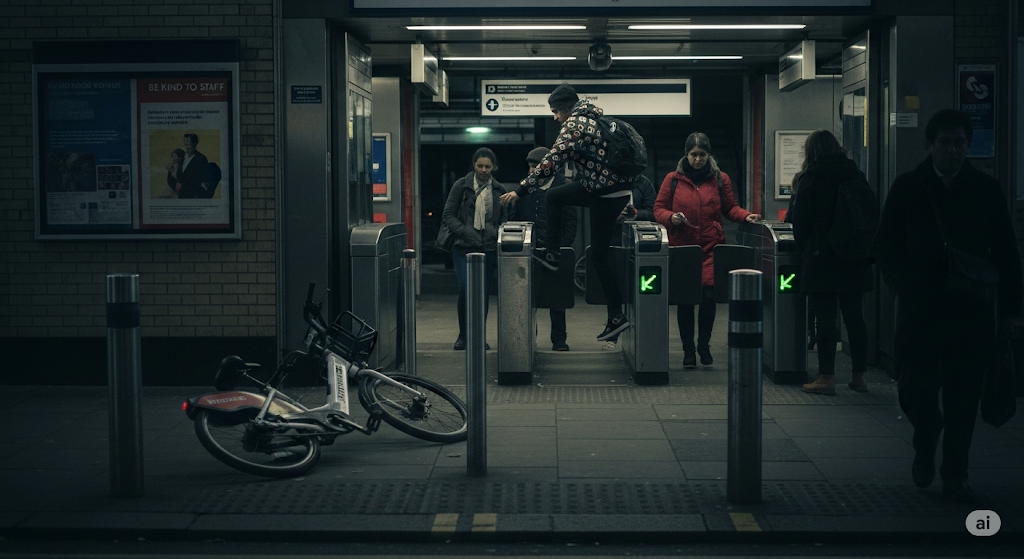
A dimly lit London Underground station entrance at street level in the early evening. A rental e-bike is on its side across the grimy pavement in the foreground. In the background, a young man in casual streetwear jumps over a fare gate. Other commuters in the background are looking away. The scene has a cinematic, slightly desaturated look. You can see wear on the station barriers and a faded "Be Kind to Staff" poster.

The real scandal isn’t the kid hopping the Tube barrier. It’s the fact no one even looks up.

London’s decline into low-level disorder hasn’t happened overnight, and it hasn’t happened through some grand cultural collapse. It’s been a slow demagnetising of civic expectation, one graffitied carriage, one dumped rental bike, one unchallenged fare-dodger at a time.

And for all the commentary, the plans, the posters, the social media pleas from Sadiq Khan gently asking us to be kind to TfL staff, the system continues to fray. Because it’s not just about policy. It’s about psychology. A city, like a child, becomes what you quietly tolerate.

Take a stroll through Camden. Or Putney. Or Vauxhall, or Shepherds Bush. It’s not just the spike in phone thefts or fare evasion. It’s the collective flinch away from even acknowledging it. Authority is outsourced, first to security guards who are contractually told not to intervene, then to CCTV operators watching with all the urgency of a screensaver. The presence of order exists only in post-event paperwork.

This isn’t a new problem. Every generation thinks it invented disorder. But what marks this moment is the collapse of presence. The people who once embodied low-stakes authority – ticket inspectors, bus conductors, even the occasional stern-faced commuter, have all retreated. And without those micro-moments of correction, the boundary dissolves.

Because there was a time, not utopia, not Victoriana, just the mid-2000s, when the Tube was cleaner, antisocial behaviour meant something, and fare dodgers looked over their shoulders. And crucially, someone would have said something if you left your bike in the middle of the pavement.

Now? Saying something feels like an act of madness.

Even a relatively fit man in his forties (ahem, let’s say one with the outline of muscle memory from rowing and once-upon a time lifting in the gym) thinks twice. Not because he’s afraid of being shouted at. Because he might get stabbed. Not metaphorically. Actually stabbed. By a 14-year-old with a 9-inch blade and nothing to lose.

So we look away. We (not I, reader) film instead of act. We turn up the headphones and pretend not to see. Because the calculus has changed. What used to be a moment of friction – “Oi, pack it in” – has become an existential risk assessment. Is this worth dying over?

Yes, austerity hollowed out visible staffing. But not every act of disrespect can be blamed on poverty. You can’t say the teenager in £100 sliders and a Balenciaga hoodie is evading the fare because the system failed him. Nor that the grad in Clapham dumping a Lime bike across the pavement is a victim of systemic neglect.

This isn’t all about deprivation. It’s about detachment. From consequence. From collective norms. From the sense that shared space has shared rules.

So what do we do? Because the answer isn’t doubling police numbers or shaming people on social media. Culture doesn’t change through crackdowns. And civic behaviour isn’t restored by a stronger PR campaign.

You don’t police culture. You design for it.

London’s problem isn’t just one of law or design, it’s one of contrast. As other towns and smaller cities have quietly levelled up, the capital has coasted on past prestige. Behavioural standards lag not because Londoners are worse, but because London is no longer best. The Tube is better, but the civic fabric? Worn thin. What once justified the stress (the vibrancy, the culture, the sheer aliveness) now feels out of balance. You dodge fare evaders and dumped e-bikes, but for what? A Pret subscription and an off-peak West End ticket? Meanwhile, Sheffield has sourdough, Manchester has swagger, and Kent has all the ex-London chefs who could no longer justify paying £3,500 a month to fry mushrooms near a bin store.

That’s where behavioural science (and, yes, some gentle psyops) comes in.

Behaviour is context-dependent. What people do in public space is shaped by cues, affordances, and social norms more than personal ethics. If the system is designed to look away, people will act accordingly. So design it to notice. Design it to remind. Design it to suggest.

This doesn’t mean building a digital panopticon. We already have that. London has more CCTV coverage per square inch than any city outside China. But the surveillance is abstract, remote. We’re watched, but not seen. There’s no friction. No microdose of shame. No moment of hesitation.

What we need to rebuild is civic equivalent of a raised eyebrow.

Start small. Use nudges that aren’t insulting. Place messages where norms are breached, not in corporate safe zones. A sign at the Tube barrier isn’t for the person tapping in, it’s for the kid about to hop it. Use tone accordingly.

Bring back the sense of being noticed. Not punished. Not tracked. Just observed.

We could do worse than call in Rory Sutherland and a few behavioural strategists with teeth. The work they’ve done on transport psychology (understanding how we navigate space, status, and visibility) is ripe for civic deployment.

Imagine a pilot scheme on the Bakerloo Line that doesn’t install more barriers, but changes the posture of the space. Mirrors. Eye-level signage. Floor friction that makes hopping awkward. Subtle lighting changes that simulate visibility. Staff trained not to chase, but to notice.

We could run this for twenty years. Quietly. Iteratively. Without press releases.

The point isn’t to eliminate every act of disorder. It’s to rebuild a culture that expects better.

Because somewhere along the line, shame became taboo. Correction became aggression. We outsourced authority to laminated posters and video cameras and hoped it would be enough. It wasn’t.

Civilisation is not a vibe. It’s a ritual.

And it’s time we noticed what we’re no longer willing to defend.

AI disclosure: AI used to sub-edit the copy and perform factual research which was cross-referenced manually. AI generated the image (obviously), excerpt and tag list to enhance exposure.

Tagged , , , , , , , , , , , , , , , , , , ,

Designing in the Grey Zone: UX Strategy Between User Needs and Compliance Risk

We want this to feel seamless … but we also need explicit consent, mandatory disclosures, manual checks, and legal disclaimers.

Every seasoned designer recognises this paradox. Designing in the grey zone where intuitive user intent meets institutional paranoia; this is the real art of UX. It’s here, away from idealised personas and tidy journey maps, that experienced designers earn their keep.

There’s an invisible brief beneath every customer-focused requirement: a shadow brief shaped by compliance, legal, and operational anxieties. Good designers learn not just to sense this, but to actively probe it. Ignore it, and your project spirals into endless revisions, stakeholder reviews where the work is designed by committee, subtlety is lost; engage it early, and you gain clarity – and allies.

Take pattern fatigue. Users tire of repetitive consent modals, disclaimers, and (in most but not all cases) friction-heavy journeys. Businesses, meanwhile, cling anxiously to these same patterns as safeguards against imagined or real regulatory backlash. But real trust isn’t built through relentless checkbox rituals. It’s earned through clear, respectful experiences that make the necessary feel intentional, not a cover-your-arse afterthought.

Collaboration here isn’t confined to design reviews or user testing, it happens in office kitchen conversations, Teams/Slack channels, and impromptu chats. You learn to engage risk, legal, product, and ops stakeholders early and often, folding their concerns into the design narrative without allowing the process to be swallowed whole.

I don’t just write about this stuff. I’ve done it.

In regulated finance journeys, instead of burying disclosures or making them intrusive, my team always sought to reframe the moment as part of proactive user education, clear, transparent language turned obligatory checkboxes into moments of genuine value.

For an automotive e-commerce flow, this meant legal mandated conspicuously disruptive copy and impenetrable ‘maths stacks’. But by carefully segmenting the messaging and testing contextual placement, the caveats turned into trust-enhancing affirmations rather than flow-breaking interruptions, and those maths stacks became useful summaries of the (complex) product the customer was buying.

Other projects at Aviva and Standard Life involved compliance from day one, not as gatekeepers but co-designers. The result, I hoped users would see, was surprisingly intuitive UX – and a more collaborative approach next time around. Aligning regulatory demands early creates space for creativity rather than stifling it.

Early in my career, it’s fair to say I viewed legal and compliance as blockers (and they saw digital as suspiciously nebulous, much harder to sign off than print). Now, I see them simply as constraints: like network latency, budget, or screen size. And like those, they can be designed-for intelligently and creatively.

Art moves in to Tate St. Ives at street level and must be able to move into the galleries at different levels. (c) Jamie Fobert Architects

I always come back to something Jamie Fobert said about designing Tate St. Ives. Parts of the building were shaped around a core problem: how to get large-scale artworks in, move them through the space, and install them cleanly. Instead of fighting the constraint, they made it central to the solution. Form followed function, but with elegance. That, to me, is how I work with compliance now. Not a hurdle. Just part of the brief.

Tagged , , , , , , , , , ,

The Great Touchscreen Con Job

Some mistakes happen in a moment. A quick lapse of judgment, an ill-advised decision at 3 a.m., an email sent to Reply All. Others take years, unfolding in slow motion as warning signs are ignored, reasonable objections are silenced, and people in boardrooms nod sagely at their own catastrophic short-sightedness. The mass adoption of touchscreen-only controls in cars falls into the latter category.

Volkswagen has now admitted the error of its ways, vowing that physical buttons are back for good. “We will never, ever make this mistake again,” said their Chief of Design, as if they’d been tricked into it by some mysterious force, rather than actively championing the change.

It raises a bigger question. How did it happen in the first place? How did entire teams of HMI experts, human factors specialists, and UX researchers – people whose literal job is to stop this kind of nonsense – allow it to happen? Were they asleep at the wheel, or were they simply drowned out by design teams infatuated with minimalism and finance teams rubbing their hands at the thought of fewer moving parts?

The answer, of course, is all of the above.

The cult of minimalism, confusing more screens with innovation

At some point in the last decade, car designers decided that buttons were offensive. They cluttered up dashboards. They broke the sainted, uninterrupted lines of modern interior design. Worse, they weren’t futuristic. The ideal was a sleek, unbroken surface, like an iPhone, only larger and more expensive to replace if it b0rked.

This obsession with minimalism went unchecked because it looked fantastic in concept renders. Screens glowing with digital promise, smooth and uninterrupted by the ugliness of function. Never mind that the only reason buttons existed in the first place was that they worked. Never mind that people could reach for a dial without taking their eyes off the road, adjusting the temperature by feel alone, a level of usability that no amount of software updates could replicate.

Rob Tannen, a human-centred design specialist, summed it up recently on LinkedIn: “Fundamentally, the problem with touch-based interfaces is that they aren’t touch-based at all, because they need us to look when using them.” In a moving vehicle, that isn’t just bad design, it’s dangerous.

The significant point here though is that this was not a revelation. UX researchers have known it for years. The car industry had, in fact, already worked this out in the 1980s, which is why it spent decades refining tactile, mechanical controls that allowed drivers to focus on the road and remain at arm’s length. But in their rush to be seen as technologically advanced, OEMs decided to throw that institutional knowledge in the bin.

The accountant’s dream, confusing cost-cutting with innovation

Touchscreens are cheap. They replace dozens of mechanical components with a single panel of glass, a bit of wiring, and some off-the-shelf software. For car manufacturers looking to shave costs wherever possible, it was an irresistible proposition. Instead of painstakingly engineered switches, they could throw everything onto a digital interface and call it an upgrade.

Charles Mauro, a veteran in human factors (HF), called this for what it was: “We only have touch screens in vehicles because such interfaces provide a marketing and sales boost to new cars by lending the impression of ‘high-tech’ and modern feature sets. From HF’s perspective, they remain highly impoverished interfaces.”

In other words, it wasn’t about what was best for the driver. It was about what looked best in a press release.

But removing physical controls isn’t just an inconvenience, it’s actively worse. Simple tasks that once took a split-second, a quick flick of a switch, a half-turn of a dial, became a (painstaking) exercise in menu navigation. Climate control settings buried in submenus. Hazard lights requiring two taps and a prayer. Windscreen wipers accessed through a system designed by someone who apparently lives in the desert (i.e. Tesla).

The real irony? Some of the most expensive, high-end cars, the ones that supposedly define luxury, ended up with the worst interfaces. A £120,000 SUV with a laggy touchscreen that freezes in winter. A luxury saloon where temperature adjustments require you to gesture-swipe on visuals of air vents. The tech-driven future, they said.

The Silicon Valley delusion

Blame Tesla. When the upstart EV brand introduced its monolithic, screen-heavy interior, traditional carmakers panicked. If Tesla was doing it, surely that was the future?

OEMs, desperate not to look outdated, decided they had to copy the software-defined model. Everything should be digital, infinitely updatable, infinitely customisable. Who needs buttons when you can have a dynamically shifting interface?

This was a critical misunderstanding of why Tesla got away with it. Tesla’s approach worked (to an extent) because the entire car was designed around it. But for traditional manufacturers, retrofitting touchscreen interfaces onto vehicles that had been developed with physical controls made for a UX disaster.

The dream was that everything would be intuitive. The reality was that even basic tasks became a chore. Ford, in an attempt to embrace this brave new world, introduced ever larger screens into its cars. The result, as The Verge put it, was predictable: “Surveys have shown growing customer dissatisfaction with in-car tech, especially touchscreen software. People are overwhelmed, and Ford’s response seems to be to add more screens, which is not a guarantee for success.”

The data problem

There’s a particularly dangerous kind of UX research that looks at how often people use controls and decides that if something isn’t used frequently, it should be buried.

This is how Tesla ended up hiding the wiper controls inside a screen menu. Their reasoning? “People don’t use them often.” A brilliant insight in California, somewhat less so if you live somewhere with rain.

This logic led to cars where drivers had to dig through menus for basic functions. The entire point of a car interface is that when you do need something, it should be immediately accessible and context really, really matters. Nobody wants to enter a submenu for demisters when their windscreen is fogging up at 70mph. Auto Express’s report is well worth a read here

The Return of Sanity

Volkswagen’s public climbdown marks a turning point. Hyundai has followed suit. The backlash has been strong enough that manufacturers are now scrambling to put buttons back in their cars, pretending that they always intended to.

But it wasn’t customer complaints that forced the change. It wasn’t common sense prevailing. It was regulators.

Euro NCAP has mandated that, from 2026, cars will need physical buttons for key functions to qualify for a five-star safety rating. The industry had spent a decade ignoring drivers, but when the threat of lower safety scores loomed, suddenly they rediscovered their enthusiasm for good UX.

Where Do We Go From Here?

The great touchscreen experiment is over. Car interiors are moving back towards hybrid interfaces, a balance of digital and physical that prioritises usability over showroom aesthetics. Manufacturers are rethinking software-defined controls, realising that while over-the-air updates are useful, core functions need permanent, intuitive access.

Most importantly, UX research in automotive needs to be taken seriously again and their voices heard right up the product development and engineering chain. Not just as a box-ticking exercise, but as a genuine guide for what works.

For now, though, it’s a relief to know that the button is making a comeback. It turns out that some of the most futuristic technology in modern cars was there all along.

AI disclosure: Some article research was supported by AI, themes consolidated, article excerpt was AI generated. Article copy entirely author’s own.

Tagged , , , , , , , ,

Amazon’s UX: Why Customers Ignore the Chaos

Amazon’s interface is a mess. Everyone knows it, doesn’t matter if you’re in the industry or you just use it to buy lightbulbs, the odd book and some fancy Tupperware. It’s the digital equivalent of a hoarder’s house, clutter everywhere. A friend of mine once memorably described looking for something as like “rummaging through a warehouse with a torch”, but [she does it because] “I know the bloody thing I want is in there somewhere”. On any given part of the site there’s inexplicable stacks of unrelated items, and a sense that at any moment, something might fall on you. My particular hate are sponsored listings, intruding like pushy sales reps with their irrelevant nonsense while you’re on the way to buy the actual thing you searched for (although sometimes the actual thing turns out to be a not-quite-there copy from some random far-east factory). Genuine customer reviews also get buried under an avalanche of SEO-stuffed nonsense, and yet, dear reader… here I am, ordering 90% of what I buy from Amazon. And you do too.

However frustrating the experience, it isn’t bad enough to drive people away. Fast delivery, sheer product choice, and a checkout process so frictionless it should be flagged with Gamble Aware. All of this outweighs the UX sins.

So, Does UX Even Matter?

It is a question worth asking. If a platform’s core proposition is so compelling, with cheap prices, instant gratification and no meaningful alternative, does the user experience really determine success? Or does it just need to be functional enough?

The Amazon Conundrum

Armchair critics love to dissect Amazon’s UX. In the dark corners of the UGC web, Reddit threads are full of users raging against the chaotic interface. Tech journos lament the aggressive Prime pushing, the pay-to-win search results. On paper, it’s a usability horror show. But let’s be clear, Amazon isn’t neglecting UX. It employs entire teams of UX designers, researchers, and engineers who are constantly refining the experience. Not to make it more elegant, but to make it better at selling things. If adding another sponsored listing increases revenue, they’ll do it. In 2022 alone, Amazon made over $31 billion from its advertising business, largely driven by these placements, making it a core part of their revenue model (Vox). If customers still find something to buy despite the friction, then as far as Amazon is concerned, the system is working just fine. The difficulty we have as UXers is understanding and reconciling this. Because we see ‘Sponsored’ listings trump the actual best-result search listing we say “This is wrong, users hate this!” but somewhere deep in Amazon HQ is the data to say, “You know what, they actually don’t, and here’s some more $” (EcommerceFuel and others provide further context on how Amazon’s sponsored listings work and why they persist). The same logic applies to other blunt instruments like relentless pop-ups (deeply irritating but demonstrably effective at nudging hesitant users into making a decision) and those blinking, anxiety-inducing countdown timers all over that Instagram brand’s shop aren’t there by accident either.

When UX Takes a Back Seat

Of course, Amazon is hardly alone. Plenty of other sites with objectively terrible UX remain dominant because their value proposition is simply stronger than the frustration they cause:

  • Booking.com drowns you in pop-ups and ‘Only 1 left at this price!’ warnings. Yet its vast selection and competitive pricing make it impossible to ignore.
  • British Airways’ website looks and feels like it’s been trapped in 2009, but people still book flights because, they will always believe the brand stands for something British and the pilots are the best trained and most decent in the skies.
  • Vinted The latest upstart eCommerce brand is having a runaway success in the UK but this is absolutely down to the simplified sell-send logistics and payment process, and definitely not to the bloody awful filtering and product exploration UX (seven different ways to filter on Ralph Lauren sweaters anyone?).
  • GP surgery websites, National Rail, car park booking systems, there’s a vast ecosystem of poorly designed necessities that survive because users effectively have no choice or poorly rationalise their value/essentialism.

This phenomenon isn’t anecdotal or lost on UX thinkers. As David C. Wyld argues in The Endless Battle Against Bad UX, poor usability is pervasive in major companies, and fixing it isn’t always a top priority. Similarly, The World is Running on Bad UI (Michal Malewicz) notes how many essential services and platforms operate on clunky, outdated interfaces yet remain functionally irreplaceable. Their insights reinforce the central argument here: bad UX doesn’t necessarily mean bad business.

The Captive Audience Factor

The obvious point here is that there is a difference between platforms like Amazon, where the UX is frustrating but functional, and services where users are stuck with whatever’s available. The difference with Government portals, legacy corporate systems, anything remotely tied to infrastructure is that these things aren’t just designed badly; they are fundamentally unmotivated to improve.

It’s not even a matter of UX being ignored (again, plenty of these organisations are populated by skilled and well-meaning design folks), it’s often a mix of limited budgets, outdated tech stacks, bureaucracy (many hands), and the sheer pain and complexity of rebuilding something that’s been patched together over decades.

The same logic applies to countless internal systems in large organisations, where usability takes a backseat to bureaucratic inertia and legacy technology. Everyone grumbles about it, but change is slow, and innovation rarely prioritises the dull but essential parts of work life. Just as no one is investing to replace the office microwave that’s been there since the turn of the millennium, so we continue to suffer through whatever shitey interface we’re given.

The Reluctance to Overhaul

Could Amazon wholesale overhaul its UX if it wanted to? Technically, yes. But would it be worth it? Probably not. The site is a sprawling ecosystem of millions of products, channels and third-party sellers, advertising deals, and logistics chains. Trying to impose a sleek, minimalist interface would mean unpicking the very mechanics that drive sales at an enormous cost.

The same goes for other massive platforms. The bigger and more layered a system becomes, the harder (read more expensive) it is to rebuild from the ground up. This is exactly the scenario I described in The Local Maximum Problem, where businesses become trapped in cycles of micro-optimisation rather than taking bold steps toward meaningful UX improvements. Businesses, especially ones as enormous and entrenched as Amazon, often optimise for small, short-term gains instead of taking the risk of a complete overhaul. They’ve reached a peak where micro-adjustments keep the machine running, even if they don’t solve fundamental UX flaws. Redesigning from scratch is a leap into the unknown, and when the current setup is still printing money, who would take that risk? Maybe they update a search filter. Maybe they tweak the layout slightly. But the underlying experience remains a Frankenstein’s monster of competing priorities.

So, Does UX Matter?

Yes, but not in the way purists would like to believe. Good UX reduces friction, increases trust, and improves efficiency, but it doesn’t always dictate whether people use a platform. When the value proposition is strong enough, users will tolerate a lot.

The idealistic view is that platforms should improve out of respect for their users. But what do you think? Have you ever abandoned a platform because of its terrible UX, or do you find yourself sticking with frustrating experiences because the value proposition is just too strong? Perhaps if people keep clicking, why fix what isn’t broken?

Tagged , , , , , , , , , , , , ,

Asics Overcomplicates the Runner’s Journey

What’s worse than realising your favourite running shoe has finally given up the ghost? Watching someone else avoid that realisation for 18 months and risk an almost inevitable injury as the shoe disintegrates before our eyes. That someone, in this case, is the mother of my children, and the dearly departed in question is her much-loved, overworked Asics Gel-DS Trainers. Those shoes have put in a hell of a shift. Thousands of kilometres on pavements, parkruns, and everything in between, and she’s been putting off replacing them because Asics, in their infinite wisdom, decided to discontinue them. Ironic, really, considering they now offer what seems like an ever-expanding collection of new models that are aligned to a hundred sub-genres of our sport.

So, armed with determination and a misplaced sense of optimism, I ventured onto the Asics website, thinking, “How hard can it be to find a suitable replacement?” Fool. Absolute fool.

What followed was not so much a straightforward shopping experience as a complex game of hide-and-seek with 100+ models of women’s running shoes. I began narrowing things down: size 5.5—okay, now we’re at 80 options. Neutral pronation—down to 54. Road running—down to 46. Surely, at this point, I’d found a clear path. Instead, I was still faced with an onslaught of variants. The Metaspeed, for example, comes in Edge+ and Sky+ (for stride runners and cadence runners, respectively). Then there’s the Nimbus with a Platinum version, because apparently, even running shoes need luxury trims these days. Add in the Cumulus GTX, Lite-Show, and Noosa Tri, and it quickly started to feel like I’d stumbled into Asics’ fashion line instead of a practical search for neutral road shoes.

The Asics Maze
Even after filtering, I was still staring at something like 46 items. Surely, price could help narrow things down? Not quite. More expensive didn’t necessarily mean better, and so using price as a guide only added to the confusion. Was the extra cost because of space-age tech, or was it just a fancy colourway? No way to tell.

Take the Metaspeed and Superblast—both at the top end of the price range. Are they substantially better than the Gel-Pulse or Magic Speed? It depends on what you’re after. The pro models may have carbon plates and advanced cushioning, but that doesn’t mean they’re always the right choice for someone looking for a lightweight, fast shoe for 10k runs.

In the world of running shoes, price can mean anything—or nothing at all. Sometimes minimal, no-frills shoes can be cheaper simply because they don’t have much in them. Other times, pro-level shoes are expensive for performance reasons. Either way, price is a poor guide to what’s actually suited to you.

The Absurd Complexity of Asics’ Product Strategy
By this point, I was beginning to wonder who Asics had in mind when they designed this labyrinth of choice. Surely, even they must know that offering this many variants doesn’t create more positive choices—it just creates more confusion. I’d managed to reduce my options to 10 models across 16 variants, but there was still no sign of the shoe closest to the Gel-DS Trainer—the GT-2000. Apparently, Asics decided it belongs in the “stability” category, even though it offers nearly the same stability, weight, and cushioning as the Gel-DS. So there it sat, hidden in plain sight.

From a product strategy perspective, this is inefficient at best and counterproductive at worst. Developing, marketing, and maintaining so many similar models must be both expensive and confusing for the customer. Asics are doing a fantastic job of overwhelming the very people they’re trying to help, all while bloating their own production processes.

Fixing the Problem
So, what’s the fix? It’s not rocket science. What they need is a simplified, user-friendly approach that doesn’t leave customers feeling cognitively drained before they’ve even tied their laces.

Let’s start with better filters. The current system is too blunt. Instead of “road” or “neutral,” how about additional more useful filters like “lightweight,” “minimal cushioning,” or “designed for 10k runs”? Filters that speak directly to the practical needs of runners would make the entire process far more intuitive.

And, of course, an AI-powered product recommender would go a long way. Imagine inputting a few key details—distance, surface, weight preferences—and getting a personalised recommendation that actually fits your needs. No more second-guessing whether the Metaspeed Sky+ is right for you or why the GT-2000 doesn’t even show up. Other industries have embraced AI to simplify decision-making, and there’s no reason Asics can’t do the same.

Finally, streamlining the product range. Asics just doesn’t need so many variants of the same shoe. And when you consider they’re competing with the likes of Nike, Adidas, Hoka, and others, all with their multiple model variants chasing the same customer, it makes even less sense. Simplifying their product line would not only help the consumer, but it would also cut their own operational costs. Less clutter, more clarity—it’s a win-win.

In Summary
In the end, trying to replace the Gel-DS Trainer wasn’t just about shoe shopping—it turned into a case study of how not to design a user journey. Asics, with their 100+ models and endless variants, have created a labyrinth that even seasoned runners struggle to navigate. And in doing so, they’ve not only alienated customers but also made their own operations less efficient.

What Asics needs is a return to basics: a simplified product range, a streamlined user experience, and filters and tools that actually reflect the way runners think and shop. Less focus on obscure variants, and more on clear, understandable options that meet practical needs. An AI-powered recommender and better faceted filters are two easy steps to fix this.

Because, let’s face it, nobody should need a flowchart to buy a pair of running shoes. In a world where brands like Asics are meant to help runners perform better, they have forgotten the most basic rule: make the choice simple—and let us make the running bit as hard as we like.

Tagged , , , , ,