Tag Archives: Rory Sutherland

So the Hallway Shuts Up About It

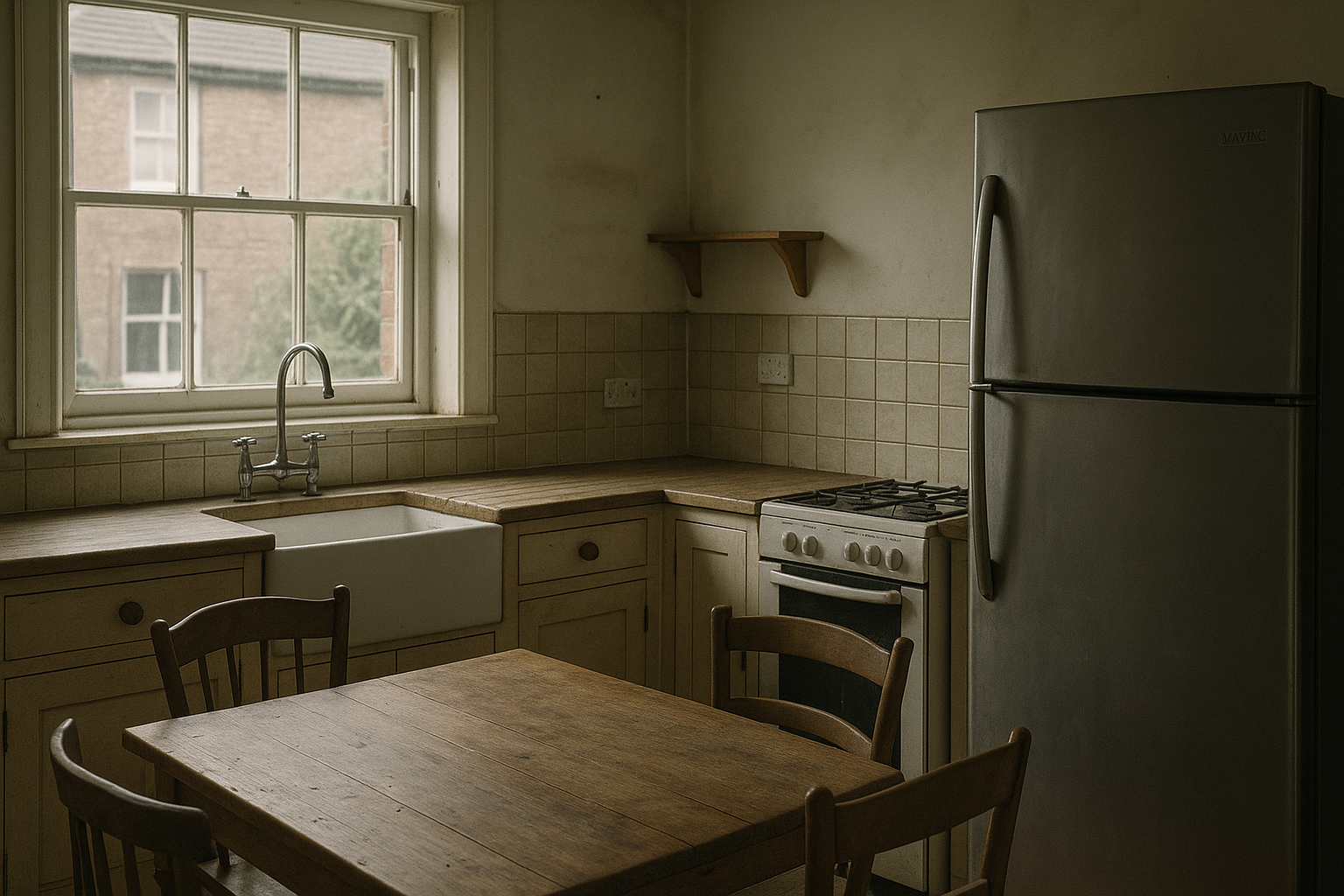
A quiet, lived-in Edwardian kitchen with soft natural light streaming through large sash windows. A brushed chrome tap stands over a deep white Belfast sink, set into pale wooden cabinets with faded cream tiling above. A worn oak table with mismatched wooden chairs sits in the centre of the room. To the right, a slightly scuffed stainless steel Maytag fridge and an old gas cooker are tucked into the corner. The space feels unstyled, with muted grey and off-white tones, and subtle signs of use but no clutter. The mood is still and contemplative, as if someone has just stepped out.
When you renovate every other room and the kitchen starts looking at you like it knows it’s next.

We’ve been doing up the house. Nothing dramatic, just the slow, financially ruinous crawl from upstairs to down. Bedrooms first. Then bathrooms. Then the living room. And now the kitchen (inherited from the previous owners) is sulking. Every time I walk into it, I swear the tiling looks a shade more shabby-shite 2006.

It’s not that much is broken. Except the tired Maytag fridge freezer, a burner that doesn’t ignite and the sink tap leaks, oh and the ruinously-expensive-to-repair-out-of-warranty Miele dishwasher. It’s just been… outclassed. Like turning up to a wedding in M&S when your wife’s in The Row.

And this irritates me, because I’d quite like to think I live with a bit of restraint. I’ve written before about resisting the upgrade spiral. About not living like a man permanently preparing for an estate agent’s photoshoot. But it turns out that once you start, the rest of the house doesn’t politely wait its turn, it stages a coup.

The formal name for this, according to Rory Sutherland, is the Diderot Effect. You buy one nice thing and everything else starts to look shit by comparison. Diderot got a red dressing gown and ended up replacing half his house. We bought a fancy shower mixer and now the kitchen tap feels like it came out of a skip.

Which is how we end up here. Discussing a kitchen renovation because although it’s neither urgent, nor falling apart, it’s because the surrounding rooms have raised the bar to a level our sad little units can’t clear. And I hate myself for it. Because I also know that if we do go ahead, the new kitchen will make the hallway feel dingy, and the garden and patio will look lazy and provincial, and so on until we die or go bankrupt.

And yet, this is the maddening bit, I also know we’ll probably do it. It’s not vanity. We don’t want quartz or fluted wood or some comically oversized kitchen island, we just want to stop thinking about it. To be able to walk through the space without mentally adding it to a list.

It’s the tyranny of the unfinished, the psychological admin of rooms and spaces you haven’t yet dealt with.

There is, of course, a way to dodge all this. You could adopt the Sutherland doctrine and buy a 16th century house. One of those glorious old piles that look better because they’re full of crap. But we don’t live in a Tudor house. We live in an Edwardian semi in Surrey where any attempt at minimalism makes the place look like a probate sale, and maximalism makes it look like you’re an edgy creative that’s gone mad on Etsy.

So here we are. Planning a kitchen. Not for resale. Not for guests. Not even for ourselves, really. Just so the hallway shuts up about it.

AI: This piece was, as ever, written by me. I used ChatGPT to sub-edit, and keep the tone aligned with my voice. The experiences, perspectives, and final edits are mine. AI also produced the tag list, excerpts and image that accompanies it.

Tagged , , , , , , , , , , , , , , , , , ,

You’ve Booked the Flight. Now Feed the Cat.

Or, What a Ryanair journey map taught me about real UX.

There’s a type of interface that shows up on Dribbble every few months: flight check-ins, boarding passes, baggage-tracking dashboards. Always slick. Always serene. The UI equivalent of cucumber water.

Most of them start at Choose your seat and end at Enjoy your flight. Which is tidy. But also nonsense.

A few years ago, I worked on a project for Ryanair. I drew out a journey map (with pens, natch), not the polished, stakeholder-pleasing kind, but something closer to the real emotional terrain of travel. One that began well before the confirmation screen. One that started, in fact, with the cat.

Because booking a flight isn’t a clean beginning. By the time anyone taps “Book now,” they’ve already trawled five sites, tried to align half-term dates with the one cousin who replies to group chats, checked weather reports, and googled “Do I need a visa for Croatia?” even though they’re flying to Naples.

Life admin, not travel ambition, is what usually kicks things off. That’s where the journey begins.

The diagram traced everything from that fraught pre-booking stretch through to the post-trip hangover, highlighting the emotional and logistical clutter that most airline UX avoids. Not because it isn’t there, but because it’s messy. And mess doesn’t fit neatly into a product roadmap.

There’s the bit after you book, when nothing much happens, except everything might. The vague unease when no one’s confirmed your seats. The passive-aggressive alert that “something has changed” in your itinerary, but you’re left to figure out what. The nervous rechecking of emails. The slow panic over cabin bag dimensions.

Then comes the day itself. A spike in interaction. The printer runs out of ink. You’re stood at Departures at 6:30am trying to download Peppa Pig episodes with 4% battery and no signal. Your toddler’s hungry. Your partner’s tense. And you’re still wondering if you packed the Calpol.

And yet… this is the brand moment. Not the glossy UI, not the neat API integration. Just this: the knot in your stomach, the uncharged phone, the boarding pass you can’t pull up without a connection.

The map tried to capture that. Not to romanticise it, but to acknowledge it.

Even on the return leg, the friction isn’t over. Passport queues. Lost luggage. The existential despair of a train replacement service. You get home, open a week’s worth of mail, find a parking fine, trip over a stray shoe from the hasty departure packing, and realise you didn’t leave anything for the cat-sitter.

Most journey maps stop at wheels-up. Ours didn’t. Because experience doesn’t follow a clean arc. It loops, it stutters, it sags in the middle. Thoughtful UX understands that.

A tired parent, dressed in a dark winter coat with a fur-lined hood, stands in a dimly lit Swedish airport baggage claim area late at night. They are looking down at their phone, which shows a 4% battery icon. To their left, a child sleeps soundly in a dark grey stroller. A large, dark suitcase tilts precariously next to the parent, appearing as though it might fall. In the background, an empty luggage carousel stretches out, with a few other suitcases scattered on it. Further back, blurred figures of other travelers are visible, and the warm glow of a vending machine can be seen on the far left. The overall atmosphere is one of exhaustion and quiet resignation.

Of course, Ryanair won’t build an app that books your pet-sitter or packs plug adapters. But this kind of messy map reveals where the brand can quietly show up—not with a feature, but with timing, tone, and the rare dignity of being understood.

Maybe that’s a 6-sheet in the departure lounge that says “Still cheaper than therapy.” Maybe it’s an email that clears, not clouds. Maybe it’s an in-seat comm that drops the marketing voice for once and just says: “Made it. Welcome back.”

Even for Ryanair, in fact especially for Ryanair, those moments can build memory, trust, and repeat business. Because no one remembers the boarding pass. They remember how they felt when the wheels touched down, the keys were missing, and the cat looked at them with contempt.

You’re not designing for delight. You’re designing for 4% battery, no signal, and a queue that won’t move. That’s where memory lives. And maybe loyalty too.

AI disclosure: This piece was written with the assistance of AI, used strictly as an editorial and thinking partner. All ideas, edits, and final phrasing are mine. ALT text and tagging were also generated with AI support.

Tagged , , , , , , , , , , , , , , , , , , ,

The Cost of Looking Away

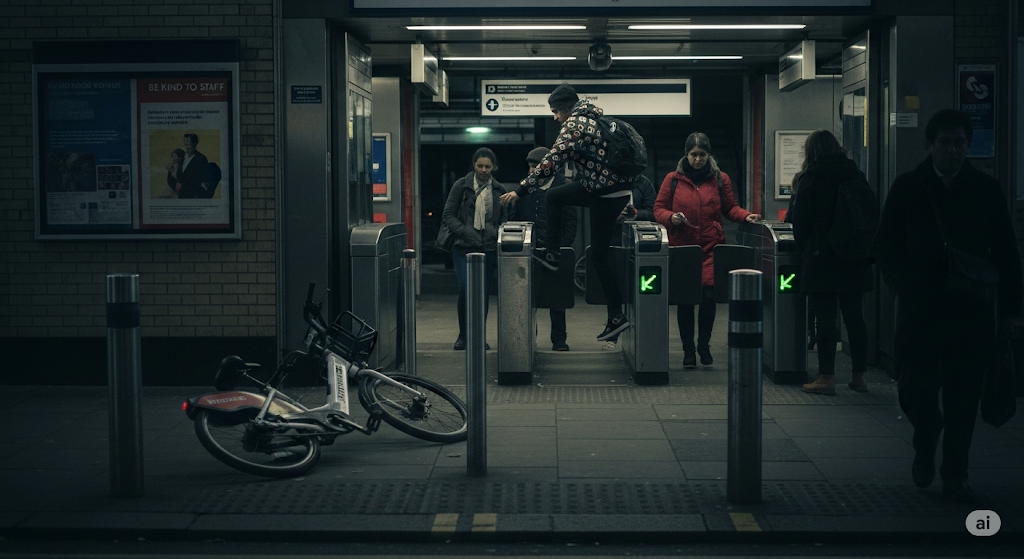
A dimly lit London Underground station entrance at street level in the early evening. A rental e-bike is on its side across the grimy pavement in the foreground. In the background, a young man in casual streetwear jumps over a fare gate. Other commuters in the background are looking away. The scene has a cinematic, slightly desaturated look. You can see wear on the station barriers and a faded "Be Kind to Staff" poster.

The real scandal isn’t the kid hopping the Tube barrier. It’s the fact no one even looks up.

London’s decline into low-level disorder hasn’t happened overnight, and it hasn’t happened through some grand cultural collapse. It’s been a slow demagnetising of civic expectation, one graffitied carriage, one dumped rental bike, one unchallenged fare-dodger at a time.

And for all the commentary, the plans, the posters, the social media pleas from Sadiq Khan gently asking us to be kind to TfL staff, the system continues to fray. Because it’s not just about policy. It’s about psychology. A city, like a child, becomes what you quietly tolerate.

Take a stroll through Camden. Or Putney. Or Vauxhall, or Shepherds Bush. It’s not just the spike in phone thefts or fare evasion. It’s the collective flinch away from even acknowledging it. Authority is outsourced, first to security guards who are contractually told not to intervene, then to CCTV operators watching with all the urgency of a screensaver. The presence of order exists only in post-event paperwork.

This isn’t a new problem. Every generation thinks it invented disorder. But what marks this moment is the collapse of presence. The people who once embodied low-stakes authority – ticket inspectors, bus conductors, even the occasional stern-faced commuter, have all retreated. And without those micro-moments of correction, the boundary dissolves.

Because there was a time, not utopia, not Victoriana, just the mid-2000s, when the Tube was cleaner, antisocial behaviour meant something, and fare dodgers looked over their shoulders. And crucially, someone would have said something if you left your bike in the middle of the pavement.

Now? Saying something feels like an act of madness.

Even a relatively fit man in his forties (ahem, let’s say one with the outline of muscle memory from rowing and once-upon a time lifting in the gym) thinks twice. Not because he’s afraid of being shouted at. Because he might get stabbed. Not metaphorically. Actually stabbed. By a 14-year-old with a 9-inch blade and nothing to lose.

So we look away. We (not I, reader) film instead of act. We turn up the headphones and pretend not to see. Because the calculus has changed. What used to be a moment of friction – “Oi, pack it in” – has become an existential risk assessment. Is this worth dying over?

Yes, austerity hollowed out visible staffing. But not every act of disrespect can be blamed on poverty. You can’t say the teenager in £100 sliders and a Balenciaga hoodie is evading the fare because the system failed him. Nor that the grad in Clapham dumping a Lime bike across the pavement is a victim of systemic neglect.

This isn’t all about deprivation. It’s about detachment. From consequence. From collective norms. From the sense that shared space has shared rules.

So what do we do? Because the answer isn’t doubling police numbers or shaming people on social media. Culture doesn’t change through crackdowns. And civic behaviour isn’t restored by a stronger PR campaign.

You don’t police culture. You design for it.

London’s problem isn’t just one of law or design, it’s one of contrast. As other towns and smaller cities have quietly levelled up, the capital has coasted on past prestige. Behavioural standards lag not because Londoners are worse, but because London is no longer best. The Tube is better, but the civic fabric? Worn thin. What once justified the stress (the vibrancy, the culture, the sheer aliveness) now feels out of balance. You dodge fare evaders and dumped e-bikes, but for what? A Pret subscription and an off-peak West End ticket? Meanwhile, Sheffield has sourdough, Manchester has swagger, and Kent has all the ex-London chefs who could no longer justify paying £3,500 a month to fry mushrooms near a bin store.

That’s where behavioural science (and, yes, some gentle psyops) comes in.

Behaviour is context-dependent. What people do in public space is shaped by cues, affordances, and social norms more than personal ethics. If the system is designed to look away, people will act accordingly. So design it to notice. Design it to remind. Design it to suggest.

This doesn’t mean building a digital panopticon. We already have that. London has more CCTV coverage per square inch than any city outside China. But the surveillance is abstract, remote. We’re watched, but not seen. There’s no friction. No microdose of shame. No moment of hesitation.

What we need to rebuild is civic equivalent of a raised eyebrow.

Start small. Use nudges that aren’t insulting. Place messages where norms are breached, not in corporate safe zones. A sign at the Tube barrier isn’t for the person tapping in, it’s for the kid about to hop it. Use tone accordingly.

Bring back the sense of being noticed. Not punished. Not tracked. Just observed.

We could do worse than call in Rory Sutherland and a few behavioural strategists with teeth. The work they’ve done on transport psychology (understanding how we navigate space, status, and visibility) is ripe for civic deployment.

Imagine a pilot scheme on the Bakerloo Line that doesn’t install more barriers, but changes the posture of the space. Mirrors. Eye-level signage. Floor friction that makes hopping awkward. Subtle lighting changes that simulate visibility. Staff trained not to chase, but to notice.

We could run this for twenty years. Quietly. Iteratively. Without press releases.

The point isn’t to eliminate every act of disorder. It’s to rebuild a culture that expects better.

Because somewhere along the line, shame became taboo. Correction became aggression. We outsourced authority to laminated posters and video cameras and hoped it would be enough. It wasn’t.

Civilisation is not a vibe. It’s a ritual.

And it’s time we noticed what we’re no longer willing to defend.

AI disclosure: AI used to sub-edit the copy and perform factual research which was cross-referenced manually. AI generated the image (obviously), excerpt and tag list to enhance exposure.

Tagged , , , , , , , , , , , , , , , , , , ,

Behavioural Economics / Psychology of Persuasion & Influence Reading List

Thanks to a Quora answer from Rory Sutherland I stumbled across this excellent (and lengthy) starter reading list for those interested in the sociology, psychology and economics of persuasion. Well worth looking at for the people that have said ‘I’m done with Nudge, anything else I should read?’

ASIDE: This is probably the first time I’ve found myself on Quora and learned something. That’s not to say it’s rubbish (and who’d care about my opinion anyway) just that I’ve been a member of it for about 6 months but don’t bother checking so I only discovered this when it popped up on Twitter. So Quora made it happen, Twitter made me find it.

Tagged , , ,