Tag Archives: behavioural economics

Predictive Luxury: When the Algorithm Decides You’re Worth It

The paradox of modern luxury is that the more precisely it knows us, the less we seem to want it.
AI-driven personalisation flatters our taste so efficiently that desire itself begins to flatten. You open an app and there it is – the jacket you’d half-imagined, or the playlist that mirrors your mood before you’ve named it. The system anticipates, arranges, and completes. It feels frictionless, even generous.

But when everything fits this neatly, what’s left to reach for? Desire once depended on a perceptible gap, the space between wanting and getting. Now that gap has been optimised away. We no longer aspire; we’re simply anticipated.

Behind that easy charm sits a machinery, an industry, of prediction. Every scroll, hover, and hesitation becomes a confession. From these micro-gestures, the algorithm builds a probabilistic portrait: accurate enough to sell to, not to know.

This is predictive luxury – the luxury of convenience. It packages aspiration for the mass-affluent, translating status into data. The product is still expensive, but the experience is engineered for scale: “exclusive” taste delivered by statistical consensus. What once required discernment now arrives pre-approved.

To be clear, this isn’t curation. It’s correlation. Your discernment becomes the weighted average of everyone who clicked before you. Luxury houses once guarded their ateliers; now they guard their datasets. What was once stitched by hand is now inferred by pattern.

The shift sounds harmless until you notice what it removes.
Aspiration (the slow, self-defining kind) relies on uncertainty. We learned our taste through trial, boredom, and even embarrassment. Those edges are gone. There’s no risk in going to the restaurant where the algorithm has all but booked you the table. The algorithm keeps our preferences in a holding pattern, replaying what we’ve already confirmed, always within one standard deviation of safety.

The Predictive Plateau: a system that sells us the most probable choice, not the most interesting one. Left unchecked, it narrows the collective palate. As I argued in Luxury UX: Beyond Veneer, lasting equity comes from structure and restraint, not surface gloss. The real risk for luxury brands isn’t technological obsolescence but aesthetic homogeneity, a market trained to prefer the median.

Prediction is never neutral. Behind every act of personalisation sits a hierarchy of visibility, whom the machine believes is worth showing first. The more data you surrender, the clearer your silhouette in its model; those who resist become statistical ghosts.

There’s a quiet economics to this. By automating inequality, the algorithm devalues any form of wealth it cannot quantify or identify. The ultimate luxury, then, is to disappear from the data entirely, to operate through introductions, word of mouth, and private networks. The truly exclusive product is the one the algorithm cannot find, let alone recommend.

And yet there’s still one lever left: intentionality. The deliberate pause before purchase. The refusal to click “similar items”. The act of finding something the algorithm couldn’t possibly have foreseen. In a world of predictive luxury, this is not passive rebellion but an active aesthetic stance, a luxury of choice by will.

The smartest brands will design for this intentionality, not against it. They’ll reintroduce or retain friction as a feature: the waitlist, the mandatory consultation, the garment that demands to be felt. These are not inefficiencies but signals of depth, proof that the experience values attention over automation.

For all its precision, predictive luxury leaves a vacuum at the top. Once algorithms have colonised the middle (the mass-affluent market chasing “smart” recommendations), genuine exclusivity must move elsewhere. Increasingly, it drifts back to what machines can’t do: interpretation, eccentricity, the unrepeatable judgement of people who know.

That’s where true luxury now lives, in human-centred unpredictability. The ultra-wealthy and the culturally literate aren’t rejecting technology; they’re augmenting it. Data may light the runway, but the finale still belongs to the artisan, the editor, the quietly idiosyncratic expert who can surprise you in ways no model can.

Close-up of a tailor’s worktable lit by soft natural light, showing thread spools, scissors, and a half-finished jacket with a visible imperfect seam — an image symbolising human craftsmanship and intentional imperfection in contrast to algorithmic precision.

British luxury has long understood this. Our best exports – Savile Row, Bentley Mulliner, McQueen, Hockney, Grayson Perry – thrive on that narrow line between discipline and disobedience. Their genius isn’t efficiency but editing: knowing when to break symmetry, when to leave the imperfect seam that proves a hand was there. The imperfect seam is a brand’s deliberate investment in unscalable production – the final, physical proof of value when all scalable processes have been commoditised. Curation, as I’ve argued before, isn’t collection. It’s the art of choosing what not to automate.

The challenge for brands now is to build value not through correlation but through judgement. To shift from efficiency to experience, from prediction to anti-prediction. Their next digital frontier isn’t better personalisation; it’s deliberate unpredictability, the algorithm that refuses to close the loop. Designing such friction isn’t romantic contrarianism; it’s the only sustainable strategy for generating new forms of scarcity, and with them, price elasticity.

Because in an economy obsessed with knowing what comes next, the rarest thing a brand can offer is the pleasure of not knowing, of being surprised, seen, and momentarily off-script. That’s the new exclusivity. That’s predictive luxury, undone.

Acknowledgements: This piece was partly inspired by Antonia Hock’s recent post on invisibility and the next era of ultra-luxury.

AI: This piece was refined with AI, for the image prompt, tags, excerpt, and a little sub-editing. The ideas, references, and rhythm are mine. You can still see my hand.

Tagged , , , , , , , , , , , , , , , , , , ,

Why UK Kids Can’t Have Bank Accounts Before Six – And Why That’s Silly

A close-up, hyper-realistic photo shows a wooden piggy bank with a coin slot on its back and a coin partially inserted. The piggy bank is positioned next to a smartphone displaying a children's banking app with icons for savings goals and coin graphics. To the right of the phone is a neatly folded stack of pastel-colored baby clothes, including a small pair of knitted booties, with a Vinted parcel label and barcode clearly visible. The scene is illuminated by soft, natural light, creating a muted, editorial feel.

Here’s a sentence that shouldn’t exist: our two-year-old has a savings pot inside her eleven-year-old brother’s bank account.

Not because we’re trying to confuse HMRC or because we’ve discovered some fintech hack that’s too good to share. Simply because no UK bank will give her an account until she turns six, and when she does, it will still be hamstrung by limits that assume every child’s money arrives in neat, predictable chunks from a parent’s allowance.

The set-up is simple. We sell her old clothes and toys on Vinted. It’s honest, traceable money, every transaction recorded by a platform that has its own anti–money laundering checks baked in. The items avoid landfill. The proceeds go to her future self. It’s the kind of wholesome circular economy PR departments love to posture about. And yet the only way to park that money somewhere with her name on it (sort of) is to create a ‘pot’ inside her brother’s Rooster account.

This is not a problem the Financial Conduct Authority asked the banks to solve. There is no specific regulation that says under-sixes cannot have a bank account. This is a product design decision, dressed up in safeguarding logic. NatWest’s own Rooster service told me:

We’ve had to introduce limits, with these limits created and set at what we believe is a generous amount for a child’s pocket money app… We recommend that you make fewer larger top-ups in the month, and then boost the money over as often as you like.Katie, 15.AUG.25

The logic, if you squint, is that transaction caps stop laundering. But laundering what, exactly? In our case: a baby’s outgrown sleepsuits. The “10 loads a month” cap on Rooster is not cumulative-value–driven (the actual pound-limit is much higher). It’s a blunt instrument, applied as though fewer transactions automatically means less risk.

In reality, this isn’t about AML at all. It’s about the convenience of enforcing one simple rule across the board rather than designing for the messy reality of modern family finances:

  • Parents with irregular incomes.
  • Blended households with multiple contributors.
  • Ad-hoc earnings from resale platforms.
  • Grandparents who send £5 here and there for birthdays or because they saw a cute jumper in M&S.

Under the current design, the system doesn’t distinguish between proceeds from a second-hand pushchair and proceeds from illicit activity. The compliance blanket is thrown equally over both.

The result: we’ve built a workaround. Her ‘earnings’ from Vinted go into his account, into her pot, under our management. One day, in about four years, we’ll withdraw the lot and hand it to her. Which is absurd, not least because we’ll have to move it in fewer than ten transactions to avoid tripping the same rules all over again.

If we were serious about aligning banking with real life, we’d have:

  1. A from-birth, save-only account – visible in the parent’s banking app, locked against spending, able to receive small, traceable contributions from approved sources.
  2. Transaction rules shaped by value and source, not arbitrary counts.
  3. A seamless graduation path at age six to a junior current account with a card and spending controls.

The point is not to hand toddlers contactless cards. It’s to start building the habits, and the visibility, early. Money in, money saved, money safe. The actual ‘banking’ part should be the least absurd bit of that equation.

This piece was written and fact checked by me and then sub-edited with the assistance of AI. The image was rendered by Gemini and excerpt, ALT tag were AI generated.

Tagged , , , , , , , , , , , , , , ,

Amazon’s UX: Why Customers Ignore the Chaos

Amazon’s interface is a mess. Everyone knows it, doesn’t matter if you’re in the industry or you just use it to buy lightbulbs, the odd book and some fancy Tupperware. It’s the digital equivalent of a hoarder’s house, clutter everywhere. A friend of mine once memorably described looking for something as like “rummaging through a warehouse with a torch”, but [she does it because] “I know the bloody thing I want is in there somewhere”. On any given part of the site there’s inexplicable stacks of unrelated items, and a sense that at any moment, something might fall on you. My particular hate are sponsored listings, intruding like pushy sales reps with their irrelevant nonsense while you’re on the way to buy the actual thing you searched for (although sometimes the actual thing turns out to be a not-quite-there copy from some random far-east factory). Genuine customer reviews also get buried under an avalanche of SEO-stuffed nonsense, and yet, dear reader… here I am, ordering 90% of what I buy from Amazon. And you do too.

However frustrating the experience, it isn’t bad enough to drive people away. Fast delivery, sheer product choice, and a checkout process so frictionless it should be flagged with Gamble Aware. All of this outweighs the UX sins.

So, Does UX Even Matter?

It is a question worth asking. If a platform’s core proposition is so compelling, with cheap prices, instant gratification and no meaningful alternative, does the user experience really determine success? Or does it just need to be functional enough?

The Amazon Conundrum

Armchair critics love to dissect Amazon’s UX. In the dark corners of the UGC web, Reddit threads are full of users raging against the chaotic interface. Tech journos lament the aggressive Prime pushing, the pay-to-win search results. On paper, it’s a usability horror show. But let’s be clear, Amazon isn’t neglecting UX. It employs entire teams of UX designers, researchers, and engineers who are constantly refining the experience. Not to make it more elegant, but to make it better at selling things. If adding another sponsored listing increases revenue, they’ll do it. In 2022 alone, Amazon made over $31 billion from its advertising business, largely driven by these placements, making it a core part of their revenue model (Vox). If customers still find something to buy despite the friction, then as far as Amazon is concerned, the system is working just fine. The difficulty we have as UXers is understanding and reconciling this. Because we see ‘Sponsored’ listings trump the actual best-result search listing we say “This is wrong, users hate this!” but somewhere deep in Amazon HQ is the data to say, “You know what, they actually don’t, and here’s some more $” (EcommerceFuel and others provide further context on how Amazon’s sponsored listings work and why they persist). The same logic applies to other blunt instruments like relentless pop-ups (deeply irritating but demonstrably effective at nudging hesitant users into making a decision) and those blinking, anxiety-inducing countdown timers all over that Instagram brand’s shop aren’t there by accident either.

When UX Takes a Back Seat

Of course, Amazon is hardly alone. Plenty of other sites with objectively terrible UX remain dominant because their value proposition is simply stronger than the frustration they cause:

  • Booking.com drowns you in pop-ups and ‘Only 1 left at this price!’ warnings. Yet its vast selection and competitive pricing make it impossible to ignore.
  • British Airways’ website looks and feels like it’s been trapped in 2009, but people still book flights because, they will always believe the brand stands for something British and the pilots are the best trained and most decent in the skies.
  • Vinted The latest upstart eCommerce brand is having a runaway success in the UK but this is absolutely down to the simplified sell-send logistics and payment process, and definitely not to the bloody awful filtering and product exploration UX (seven different ways to filter on Ralph Lauren sweaters anyone?).
  • GP surgery websites, National Rail, car park booking systems, there’s a vast ecosystem of poorly designed necessities that survive because users effectively have no choice or poorly rationalise their value/essentialism.

This phenomenon isn’t anecdotal or lost on UX thinkers. As David C. Wyld argues in The Endless Battle Against Bad UX, poor usability is pervasive in major companies, and fixing it isn’t always a top priority. Similarly, The World is Running on Bad UI (Michal Malewicz) notes how many essential services and platforms operate on clunky, outdated interfaces yet remain functionally irreplaceable. Their insights reinforce the central argument here: bad UX doesn’t necessarily mean bad business.

The Captive Audience Factor

The obvious point here is that there is a difference between platforms like Amazon, where the UX is frustrating but functional, and services where users are stuck with whatever’s available. The difference with Government portals, legacy corporate systems, anything remotely tied to infrastructure is that these things aren’t just designed badly; they are fundamentally unmotivated to improve.

It’s not even a matter of UX being ignored (again, plenty of these organisations are populated by skilled and well-meaning design folks), it’s often a mix of limited budgets, outdated tech stacks, bureaucracy (many hands), and the sheer pain and complexity of rebuilding something that’s been patched together over decades.

The same logic applies to countless internal systems in large organisations, where usability takes a backseat to bureaucratic inertia and legacy technology. Everyone grumbles about it, but change is slow, and innovation rarely prioritises the dull but essential parts of work life. Just as no one is investing to replace the office microwave that’s been there since the turn of the millennium, so we continue to suffer through whatever shitey interface we’re given.

The Reluctance to Overhaul

Could Amazon wholesale overhaul its UX if it wanted to? Technically, yes. But would it be worth it? Probably not. The site is a sprawling ecosystem of millions of products, channels and third-party sellers, advertising deals, and logistics chains. Trying to impose a sleek, minimalist interface would mean unpicking the very mechanics that drive sales at an enormous cost.

The same goes for other massive platforms. The bigger and more layered a system becomes, the harder (read more expensive) it is to rebuild from the ground up. This is exactly the scenario I described in The Local Maximum Problem, where businesses become trapped in cycles of micro-optimisation rather than taking bold steps toward meaningful UX improvements. Businesses, especially ones as enormous and entrenched as Amazon, often optimise for small, short-term gains instead of taking the risk of a complete overhaul. They’ve reached a peak where micro-adjustments keep the machine running, even if they don’t solve fundamental UX flaws. Redesigning from scratch is a leap into the unknown, and when the current setup is still printing money, who would take that risk? Maybe they update a search filter. Maybe they tweak the layout slightly. But the underlying experience remains a Frankenstein’s monster of competing priorities.

So, Does UX Matter?

Yes, but not in the way purists would like to believe. Good UX reduces friction, increases trust, and improves efficiency, but it doesn’t always dictate whether people use a platform. When the value proposition is strong enough, users will tolerate a lot.

The idealistic view is that platforms should improve out of respect for their users. But what do you think? Have you ever abandoned a platform because of its terrible UX, or do you find yourself sticking with frustrating experiences because the value proposition is just too strong? Perhaps if people keep clicking, why fix what isn’t broken?

Tagged , , , , , , , , , , , , ,

Asics Overcomplicates the Runner’s Journey

What’s worse than realising your favourite running shoe has finally given up the ghost? Watching someone else avoid that realisation for 18 months and risk an almost inevitable injury as the shoe disintegrates before our eyes. That someone, in this case, is the mother of my children, and the dearly departed in question is her much-loved, overworked Asics Gel-DS Trainers. Those shoes have put in a hell of a shift. Thousands of kilometres on pavements, parkruns, and everything in between, and she’s been putting off replacing them because Asics, in their infinite wisdom, decided to discontinue them. Ironic, really, considering they now offer what seems like an ever-expanding collection of new models that are aligned to a hundred sub-genres of our sport.

So, armed with determination and a misplaced sense of optimism, I ventured onto the Asics website, thinking, “How hard can it be to find a suitable replacement?” Fool. Absolute fool.

What followed was not so much a straightforward shopping experience as a complex game of hide-and-seek with 100+ models of women’s running shoes. I began narrowing things down: size 5.5—okay, now we’re at 80 options. Neutral pronation—down to 54. Road running—down to 46. Surely, at this point, I’d found a clear path. Instead, I was still faced with an onslaught of variants. The Metaspeed, for example, comes in Edge+ and Sky+ (for stride runners and cadence runners, respectively). Then there’s the Nimbus with a Platinum version, because apparently, even running shoes need luxury trims these days. Add in the Cumulus GTX, Lite-Show, and Noosa Tri, and it quickly started to feel like I’d stumbled into Asics’ fashion line instead of a practical search for neutral road shoes.

The Asics Maze
Even after filtering, I was still staring at something like 46 items. Surely, price could help narrow things down? Not quite. More expensive didn’t necessarily mean better, and so using price as a guide only added to the confusion. Was the extra cost because of space-age tech, or was it just a fancy colourway? No way to tell.

Take the Metaspeed and Superblast—both at the top end of the price range. Are they substantially better than the Gel-Pulse or Magic Speed? It depends on what you’re after. The pro models may have carbon plates and advanced cushioning, but that doesn’t mean they’re always the right choice for someone looking for a lightweight, fast shoe for 10k runs.

In the world of running shoes, price can mean anything—or nothing at all. Sometimes minimal, no-frills shoes can be cheaper simply because they don’t have much in them. Other times, pro-level shoes are expensive for performance reasons. Either way, price is a poor guide to what’s actually suited to you.

The Absurd Complexity of Asics’ Product Strategy
By this point, I was beginning to wonder who Asics had in mind when they designed this labyrinth of choice. Surely, even they must know that offering this many variants doesn’t create more positive choices—it just creates more confusion. I’d managed to reduce my options to 10 models across 16 variants, but there was still no sign of the shoe closest to the Gel-DS Trainer—the GT-2000. Apparently, Asics decided it belongs in the “stability” category, even though it offers nearly the same stability, weight, and cushioning as the Gel-DS. So there it sat, hidden in plain sight.

From a product strategy perspective, this is inefficient at best and counterproductive at worst. Developing, marketing, and maintaining so many similar models must be both expensive and confusing for the customer. Asics are doing a fantastic job of overwhelming the very people they’re trying to help, all while bloating their own production processes.

Fixing the Problem
So, what’s the fix? It’s not rocket science. What they need is a simplified, user-friendly approach that doesn’t leave customers feeling cognitively drained before they’ve even tied their laces.

Let’s start with better filters. The current system is too blunt. Instead of “road” or “neutral,” how about additional more useful filters like “lightweight,” “minimal cushioning,” or “designed for 10k runs”? Filters that speak directly to the practical needs of runners would make the entire process far more intuitive.

And, of course, an AI-powered product recommender would go a long way. Imagine inputting a few key details—distance, surface, weight preferences—and getting a personalised recommendation that actually fits your needs. No more second-guessing whether the Metaspeed Sky+ is right for you or why the GT-2000 doesn’t even show up. Other industries have embraced AI to simplify decision-making, and there’s no reason Asics can’t do the same.

Finally, streamlining the product range. Asics just doesn’t need so many variants of the same shoe. And when you consider they’re competing with the likes of Nike, Adidas, Hoka, and others, all with their multiple model variants chasing the same customer, it makes even less sense. Simplifying their product line would not only help the consumer, but it would also cut their own operational costs. Less clutter, more clarity—it’s a win-win.

In Summary
In the end, trying to replace the Gel-DS Trainer wasn’t just about shoe shopping—it turned into a case study of how not to design a user journey. Asics, with their 100+ models and endless variants, have created a labyrinth that even seasoned runners struggle to navigate. And in doing so, they’ve not only alienated customers but also made their own operations less efficient.

What Asics needs is a return to basics: a simplified product range, a streamlined user experience, and filters and tools that actually reflect the way runners think and shop. Less focus on obscure variants, and more on clear, understandable options that meet practical needs. An AI-powered recommender and better faceted filters are two easy steps to fix this.

Because, let’s face it, nobody should need a flowchart to buy a pair of running shoes. In a world where brands like Asics are meant to help runners perform better, they have forgotten the most basic rule: make the choice simple—and let us make the running bit as hard as we like.

Tagged , , , , ,

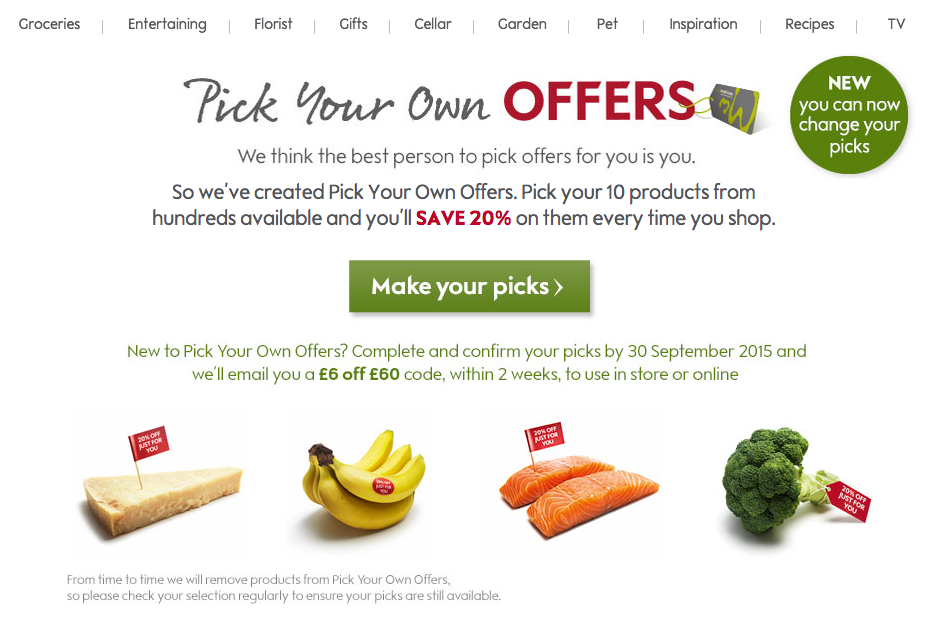
Waitrose, don’t make me think. The illusion of choice in the myWaitrose offers programme.

We have to begin by making the assumption that Waitrose made the decision to ‘force’ their loyal customers to choose their own offers on the basis that it would engender those customers to the brand and this would benefit the business. That is to say that someone at Waitrose ran the numbers and built a business case that said “This will be good for our business”. Now, there’s also a complication (that I freely admit I don’t fully understand) that getting more people to convert on these offers presumably means they lose margin on the specific sale but there is a general uplift on the basket of goods. One estimate put the cost of the scheme at a potential £5m to Waitrose.

From The Guardian, this is how it works:

To use the scheme shoppers must have a myWaitrose card. They can then create an online account, log in, and view the full list of almost 1,000 products from which to select the 10 items they want. They will then get 20% off the cost of these goods, however many times they buy them.

Discounts last for a fixed period, […]. After that shoppers get the chance to choose from a new list. The discount is applied automatically at the checkout, and is on top of other promotions. For example, chickens are currently £10 for three, with the 20% off on top of this.

I’m not a retail analyst. I am merely musing on a set of behavioural biases. A lot of the articles about the scheme are rich with chat about whether it’s a good deal or not for the customer. These article presuppose that the customer has done the work and selected the most pertinent 10 offers for them.

And that, dear reader, is quite the presupposition. More on that in a minute.

Talking of suppositions, Waitrose themselves make one by assuming that customer choice in this sphere is a good thing. Now, they may have done research that told them ‘customers want to choose their offers’. We know, however, that customers – human beings – are not that good at making unbiased decisions. That’s what behavioural theory tells us. Unless the research was rigorously executed with absolutely no bias then I have little faith in the leap Mark Price makes in this BBC News article from June:

The boss of Waitrose, Mark Price, says it’s a ground-breaking move giving customers the power to choose the offers they want.

“Different forms of personalised marketing have been around since the 1990s, but we’re introducing mass customisation in grocery. Customers can choose what’s valuable to them when they shop for groceries. We really are giving power to the consumer,” he said.

Ground-breaking it might be. Doesn’t make it right though.

A host of paradox of choice experiments have been run which demonstrate we are confounded by choice; too much choice, particularly where there is considerable cognitive effort involved in the eventual decision, makes that choice harder to make. We know that increasing choice (often) results in:

  • Regret that we made an incorrect choice. We have no-one but ourselves to blame.
  • Loss of presence; effectively question why we’re doing this task in the first place.
  • Elevated expectation, we’ve been given this choice, we have to make the most of it.
  • Peer pressure, other people would make better choices.

With the possible exception of the last item, the myWaitrose scheme falls, in my opinion, into this trap. The illusion of control and freedom it presents, coupled with the possible cost savings is insufficient motivation for me to get over the hump of the effort required to actually do it. As a customer and myWaitrose member, I must have received 20+ emails and direct mails encouraging me to take up my offers, I have never done this beyond a cursory look online. The reason is plain and simple: I cannot be bothered. Even before I’d seen the summaries in the aforementioned articles that showed around a 10% saving on a basket of goods (vs. Tesco) and that the hyped 20% on offer isn’t really against staples but more high-value infrequent goods.

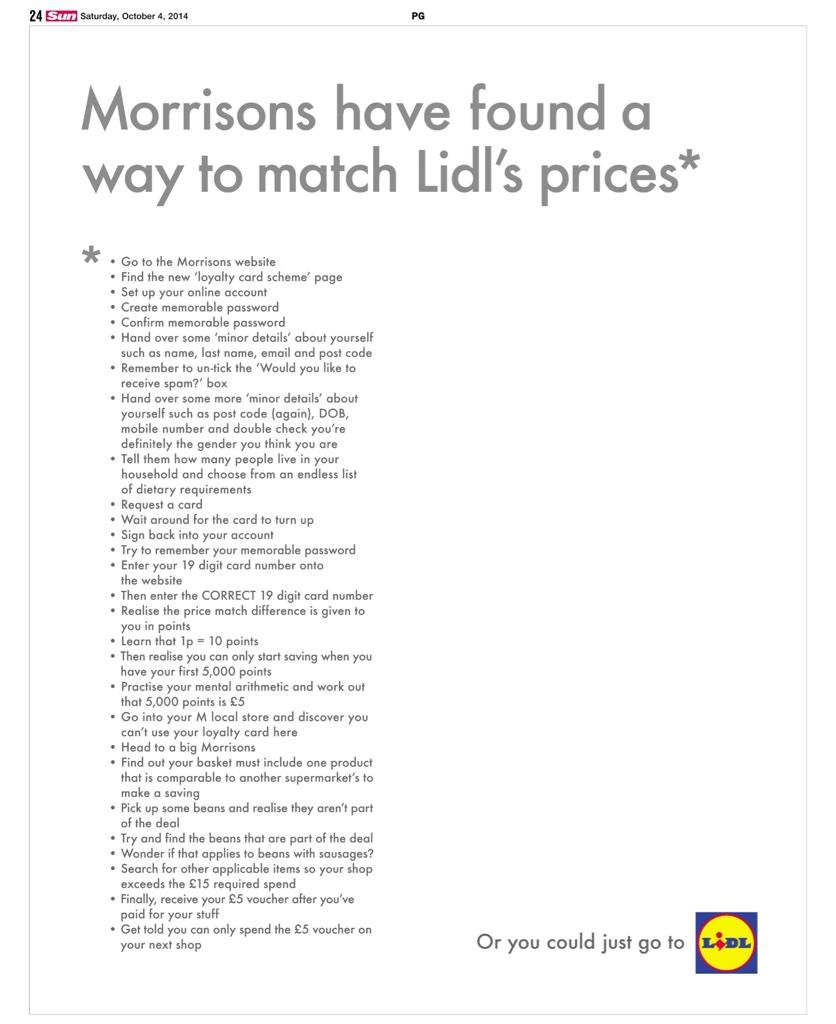
Stopping to think about the customer touchpoints and the interface here might help illustrate. It’s right out of the mantra of Don’t Make Me Think, perhaps that’s idealistic in this day and age, some things are inherently complicated, but saving money at a supermarket shouldn’t be difficult (as pointed out in this fantastic work by Lidl).

myWaitrose try and make things easier by pulling in the favourites from your recent in-store, online and Ocado shops, using these to guide you toward things you’re likely to want offers on. Aside from a couple of high-frequency items like baby wipes, I found myself getting stuck as the task of completing the 10 slots (actually a good, persuasive interaction pattern) became tricky. The value of these slots is such that you want to make the most of them, you don’t want to waste the 10 scarce slots with bad choices. So the decision gets harder.

You, the customer has to do some tricky things. Workout how best to ‘spend’ your ten offer slots. You’re effectively making 10 assessments on whether the offers are for items you’re likely to actually buy (wants vs. needs), taking a view on when you might buy them, and, of course, establishing whether the saving is considerable (accounting for multipacks, alternative places you might get them from etc.). The ‘when’ assessment here matters quite considerably; it’s not made particularly clear when these offers expire and the customer has to predict their own behaviour: “Am I likely to buy this in my next shop?”. They are highly unlikely to be making a prediction based on the likelihood to need an item in 2 month’s time, much of this will be based on the availability heuristic, meaning that they will be thinking about their most recent purchase of that item.

Waitrose offers

In short, it ain’t easy.

Time and data will tell Waitrose whether the process works for them. Whether the small % of their customers who have a loyalty card (and note, loyalty schemes tend to reward the already loyal, not magically create new loyalists) go through the process and buy more of the stuff they were already buying (one little-promoted benefit is that the offers are repeatable within the period so you can keep saving). My hunch is that the number of engaged and active myWaitrose offers is not the point. This is a brand exercise, encouraging people to think that Waitrose are all customer-focussed and that maybe having one of their free loyalty cards is a good thing. The important thing to Waitrose is knowing which customers spend on what products. I just wonder how long it will be before customers figure out the scheme just isn’t for them and that data mine ceases to be profitable.

EDIT: Update 08.FEB.2018 …. Waitrose close their PYO Offers scheme saying: “We’re always listening to our customers’ feedback on how we can make your shopping experience with us even better. Customers have increasingly told us they have difficulty remembering what their Pick Your Own choices were and how to update them, so we will be stopping ‘Pick Your Own Offers’ after 28 February. We will now be providing tailored vouchers and personalised offers through the post or at the checkout to make it easier for you to make savings on your favourite products.” It only took 3 years to come to that conclusion….

Tagged , ,

Carrots and Sticks Wielded at the RSA

In doing a little research for some behavioural change theory as part of my day-job I came across this wonderfully brief talk that Ian Ayres did at the RSA back in April. I’ve been toying with carrots and sticks (I think both approaches can be wonderfully split-tested online) in my own work particularly around financial services. However, Ian introduces the idea of the anti-incentive and it’s a bit of a head-scratcher that I’m going to spend some time exploring for my clients. I think it’s got some potential but it’s perilous in terms of setting oneself up for quite the outlay should it be implemented incorrectly. So, without further ado, take a moment:

> More on anti-incentives found by Liz Danzico

Tagged , , , ,

A very special persuasion brief

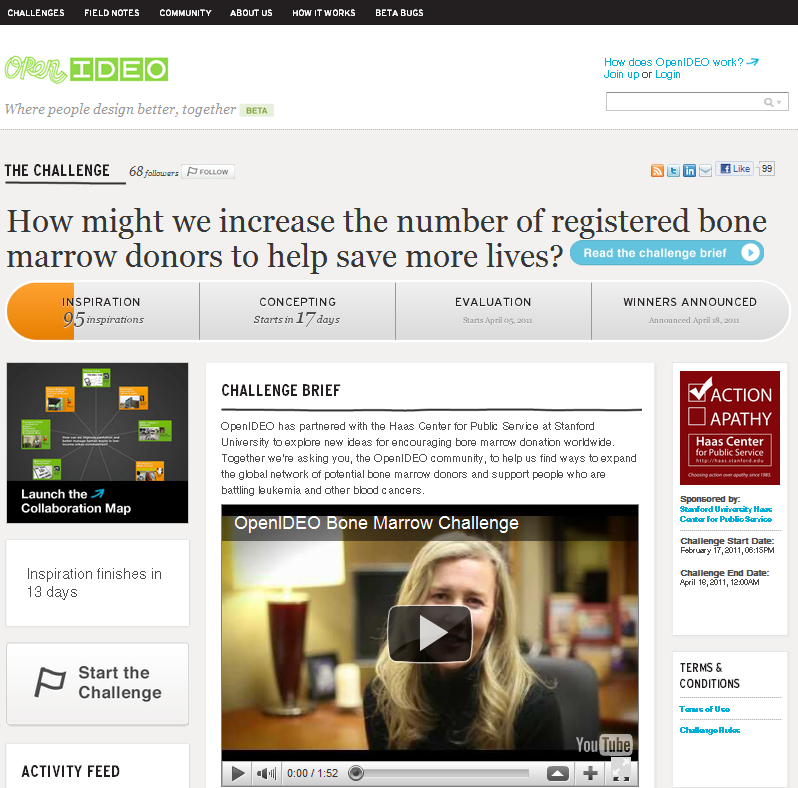
Screengrab of the OpenIDEO brief

As an advocate of the trendy field of behavioural economics & persuasive psychology, it’s rather humbling to read a brief that plays in this space but is a little more worthy than trying to get people to spend a little more. Open IDEO have posted their latest brief:

How might we increase the number of registered bone marrow donors to help save more lives?”

For all the right reasons anyone with a creative interest in the field of persuasion should take a look and start sketching. The basics are explained eloquently in this YouTube clip. For my part, this is the reason I haven’t joined the the register is pathetically:

1. I once heard/read that the donation process is incredibly painful
2. I one heard/read that the donation process leaves you immuno-supressed for some time.
3. The small number of registered donors means it’s much more likely your marrow will be called upon

But I know, without out ever having been in the position, that if I or close family needed marrow I would be out campaigning hard to get people to sign up and I would of course submit my own marrow.  It’s a big challenge, a worthy one and one where the answers elude me right now. I shall follow this with keen interest.

Tagged , , , , ,

Brands as Placebos


Placebo! by Akácio S. [ /photographyk ], on Flickr

There’s something quite lazy in blogging about a blog post that someone wrote about someone else’s blog post. But I think that it’s less lazy than having a blog and not blogging. And, in my meagre defence, I do have a proper post up my draft.

Besides, the post comes from Nick, a clever chap who I work with (more accurately underneath) at Dare. And it concerns that trendy Behavioural Economics stuff. The long and short of it is that placebos are hugely powerful things and if you take the idea of a placebo and apply it to a brand you can see the power of branding and experience bias on the apparent efficacy and tolerance of products and services. Take a look-see at Nick’s post (itself a reference of the original work by the Geary Institute)

Tagged , , ,

The Obsolescence Treadmill (feat. Nike Mayfly)

Nike Mayfly

Nike Mayfly by moleitau, on Flickr

Followers of my public streams will be aware that I am engaged on a 16-week training programme* to run the Virgin London Marathon on April 17th. This does rather mean that much of my waking moments are preoccupied with all things running. Occasionally my vocational and extra curricular interests collide, as is the case here with the Nike Bowerman Mayfly running shoe.

Alerted to its existence via Matt Jones’ concise post on the Berg blog, I started to think a little more about what this does to strengthen my opinion of Nike‘s marketing function as one that just gets the psychology of the runner.

It may be stating the obvious to some, but Nike aren’t just a manufacturer of sportswear. Their heritage shows a healthy track record (ahem) of producing products based on solid insight within the running community. In the case of the Mayfly this is insight that runners are want to wear their shoes for too long. The ramifications of this are not inconsiderable: worn-down shoes lead to poor form and consequentially impact-related injuries. In addition, enthusiastic amateur runners may well own multiple pairs of shoes aligned to particular conditions: trail, track and asphalt surfaces for example. Keeping track (again…) of the kilometres out through each pair of shoes is a challenge.

In the case of the Mayfly we have a £20 shoe with a tight limit on their effective usage; you get just 100km wear out of them. A planned obsolescence. The shoes have been designed with a tight engineering tolerance such that their performance is notably degraded once the user (runner) exceeds 100km. This fact isn’t hidden, it’s considered a selling point and the shoes themselves feature a manual odometer for you to clock up the km run on the side as an aide memoir and perhaps badge of intent to fellow runners.

So, what’s happening here, isn’t this just a trick to get us to buy more shoes more often? The cynic might suggest so, but let me suggest:

Scarcity: We are a little biased toward placing greater value on items that have a obvious limitation … the scarcity of the distance you can run in these shoes ensure you use them for only the right conditions (e.g. track running) and not perhaps as your daily runner – they’re your best pair.

Anxiety: Nike have form here – Nike+ on your headphones counts you up to the mid-point and then down to the end point of your run, increasing the performance anxiety. The same ticking clock is at work in these shoes, from the moment you put them on you’re running them into the ground. Of course this is nothing new – all shoes wear out – but these shoes makes it notably more explicit.

Reactance: When faced with a limit we’re rather prone to reacting against it (see anxiety above and consider the effect this has on performance). Does this limit actually challenge the runner to exceed it faster, sooner by covering the mileage at a greater pace or running more often? Mayfly runners might find themselves running harder and faster as consequence. There is little in life that is a simple and free as going running, by placing a limit on such a libertarian behaviour the reaction – if largely subconscious – could be profound.

I’ll concede that this might all be a case of me over-thinking a rather crude marketing strategy – planned obsolescence is nothing new after all – and that instead of positive reactance, consumers might actually react by seeing the limit as a weakness in Nike‘s durability and applicability to their sport. An analogous example might be the restrictions printer manufactures placed on their low usage and non-refillable ink cartridges. Indeed, one of the most significant issues that Nike will face is possibility that consumer watchdogs may deem the practise simply unethical. Perhaps in defence of this – and the inevitable environmental criticism – the shoes have been designed to be recycled by the responsible owner.

For the moment I am happy to continue with the upgrade treadmill of my (Asics) shoes on a 500km cycle which (at a current weekly effort of 30km+) should just see me through the 16 weeks.

John

* – Training programme via the wonderful Sam Murphy from her seminal work Marathon & Half Marathon: From Start to Finish

Tagged , ,