Author Archives: John Gibbard

smörgåsbord choice cuts (vi)

Today was a watershed. I visited Scandinavian Kitchen for fikka for the first time since Anna left us. It was lonely. I got asked if I spoke Norweigan, I don’t, but takk som spør. Here are the things I’ve been thinking and reading about recently:

Persuasive Design
Almost everyone in the advertising and marketing world reads PSFK so perhaps this isn’t new to anybody reading this blog but occasionally we all miss stuff. In Finland at less-busy intersections, a little proximity sensor detects the presence of pedestrians and alerts other road-users with a little light. It’s a great nudge to help with nighttime road safety.

Again, from PSFK, this little chart from Leo Burnett is worth a look as they attempt to represent behavioural archetypes in simplified form.

Human Computer Interaction
Saneel Radia writing on BBH Labs‘ blog dug up a great little piece from David Bryant at Google where tells a compelling tale about the rise of the Human Operating System. It’s an often over-looked element of the success of some of the most lauded devices and innovations in recent years, that by using humanised nuances that trigger limbic responses, the designers have made products that simply feel more human and instinctive. Thinking about what might be dismissed as interaction frivolity, behaviours like inertia, resistance, sliding, bumping, flying and so on are of profound importance.

Related to that thought, but worthy of more exploration at a later point, is a piece by Joshua Allen on “Transience” (UX Magazine) and another one by Suzanne Ginsburg (also at UX Magazine) on “The Evolution of Discoverability“.

Design Pattern
Jason over at Signal vs. Noise has piqued my interest with this charming transfer of inspiration. I’ll let him tell you the story of how a notice on a rest-stop booth on a recent journey challenged 37 Signals to re imagine the FAQ. As someone with a love-hate relationship with the FAQ (though mainly hate) it might just be a new pattern to appropriate from the marvellously fresh-feeling 37 Signals showcase.

Restaurant Websites
Mark Hurst found a nice piece on the Boston Globe site which popped-up in my Good Experience feed yesterday. I often cite menu-design as an example that choice architecture is nothing new and better-understood by restaurateurs the world over than many people paid to be in the persuasion industry. It concerns the fact the restaurant websites are often atrociously designed pieces of design-wank, portfolio pieces for one-man-band flash designers. (The BG article doesn’t use the term wank though, more’s the pity).

The Oatmeal gloriously lampoons the practise but please do read the post at Good Experience as Mark’s appropriately gutted (ahem) the Boston piece for us.

Crowd Mapping
It’s not a new thing to do but I was new to me. Anne Czernek drew my flighty attention to a Google-sponsored “ladies mapping party” in Kenya. Here 70 educated and not-so educated community members lent their hands to populating, correcting and otherwise improving the state of their local community’s map at Nairobi’s iHub last month.  It’s easy to think sometimes that with enough people and enough time that crowd-sourced knowledge like this just happens but occasionally you just need to get a lot of people in a room and give it a bit of a kick in the proverbials. These Kenyan ladies did just that.

Have a great weekend.

A very special persuasion brief

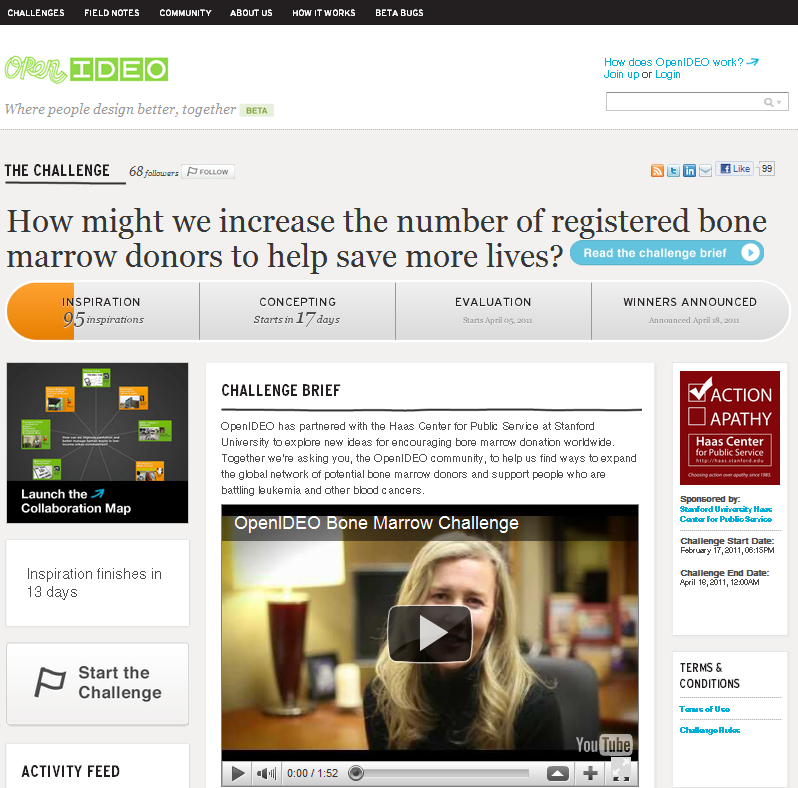
Screengrab of the OpenIDEO brief

As an advocate of the trendy field of behavioural economics & persuasive psychology, it’s rather humbling to read a brief that plays in this space but is a little more worthy than trying to get people to spend a little more. Open IDEO have posted their latest brief:

“How might we increase the number of registered bone marrow donors to help save more lives?”

For all the right reasons anyone with a creative interest in the field of persuasion should take a look and start sketching. The basics are explained eloquently in this YouTube clip. For my part, this is the reason I haven’t joined the the register is pathetically:

1. I once heard/read that the donation process is incredibly painful
2. I one heard/read that the donation process leaves you immuno-supressed for some time.
3. The small number of registered donors means it’s much more likely your marrow will be called upon

But I know, without out ever having been in the position, that if I or close family needed marrow I would be out campaigning hard to get people to sign up and I would of course submit my own marrow.  It’s a big challenge, a worthy one and one where the answers elude me right now. I shall follow this with keen interest.

Tagged , , , , ,

Apple Stores: Experience Design = Great. Reality = Aaagh!

Rory Cellan-Jones writes over at the BBC dot.Rory blog today about the emergence of the Microsoft facsimile of the Apple retail store experience. I contend that we shouldn’t fawn too much over the Cupertino firm’s success here.

I am an Apple fan, albeit one without the disposable cash to have actually bought one of their computers. I have bought several iPods and my iPhone at the Apple retail store. My local store is Kingston [photo: a typical Saturday] and I suspect this store is representative of their mall units in the UK. It’s wonderfully designed inside with clear experience design – the analysis of which is covered well here. The reality is that the store is incredibly popular and consequentially the experience takes a pounding. I’d love to spend time browsing the Apple TV interface and discovering if the paucity of content has improved to the point that I might buy one. But I can’t because on a Saturday I’m lucky if after 5 minutes of trying I have actually managed to get near it. There are lots of teenagers who have absolutely no intention of purchasing nor the money to do so but they’re in the store in their hundreds. They stand two-three deep around £1500 machines taking photos of their faces and warping them, updating their Facebook status’ “in the Apl str, LOL” and generally cooling my enthusiasm for the brand.

Of course I can see that these teenage browsers are prospects themselves in a few years’ time or – through their parents’ wallets – in the near future. I’m not really attempting to make an assessment of the financial success of the Apple store (for which a selection of financials need to be considered). What I am really trying to draw attention to is that we are often a little too quick to wax on about such experiences without actually thinking them through by actually experiencing it. This means ethnographic reporting following a field trip out to the store with a given sequence of tasks to perform/observe. A report under these conditions would surely reveal more about the service experience than the  blind hyperbole of jumping on that jolly popular bandwagon.

Tagged , , ,

Downshift to accelerate

I expected to have lower-limb problems in my training with chronic patellar tendonitis, what i didn’t expect is that an acute ankle overuse injury would take me out for over a week, nor did i expect the psychological impact of a forced lay-off.

It’s been a bad week for my marathon effort. After a good two-hour slog on Sunday afternoon (13 February) I started to feel some pain on the outside of left ankle. By the following morning, walking was difficult and certainly my pain grade was in the 3-5 range. Clearly my 30′ easy run that evening would have to be canned. It turned out that the Tuesday intervals were canned too, the Wednesday rest was inevitable and then on Thursday, with no significant improvement in the walking phase, an attempted threshold session was abandoned after 3′ at just 10kph.

Fortunately I have access to Liam Grimley, and after some intensive manipulation and massage by Saturday morning I have finally started to feel improvement. I’m popping NSAIDs like Smarties, icing whenever convenient and, importantly, resting. But it is a mental challenge. I am desperate to get out on my feet again and I can see empty entries in my running log and the days ticking away. I know my CV won’t drop off a cliff and I’m checking my resting HR to ensure I’m not stepping backwards but there are always CV options at the gym and perhaps now would be a great opportunity to work at those core stabilising muscles.

What I have missed most this week is the structure. I have genuinely been at a bit of a loss with what to do with myself. In the last two months my saturdays have been configured around fueling up for the long run on sunday and getting a 30′ run in. Sunday has been a logisitcal challenge of domestic chores and the run-recovery cycle of increasingly long outings – made all the more difficult by the longest bathroom refurbishment project ever. I have tried to avoid buying Runners World and only briefly listened to an episode of Marathon Talk; not knowing if my injury is likely to entirely scupper London it’s a thought I just need t0 bury whilst I focus on rehab.

My personal feeling is that it is some sort of inflammation of the calcaneofibular ligament, a ligament on the lateral side of the ankle and that this is the consequence of the hypermobility in my ankle being tested in a long off-camber/trail run on the sunday. But frankly, I’ll let Liam decide and treat it.

So, with progress again today in term of pain decreasing, I’ll see how htings progress and hopefully be back on my feet with a good few weeks to go before London.

Brands as Placebos


Placebo! by Akácio S. [ /photographyk ], on Flickr

There’s something quite lazy in blogging about a blog post that someone wrote about someone else’s blog post. But I think that it’s less lazy than having a blog and not blogging. And, in my meagre defence, I do have a proper post up my draft.

Besides, the post comes from Nick, a clever chap who I work with (more accurately underneath) at Dare. And it concerns that trendy Behavioural Economics stuff. The long and short of it is that placebos are hugely powerful things and if you take the idea of a placebo and apply it to a brand you can see the power of branding and experience bias on the apparent efficacy and tolerance of products and services. Take a look-see at Nick’s post (itself a reference of the original work by the Geary Institute)

Tagged , , ,

The Obsolescence Treadmill (feat. Nike Mayfly)

Nike Mayfly

Nike Mayfly by moleitau, on Flickr

Followers of my public streams will be aware that I am engaged on a 16-week training programme* to run the Virgin London Marathon on April 17th. This does rather mean that much of my waking moments are preoccupied with all things running. Occasionally my vocational and extra curricular interests collide, as is the case here with the Nike Bowerman Mayfly running shoe.

Alerted to its existence via Matt Jones’ concise post on the Berg blog, I started to think a little more about what this does to strengthen my opinion of Nike‘s marketing function as one that just gets the psychology of the runner.

It may be stating the obvious to some, but Nike aren’t just a manufacturer of sportswear. Their heritage shows a healthy track record (ahem) of producing products based on solid insight within the running community. In the case of the Mayfly this is insight that runners are want to wear their shoes for too long. The ramifications of this are not inconsiderable: worn-down shoes lead to poor form and consequentially impact-related injuries. In addition, enthusiastic amateur runners may well own multiple pairs of shoes aligned to particular conditions: trail, track and asphalt surfaces for example. Keeping track (again…) of the kilometres out through each pair of shoes is a challenge.

In the case of the Mayfly we have a £20 shoe with a tight limit on their effective usage; you get just 100km wear out of them. A planned obsolescence. The shoes have been designed with a tight engineering tolerance such that their performance is notably degraded once the user (runner) exceeds 100km. This fact isn’t hidden, it’s considered a selling point and the shoes themselves feature a manual odometer for you to clock up the km run on the side as an aide memoir and perhaps badge of intent to fellow runners.

So, what’s happening here, isn’t this just a trick to get us to buy more shoes more often? The cynic might suggest so, but let me suggest:

Scarcity: We are a little biased toward placing greater value on items that have a obvious limitation … the scarcity of the distance you can run in these shoes ensure you use them for only the right conditions (e.g. track running) and not perhaps as your daily runner – they’re your best pair.

Anxiety: Nike have form here – Nike+ on your headphones counts you up to the mid-point and then down to the end point of your run, increasing the performance anxiety. The same ticking clock is at work in these shoes, from the moment you put them on you’re running them into the ground. Of course this is nothing new – all shoes wear out – but these shoes makes it notably more explicit.

Reactance: When faced with a limit we’re rather prone to reacting against it (see anxiety above and consider the effect this has on performance). Does this limit actually challenge the runner to exceed it faster, sooner by covering the mileage at a greater pace or running more often? Mayfly runners might find themselves running harder and faster as consequence. There is little in life that is a simple and free as going running, by placing a limit on such a libertarian behaviour the reaction – if largely subconscious – could be profound.

I’ll concede that this might all be a case of me over-thinking a rather crude marketing strategy – planned obsolescence is nothing new after all – and that instead of positive reactance, consumers might actually react by seeing the limit as a weakness in Nike‘s durability and applicability to their sport. An analogous example might be the restrictions printer manufactures placed on their low usage and non-refillable ink cartridges. Indeed, one of the most significant issues that Nike will face is possibility that consumer watchdogs may deem the practise simply unethical. Perhaps in defence of this – and the inevitable environmental criticism – the shoes have been designed to be recycled by the responsible owner.

For the moment I am happy to continue with the upgrade treadmill of my (Asics) shoes on a 500km cycle which (at a current weekly effort of 30km+) should just see me through the 16 weeks.

John

* – Training programme via the wonderful Sam Murphy from her seminal work Marathon & Half Marathon: From Start to Finish

Tagged , ,

Olympic Arena: Experience Architecture

Not all my good links, insights and thoughts are lifted off the Twittersphere. Despite having my eyes on over 1000 people now, this little gem came from my brother. He’s had his nose in a few forums, tracking the progress of our developing city – notably the skyscrapers and Olympic village – and he drew my attention to this work in the East End.

The handball arena is finished…. tumbleweed….

Which is kinda my point. It’s a beautiful wee building, clad in copper and with top-spec light-wells in the ceiling but it’s for a sport that has a pretty fringe interest at least in the UK (in spite of efforts) and it’s global popularity is a moot point. Perhaps because of this, the inclusion in the 2012 games in London means that the organisers might fear a repeat of the empty seats we saw in Beijing and have uncovered an innovative solution which also adds a legacy benefit for a stadium unlikely to get capacity crowds easily.

Coloured seats. It’s already used at the Estádio Municipal de Aveiro, Portugal and now it’s in the  Handball Arena, the idea being that – even when partly occupied – the stadium looks more full as glaring solid blocks of coloured seating are not visible. The consequence is that the stadium for players and fans feels more atmospheric in low-crowd situations. It’s just simply good experience design that makes use of our visual attention biases.

As a footnote, the arena will also be used for modern pentathlon events.

> Mark Small’s blog article on 2012 Entrepreneurial designs…
> The 2012 update: Handball arena nears completion

Tagged , , ,

smörgåsbord choice cuts (v)

So, it’s been a while, no excueses, let’s just get on with it shall we?

Leadership
As a leader in the UX industry, i’m a sucker for some comment on what it takes to be a leader in the UX industry (Kim Goodwin, via Jeroen van Geel)

Advertising
Whilst certain luminaries in the business have a beef about advertising agencies doing digital work, at least we are an industry that can lampoon ourselves quite effectively: Things Real People Don’t Say About Advertising .

– For the record, I’m really glad I didn’t knee jerk respond to Peter’s terribly misinformed piece at the time and that time has given him and others a bit more perspective on the issues he raised.

Memory
Several of us at Dare are thinking a lot about memory (in part thanks to this) and its relevance to experience design. Although this piece only briefly covers memory, it might interest you to reconsider some of the psychology at work in what we do.

Driving
An extraordinarily detailed and comprehensive driving education is being offered (presumably at some considerable cost) by AMG Mercedes. The winter driving at Arjeplog, Sweden looks a particular highlight.

Behavioural Design/Information Visualisation
Some attractive work by the ever-talented Stephanie Posavec and David McCandless to reimagine, in a patient-centred approach the presentation of medical data – particularly cardiology data. I would dearly love to get my mitts on the opportunity to rework a patient information site with these two.

Reading
This week the clever James Hamilton wrote a blog post about his (i’m assuming) current passion Surprise & Serendipity. My interest in this field is heavily tied into a confidential piece of work so I can’t say too much but intend to blog a little on this in the near future, not least to follow up on some tweets I traded with @gilescolborne last year. Anyway, James’ post was concerned with designing for form not function and I commented in relation to myFry. Another literary-style piece of content I saw recently that worked best as an app (rather than companion book) was the Malcolm Tucker app. Albeit it turned out to be somewhat annoying (though read the interview with the development team). The approach was sound mind you.

Might do a few more when I get a moment.

Nike’s social fitness enhancements suffer from an Achilles heel


A view of the Nike+ profile homepage for smorgasbord

Nike's attempt at social fitness has an Achilles heel

For the poor, unfortunate souls that follow my musings on Twitter and Facebook it will be rather apparent that I am training to run a marathon this year. Each time I return from one of my sessions I synchronise my iPod with Nike+ and the data from that effort is shared across my social networks. It’s probably a little annoying for people as it is issued as a mindless broadcast but it is important to me to share it with certain people within my friendship group – there is proof that sharing accomplishments like this with your peers makes it significantly more likely that you maintain the motivation to continue. It’s a topic for another post maybe, but it would be nice to exclude certain people from seeing the postings without relying on them to block it. In any event, I think sharing my marathon training is a lot more meaningful and socially acceptable than telling someone that I’ve just bought some chickens on Farmville or that I’ve checked into my local Subway. [NB. I do not use Farmville or 4square].

My beef isn’t so much with this posting behaviour but rather Nike’s desire to incrementally enhance their Nike+ offering without fixing the core functionality on which it relies. To take a step back, let’s look briefly at the tracking and personal data movement. I wrote some time ago (post now deleted sadly) about the rise of personal data logging and how it was peverse, though not unwelcome, that we were seeking data on the most basic elements of our daily lives. Running is a simple endeavour, yet we are now surrounded with an array of methods to track our activity; just as a quick snapshot:

Garmin
Garmin’s Forerunner and similar personal GPS devices track your runs and display the core data in a personal profile page that can easily be shared.

Runkeeper, Mapmyrun, Endomondo
Similar to the Garmin implementation – these are often smartphone apps that use GPS to track your runs. Some integrate with Polar or ANT heart rate monitor straps to overlay cardiovascular data (so, ‘effort’) on the route and pace (‘output’).  These seem to be the most popular in my social media stream at least, if I go to the Runkeeper site it even tells me directly which of my friends are using it.

Nike+, Adidas miCoach
Both sportswear giants have their own systems – Nike were first with their iPod-integrated solution and as Adidas have moved on, their focus has been on realtime coaching as opposed to ex post facto analysis. But, as we will see, Nike+ is not a simple universe…

Others
Of course there are loads more – Timex, Samsung … almost every smartphone and sports timer company have something and there are a bunch of opensource implementations too.

So, to return to Nike+ (since it is the system I use), let’s understand a little more about the offering.

Nike+ and iPod: At it’s most basic, your iPod forms the user-interface to a system that uses a shoe-based sensor to track your stride length and establish a distance run, with all the additional statistics around pace and time. This implementation varies on the age of the iPod and the additional equipment (e.g. heart rate strap). Synchronising your iPod after the run uploads the data to the Nike+ site.

Nike+ and iPhone: There are two implementations here, a native application that does little more than the iPod version above, and then the Nike+ GPS app – a free download which uses GPS tracking to trace your runs and – because it’s connected to the web – additionally allows friends to cheer you on via Facebook comments.

Nike+ GPS sportswatch: The latest development showed-off at CES this winter, a wristwatch powered by TomTom to rival the Garmin offering, taking the basic GPS functionality of the iPhone app and simplifying this to a watch interface at the same time as integrating with heart rate data.

The fact is, this product offering is now more than a little confusing. As an iPhone user I am able to track my run using any of the free apps from Runkeeper, mapmyrun Nike+, Adidas and so on. As an iPod user I may also use my Nike+ shoe sensor. So, I sort of need a reason to use one service over any other. The decision needs to be made based on a few things: Which device gives me the best data? Which device is least hassle (bulk, user-interface) and, crucially, Which device/service are my peers using?

Before the smartphone app trend it was a given that most people were using Nike+ or, possibly, Garmin. Nevertheless it was still tricky to find friends using the service and then compare your efforts. With the wider marketplace it’s even harder as people sign-up for a service, use it and move on. To try and differentiate their service and encourage participation, Nike + continue to innovate. Recently they launched Nike+ Tag – the premise is simple, runners have to avoid being “it” by beating their friends to longer runs, faster speeds or getting up and running earlier in the day.

The trouble with this – and the many other connected challenges on Nike+ – is that they are predicated on having a (wide) circle of friends using the system. In the case of tag, your friends also need to have the particular app and, as we have seen, many may simply have one of the other Nike+ devices. Unfortunately (and after several lengthy paragraphs we are finally at the point of the post) the system for finding friends is fatally flawed. Nike seem to have a long-standing problem with the friend search function within Nike+ on Gmail. Unlike numerous other sites, you cannot import other social network friends only search for signed-up friends via Gmail (which doesn’t work) or by using the native search (which won’t discover your friends if they’re profiles are set to private – which is the default). The end result is that despite having 700-odd people in my Twitter contacts, a hundred or so in Gmail and 300+ in Facebook, without being able to scan for them I have found a grand total of about 6 on Nike+ and most of those are infrequent, lapsed runners. Tag, despite being exciting and well-considered, is all but useless to me (I’m not the only one).

It makes no sense to me that you would build a service that relies on the motivation and challenges of friends and then have such a limited social connection engine. I am quite sure this isn’t the intent but the lack of attention to fixing the technical problems with it jars somewhat with the attention to rolling out new features that rely upon friendship. It all smacks of the same criticisms that continue to face Apple’s Ping:

“Without importing existing networks from Twitter or Facebook (inviting friends through Apple Mail is not enough), there’s a significant investment of time needed to set Ping up. Now social networking is more mature, there’s less appetite for putting in that groundwork – and why should we have to when our networks already exist?” – Jemima Kiss on Ping (Guardian2 ix 2010)

It is peculiar that at least the connection to post my output works largely flawlessly, runs are posted automatically to twitter and Facebook with a near 100% success rate. It’s a touch disappointing then that the simplicity of the service that  first attracted me has been replaced with a complexity in offering designed to retain me (via unsolicited feature-creep) is so hamstrung by fundamental technical flaws that I crave a more simple, socially-integrated solution that increasingly looks likely to exist amongst Nike’s competitors instead.


For the record, my Nike+ profile is smorgasbord, please drop by and be my mate.
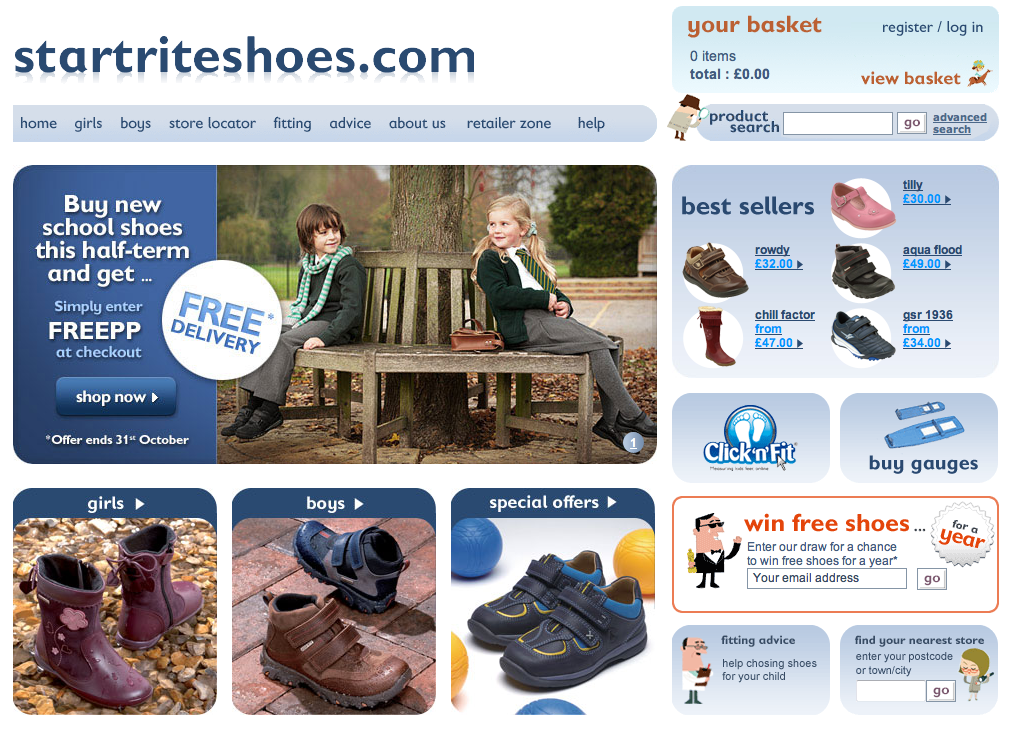
Start-Rite shoes produce a feet of digital integration

Start-Rite shoes homepage screen grabWe’re always on the look out for ideas that cross the digital and physical boundary. This week a Dare client told us about his great experience with Startriteshoes.com. He’s a bit older than their target audience, but his kids aren’t, and he has been impressed by their quality and fit. That said, to get hold of the product, parents will undoubtebly know the discomfort of dragging their children out at the weekend to try shoes, only a trip dentist can match the inevitable lack of enthusiasm.

Ideally this process would happen online;  largely quiet, no crowds, calm. If only you could be sure of getting the right fit. For adults, buying shoes online is easy but the frequency with which kids’ sizes change makes getting the right fit a little harder.

Our client was delighted to discover that Startriteshoes.com featured an tool (Click’n’Fit) that made the most of the ubiquity of digital cameras to allow a shoe fitting to take place online at home and consequently the purchase can take place without having to suffer the tantrums, smelly socks and sulky staff of the high-street shoe shop.

How Start-rite sole-ved the problem of buying online

1. You photograph your child’s feet positioned on a special grid (which you print off) in three orientations.

2. Upload these photos

3. the site responds with accurate sizing based on an analysis of the feet in relation to the grid.

I have seen plenty of examples of the web solving the friction of offline experiences (grocery shopping deliveries) and even the embarrasment factor (men buying lingerie). Start-Rite is a great example of using a digital environment to bring some theatre to the experience. Kids can get involved in printing and photographing each other’s feet and the interactions and relationships take place in the intimacy and comfort of home. Later, when it is time for more shoes, one could conceive of the children asking to “do the photograph thing”.

The success of Kodak was in taking a previously laborious film and developing interaction and turning it into simple cartridge roll film – “you press the button and we do the rest“. iTunes did a similar thing a hundred years later for music; it might not bequite so revolutionary but digital photo-sizing for children’s shoes means Startrite have left miserable shoe shopping on its last legs and at they continue to make kid’s feet more comfortable. Double rainbow.