Author Archives: John Gibbard

Carrots and Sticks Wielded at the RSA

In doing a little research for some behavioural change theory as part of my day-job I came across this wonderfully brief talk that Ian Ayres did at the RSA back in April. I’ve been toying with carrots and sticks (I think both approaches can be wonderfully split-tested online) in my own work particularly around financial services. However, Ian introduces the idea of the anti-incentive and it’s a bit of a head-scratcher that I’m going to spend some time exploring for my clients. I think it’s got some potential but it’s perilous in terms of setting oneself up for quite the outlay should it be implemented incorrectly. So, without further ado, take a moment:

> More on anti-incentives found by Liz Danzico

Tagged , , , ,

Press Here to Play

 For some reason this new bit of work from my colleagues here at Dare has me clicking the video ‘play’ call-to-action a lot. Still not got to the bottom of whether it was intentional or not…

Wood Preservation Society: Participation Marketing At Its Worst

It’s been a great and sunny weekend in this Sceptered Isle. Britain has come out (well, at least in this rather Royalist corner of Surrey) in red, white and blue.  There’s a frisson of wedding buzz and I even saw several amorous middle-aged couples dry-humping in the evening sun on the grassy banks of the Thames as I enjoyed my first post-marathon run last night. A weekend of BBQs, Zinfandel Rose and wall-to-wall sunshine will do that to our repressed Northern Hemisphere blood.

Imagine how sad it was therefore to find it all come crashing down last night during the ad-break to the Suspicions of Mr. Whicher on ITV.  To the unmistakably British melody of ‘The Self Preservation Society’ tune written for the Italian Job, the British TV view was subjected to the latest ‘wood preservation society’ advert for either Cuprinol/Ronseal (so clear I couldn’t remember which one it was), it encouraged people to sign-up to their (turns out it’s Cuprinol) Facebook page and to presumably tell lots of stories about painting and preserving external wood.

This is Britain at its worst. A mind-bogglingly stupid consequence of a creative idea that spun out of that song from The Italian Job. The incentive (there HAS to be an incentive because clearly nobody in their right mind cares that much about external wood preservation) is to win a shed or something. But of course you do benefit it other ways: ergo … tips … (there’s always a market for tips isn’t there? “Try using a brush!” “Consider sealing your wood when it isn’t raining!”) and inspiration (“Why not use green, instead of brown, or brown instead of green if you prefer!”) and the worryingly vague ‘other updates’ can also be found lurking behind this terrible stock shot of yummy mummy in pink gloves watering her pansies. Presumably they have people hanging on the line for the latest in ICI’s wood-preservation solvent technology.

I hate Facebook participation campaigns so very much now.

EDIT: I have since discovered this ‘idea’ has been around since 2009, and as this post explains even more acerbically, it was pretty lame first time around…

Tagged , , , , ,

Marathon: What went wrong?

I have waited almost a week to write this post. I’ve composed at least some of it many times over and started composing it close to midnight last Sunday, 17th April. So, what went wrong on Marathon day?

Firstly it’s important to state that for many people 3:57:32 is a perfectly reasonable – even impressive – time to complete a marathon in. Friends, family and colleagues have assured me that ‘sub 4 hours’ seems pretty good. Only it wasn’t. I don’t see myself as an average amateur, I didn’t at any point through my training. I knew this was training that saw me run a personal best (PB) of 1hr 42″ for the half marathon just 12 weeks after starting the programme on Boxing Day, December 26th 2010. Plugging that time into the McMillan running calculator had given me a predicted 26.2 time of 3:35:28. From that, an A-goal target of 3:40:00 was set (with a B goal at 3:45:00) and subsequent training runs were tweaked to aim for a 5’11″/km (08’24″/mile) marathon pace. I wasn’t going to shoot for the 3:35, I was playing it safe for an achievable goal.

What happened?
A familiar tale to those of you who have spoken to me this week but by mile 1 I was 2 minutes outside A-goal pace and hugely frustrated by the congestion. I was tense and feeling it more than I usually do, right the way through to at least 1 hour – concentrating on not weaving too much or getting slowed down. By 13 it was hurting and I was at 1:53:22 – about 9 minutes down. Descending to Docklands I was feeling miserable, experiencing unfamiliarly heavy legs and ‘knowing’ I was too slow; at 17 miles I pulled up and gave in to the central governor and walked for two minutes, stretching off and then running a clean mile or so before pulling up again. At that point the pattern was set. The next ten miles I think I walked about 5-6 times (the Runkeeper data is unclear) for various spells, all under 2-minutes. By which time the damage was done.

On the day I did too many things differently
Music: In almost all of my training runs I have run with music or a podcast. On marathon day I’d heard and read that the atmosphere is such a huge part of the event that it would be almost churlish to run with headphones in. So I didn’t. I didn’t take strength from the crowds so much as I missed the monotonous pounding of generic dance music that helped me throughout my usual training runs to dissociate from what my body was saying.

Fuel: It was a hot day (more on that later) and despite knowing the course was peppered with Lucozade and water, I wanted to stick to what I’d trained with (sensible) so I ran with 500ml of Lucozade Lite and aimed to drink most of it by 13 and all of it by 20, relying on water and regular on-course drinks for the final 6. As it happens I just didn’t drink regularly enough in the first half of the race and by 10 I had most of my drink left, by 13 probably over half remained. Coupled to this, I added a little flexibility in my gel strategy too, taking the first gel around 70 minutes and then not really knowing what to do about the remaining gels, roughly taking them between 25 and 40 minutes apart. On my long runs I had been disciplined at taking them every 30 minutes from the 70 minute mark. Perhaps this lack of hydration and possible bonking (depeletion of glycogen stores and reliance on fat burning) was making my legs feel so damned heavy?

Walking: I never walked in my training runs. Even on runs that averaged faster than I ran on marathon day and on runs that exceeded 20 miles. Once I’d given-in it was psychologically impossible not to fall into the pattern of walk-run. It might be fine by Jeff Galloway but it’s not fine by me, I signed-up to run 26.2, not walk it. Perhaps it allowed me to finish at all, I’ll never know.

Panic: The start was not good. My position in pen 6 (of 9) was because I’d underestimated my finish time when I applied two years ago. It meant I was running with people that were not sub 4 runners and it meant that ahead of me were a group of runners all linked together for charity. Within 600m of the start line we were standing still as people peeled-off to pee. When mile 1 ticked by I was already stressed about an even paced run and that tension remained through the congested period of the first few miles. Tragically, my data shows my first 5km I cleared in 28″ and the 10km in 54″, I was slow but not crawling like I felt. But that stress and weaving (as well as the odd stride to clear the pack) had taken its toll.

External factors
These are not excuses but more contributory factors. I’m convinced my own mistakes (above) were more important to the final time but those mistakes were made, in part, by the following factors:

Heat: The temperature rose steadily throughout the race to a maximum at 13:45; Wolfram Alpha shows it peaked at 19 C (66 F) but I believe I heard on the day that it went higher in central London. My two longest long-runs were run in the range 5 C – 13 C (40 F – 55 F). Tom Williams on Marathon Talk mentioned after the high temperatures the week before at the Brighton Marathon that it should only account for c. 6 minutes variation in time based on results in the hot 22 C (72 F) 2007 London Marathon. Clearly I wasn’t used to it and I reacted badly, it was then compounded by poor hydration early on. Something my attempts later in the race to take on water more regularly failed to correct.

Congestion & Crowds: I should have run an organised race in my training plan. I didn’t and I forgot what it’s like to run both behind and around fellow runners, and even from experience in other events, the race was particularly bad. The first miles out of Blackheath are heavily congested and do not always use the full width of the road. There are toilets at 600m from the start which creates a bottleneck; there were runners with slow predicted times and running in groups; there were no pacers in my pen and I had assumed I could rely on running with a pacer to keep me in check for the first half.

Nike+: I use the sensor (non GPS) version and the short strides in the first part of the race meant it wasn’t tracking my pace properly so it counted in the first mile way before I reached it. It was then innacurate for the remainder of the race, right the way through to the point it packed-up entirely on my iPod Nano (6 Gen) after just under 30km thanks to too much sweat and an erroneous ‘end workout’ action which was never given. In all of my training runs I’ve used this – well calibrated – to judge my pace. I had nothing giving me clear data on the day. This made me feel I was too slow. As it happens, my Runkeeper app was chugging away in my back pocket and recording that I was running some great splits: from 5km to 10km I was under 5:16/km and at peaked at 4:56/km (under 8 minute miles) at the 13km (8 mile) mark. In future I will not run a marathon without a GPS watch.

Final thoughts
So it wasn’t atrocious at all but it wasn’t at all what I wanted. It’s a day that I wanted to enjoy but I didn’t do it justice. I experienced some amazing moments that eclipse anything I’ve ever done in sport, turning on to Tower Bridge to face the crowds, crying weakly as I got my medal. The crowds are joyous but I’ll be honest and say that at times you just don’t care, your selfishly wrapped up in your own world – even without the headphones.

I know I’ve moaned a bit, even whinged at my performance but reading the wonderful Sir Jog A Lot post this week I feel a little better. A seasoned runner, a pacer for Runners World, also got caught out by a few of the same issues.

I’ll be back to apply on 26th April for the ballot and I’d consider a charity place if that doesn’t work out. I know I might not get my best runs at London unless the stars align, and might look outside the city events. But in the meantime I’m back into training with at least the Humanrace Kingston 16-miler in my schedule for the Autumn. And that 1:42 half marathon can do with a little trim too…


Tagged , , , , , , , , , ,

Marathon Lessons From The Past 16 Weeks

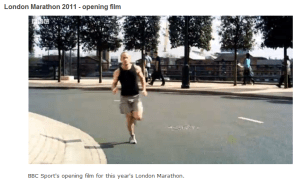
Opening Titles for the BBC Sport Coverage

I started my 16-week training journey on Boxing Day (26 December) and it culminates on race day on Sunday. Over that time I’ve run, read and eaten all I could to prepare myself for the day. I’ve done that whilst sporting a chronic tendonopathy in my knee, holding down a full-time job, commuting and coping with a bathroom renovation in a one-bathroom house. I’m not saying that this is amazing by any stretch – thousands run marathons each year and many do so with far more obstacles in their life – but frankly it is because my life is so ordinary, so middle-class, so typical that I thought I could share a few tips. It’s not arrogant to think that at some point friends and colleagues might attempt the same and might come to me for some help (as I did with others) so this is pre-emptive:

Start with a running base. I started a 16 week plan that already required the first Sunday run was about 30-40 minutes and even with slow progression in volume it built to an hour+ quite quickly. If you can’t yet run non-stop for 40 minutes or run for 30 minutes 3-4 times a week then that’s your first port of call before you start marathon training. So, if you’re doing London in 2012 then perhaps building your running base through November and December would be wise.

Budget-for and find a good sports rehab specialist. Plenty of places offer ‘physio’ and plenty offer ‘massage’. Look for a local person that understands your work obligations and – importantly – understands running. I’ve had 4 or so sessions of deep-tissue massage both preventative and curative at a cost of about £50 each time. Consider it a monthly cost for an otherwise stupidly cheap activity. Even if you don’t feel sore then have one anyway.

Listen to Marathon Talk. Honestly, as much as I read Sam’s book cover-to-cover, the weekly delivery of fresh news, genuine trials and tribulations of fellow runners and the sense of community that they build is inspiring. It reminds you on a run why you run. It’s a podcast but that doesn’t mean you need to own an iPod, see the Marathon Talk site for full details.

Run your long runs s..l..o..w..l..y, or at least easily. This was something I really struggled with. A siginificant reason for this was my obsession with logging each run on Nike+ & Runkeeper. By sharing the data on Facebook/Twitter it meant that I was reluctant to show slow times. This was stupid. Running 2-3 hours at close to marathon pace each week puts a lot of strain on your body for little gain. I got plenty of niggles in my calves, achilles and knees – so much so that I regularly missed my Monday runs in the middle parts of my training. Psychologically the feeling of extreme fatigue after those runs makes you fear them more too. If I’d treated them as easy sessions and run them at the 5’30″+ pace I should have done I’d have covered less miles on those sessions but more miles overall and progressively I would have seen more than the 400 metre improvement between my 11-week and 13-week 3hr runs. I ran my long runs alone or ahead of my wife but next time I would run with friends and talk along the way to keep the pace easy.

Sam’s training for beginners urges you to run to time in your long runs. That is, run for 3 hours rather than shoot for 21 miles. This was fine for me up until the final few weeks when I started to realise that three hours was not getting me (even at the faster pace) close to the 22 miles I really believe I should have covered on my longest of long runs. Her ‘experienced’ training programs do cover miles, I guess it’s fair to say that after 13 weeks I just didn’t feel like a beginner any more (and to some extent I never was).

—

It could be that post-event I find even more things that I’d like to talk about but I’m not going to promise an update, I’ll just leave this here nicely archived to link-to when someone asks me about it in future.

So, as the build-up continues, how about those of us running get all excited by the BBC’s wonderful opening title film to this year’s event.

Tagged , ,

Virgin London Marathon: Countdown

This week I’ll try and post a couple of things as I lead in to one of the biggest days of my life on Sunday. There are a large number of people blogging about their marathon this year (estimates put the figure at 20% of this year’s entrants) but these two stood out: Gemma Bardsley’s Beats Per Mile is a well-engineered assimilation of running data from RunKeeper, the music she will listen to and photos from points around the course taken at the time she may be passing. It’s no surprise the Gemma and her developers (Marc & Howard) are in the industry , the design is simple and sophisticated and bang on-trend with a single scroll approach. A great showcase for all concerned.

Secondly, I’m a fan of Foot4ward simply because it’s content-rich. Plenty of regular posts, diverse content (data, stories, cartography) and some charming photos. So many event-motivated bloggers set up a page and post infrequent, repetitive and impersonal material. Once you’ve read one mid-pack runners miserable grumbles about training you’ve read a lot so I’m always looking for something a little richer. Foot4ward is just about the only non elite runner’s blog I’ve added to my Google Reader this year.

There’s a good reason I didn’t do a new blog, I simply couldn’t design/code stuff like this, as much as I might sketch it out. I will, however, be revealing my progress live on Runkeeper during the race. More on that later.

I promise this is the last time I’ll mention it

Just a little note to readers new and old that we* won our first award for myFry last night at the Media Guardian Innovation awards. It was nominated in the Mobile App category alongside the well-known iHobo work (which won two other awards last night).

You’ll probably already have seen my thoughts on my time developing the app at Dare, and they still ring true today. Even though I still read the odd critical comment (and then assume it’s naive criticism) the truth is, as the awards recognised and Stephen himself states here – it fundamentally challenges the notion of linear reading for certain texts and it – more than many other alternative digital readers – understood the culture and physical environmental context in which this book would be read.

And that, said Pooh, is that.

—–

* – Dare, Stefanie Posavec & Penguin

The Waitrose Redesign: Perspective Required

This week eConsultancy’s report on the apparent usability calamity of the new Waitrose site has been widely shared: “New Waitrose website panned by users“. People queued up to take pot shots at this aspirational brand, criticising a range of issues from taxonomy, speed and the apparent non-disclosure of prices.

Several cried-out “why wasn’t this tested?” “didn’t listen to users” and so-on and so forth. Compounding the issue was the revelation that the design ‘cost £10 million’.

An unmitigated disaster eh? Well no, not in my opinion. Firstly I think that the £10m issue is swaying a lot of bad publicity. The general public, and this is not to patronise, simply do not understand the price of design (c.f. Olympics 2012 logo). I don’t understand the price of building a new bridge, or anti-retroviral drugs and I don’t presume to tell the people in those industries that the cost of such things is too much. For some reason, the great British public assume that design work is just a 17 year old with photoshop tinkering about. It completely misses the point that work like this involves high levels of expertise in visual design, logistics, accountancy, information systems, security, project management and so-on. It’s massive, it’s expensive stuff. You might re-design a local dentist’s website for £1000 but really this isn’t even vaguely comparable.

Secondly, it does actually work. To claim it’s “not fit for purpose … beyond fixing” is bonkers. Show me the evidence that no-one is shopping on the site, that the usage is down that average basket sizes are down etc. etc. I suspect you would find the opposite [EDIT 25.March: Orders are in-fact up by 34% on the previous site, according to The Guardian]. Yes, there are problems. Some of the nomenclature and taxonomy is a little unconventional. Sally pointed out that browsing freezer products was done by brand and not by type, that seems peculiarly specific. Most users would at least like a choice to filter by meal, by category (fish, poultry, ready-meal, dessert) and so on. Other glaring errors include the (now fixed) inability to identify sizes or quantities of items like milk and meat.

And then there’s the speed. The speed it’s rendering is not great. I’m no developer so can only speculate that it could be either an interface layer issue or one related to pulling items out of the eCommerce catalogue (the back-end). To the consumer this distinction is irrelevant, it just takes time and time-precious consumers get understandably narky. Fixing the speed is critical to the perception of performance.

It infuriates me to suggest that this wasn’t thought about or tested. In our industry with so much money at stake it is inconceivable to think it wasn’t tested in some way at several points throughout the process. It was designed in part by some very talented user-centred people and the fact that certain elements have been included (drop-down category breadcrumbs) suggest a user-experience designer’s hand. The key is whether the user-testing was sufficiently rigorous, sufficiently real-world and sufficiently analysed to feed back into the design process.

Interactions which are causing the most concern include long-lists – the heavy duty users at home doing > £100 shops with many items. In these scenarios they are likely to be juggling multiple threads of activity: searching for goods, ticking them off a paper list, popping to and from the kitchen, considering recipes and so on. Keeping as much of the action (‘add to basket’) transparent at the same time as the browse activity is a tricky ask. Often user-testing is done in a lab with a user isolated from the context in which they normally perform their activity. It’s not a real shop, it’s a simulated list and the observations you will make will subsequently be quite false.

Work like this is so dependant on context that it needs to be stress-tested in real-world situations. It means sample shoppers using a staging-version of the site or a high-fidelity prototype to do their normal shopping routine. It might have happened here, I speculate that it probably didn’t.

I rememeber Catriona Campbell of Foviance telling me once of some ethnography work done for Tesco where they observed online shoppers ordering in bulk from their value range. Actually observing the users in their homes showed that these were consolidated orders for their community where one person acted as a distributor from a single paid-for delivery. Insight like this rarely comes from a two-way mirror, eyetracking and a moderator.

Returning to the Waitrose site, i’d urge you not to get caught in the hype but to actually use the site. The majority of  problems cited on the forum seem to be resolvable coding/performance issues, not fundamental interface design issues. By which I mean buttons not working as intended, technical errors and so-on.  The remaining issues surround a nostalgia for old site features like the jotter. I’ve seen this sort of thing before when a quirky feature barely anyone used gets removed the one or two people who did use it take to the web to complain.

I’m not saying it’s brilliant, it clearly needs work but I just personally feel the need to call for some calm and reflection in light of the fact that passionately user-centred people would have been involved in this and working with the very best of intentions albeit perhaps without the backup to see it through to final development or the support of adequate contextual user-tests.

Tagged , , , , ,

Frustrating Lack of Consensus

You’d think that after decades of modern running and sports science that we’d have reached a few consensuses wouldn’t you?

Last week I went along to Runners Need in Holborn to hear from Sam Murphy (see previous post), Brad Jones and a chap from SiS and another from Brooks. During the two hour seminar I learned a few new things: don’t stretch after long runs – especially the marathon itself – it just worsens the microtears in your soft-tissues; tendon injuries show no inflammation in their pathology and that SiS gels are isotonic so you don’t need to sink a load of water with them at the same time.

I also picked up a free running magazine Running Free which I sort of guessed would be a bit cheap and cheerful and so wasn’t surprised when I discovered a rogue apostrophe in Fiona Bugler‘s editorial.  Reading it on the train I found another article by Andy Dubois where he dismissed static stretching. Which I think was the final straw for me. Why is there so little consensus on even the basics of running and training? Surely after decades of research, millions of miles run and hours exercising we’d at least have come to some irrefutable conclusions about biomechanics and physiology?

Stretching
Listening to the chaps on Marathon Talk (regular long-term runners) I’ve heard them assert that they never or rarely stretch. Last night Brad Jones told us never to stretch a sore tendon, other sites tell you to do just that to avoid the build up of scar tissue. Then there’s Mr. Dubois telling me not to hold a stretch whereas everything I’d heard before then said hold for 30 seconds. Oh, and if you’ve got a tight tendon you might be advised to stretch this out or you might be told that stretching is bad.

Injuries
My physio tells me to use ice and heat cycles to flush out toxins and encourage repair. Other sites tell you to never heat an injury that is probably inflammation. Brad Jones told us last night that there is no inflammation in tendon injuries so heat and ice are just pain management tools and not restorative/curative at all.

I realise everybody’s body responds differently but surely we’re not all that different. Is it just the consequence of limited amounts of research? So perhaps there are just a handful of decent studies on this stuff? When there are billions of pounds invested in sport around the world I simply can’t believe this to be true.

But all the time there is no consensus I find myself scouring the web looking for the elusive magic answers for the constant round of tendon and muscle soreness that has plagued the second half of my marathon build-up.

On Sunday I ran for 3 hours, somewhere between 32.5 and 33.5km [20.8 miles] (depending on my Nike+ data vs. Runkeeper’s data) and today (14 March) I am pretty sore. Once again I ran too fast and ran too many hills. Next weekend is a half marathon speed session but I failed to get into an organised race so will have to trace out a measured and flat course. This will give me my final benchmark time for London by running it through the McMillan calculator.

And so, to cheer us all up, have a look at some poor lads who’ve been requisitioned to model their girlfriends’ creations on Etsy: Sad Etsy Boyfriends.

Experience Planning

I decided to have a bit of a break from Twitter (and Facebook) and to revert to the long-copy pleasures of full-fat blogs. To this end I have downloaded Reeder for my iPhone, fired-up my Instapaper archives and am eschewing the free papers on the commute home with the intention to read more about the things I used to read about.

A corollary to this will hopefully be a refreshed attention to my own blog and to the joy of writing again. Though I’ve read too many blogs in the past that have a post that reads: “Am blogging again, hope to blog more, watch this space!” … and that’s the last or penultimate dusty entry. So, no promises, none at all.

Before I dismiss the microblog for the aforementioned hiatus I did just want to highlight a link I found via Anne Czerniak’s stream: David Friedman’s Twitter Thesaurus. The function of David’s thesaurus is to provide alternative, succinct variants of the words you would write if you didn’t have a 140 character limit. It seems like just the sort of thing that verbose writers like myself would like to see added as a contextual add-in to desktop and mobile twitter clients, a bit like bit.ly does for url shortening.

Experience Planning (aka. Experience Design)
My ‘new’ job title is Experience Lead. This is in part due to Dare‘s merger with MCBD and the fact that not only do I now have sight of digital work, I have an occasional role to play in designing and consulting in offline experiences and service design. Whilst we have an adorable presentation deck that covers-off what Experience Planning is (in the context of Dare), much like my This is IA tumblr, I find it helpful to describe what we do with examples of what it is to design experiences (and not just websites).

Virgin Atlantic
Ever noticed that the lighting spectrum on airplanes leaves you looking rather palid, almost green and nauseous? The chaps at Virgin America have and consequentially installed a scheme with a varying light spectrum that reflects the prevailing destination timezone and external light conditions – even the mood of the passengers at key ‘touchpoints’ in the journey, viz :  “[the lighting is] in a ‘theatrical mood’ prior to departure. When you walk down the jet bridge, you see the purple glow of the mood lighting, and it hopefully excites you…” “…people have an emotional and physiological response to lighting. So we decided to shift the colour of our cabin lights during the course of flight. They’re associated with time of day outside or ambient light outside. If you’re flying by day and heading in to dusk, it will reflect the light level outside. It’s less jarring” – Adam Wells, Virgin America [Source: Budget Travel “Travel Innovators“]

Disney
As experiences go, Disney have mastered many at their attractions around the world but queueing provides a constant target for designers with a remit to increase enjoyment at any cost. Innovations here are increasingly rare but often involve psychology (see David Maister’s article from many years ago). In this article from the New York Times late last year, Brooks Barnes details some of the cute operational armoury the experts at Disney can deploy:

  • A nerve centre with wait-time monitoring in real-time.
  • The ability to ramp up ride throughput by, for example, deploying more boats on the Pirates of the Caribbean ride.
  • The authority to re-deploy their character talent to the queues so that Goofy can take kids’ minds off the interminable wait.
  • Induce significant crowd shifts by initiating a pop-up parade: “Move it! Shake It! Shift It!” which nudges people to the less populated area.
  • Attention to operational detail to open more kiosks or cash registers, hand out menus and so-on.

Such interventions pervade in a culture of exceptional customer experience. Leaving room for staff to innovate and react in this way ensures that, collectively, the impression and memories users are left with are both positive and lasting. And memories are what all decent experience designers are after.

I got asked recently to write a piece on what might be considered a good opportunity for marketeers tired of the existing promotion calendar. I took an opportunity to assert that I think the marketing communications industry has for too long focussed on the acquisition part of the courtship of consumers. I think we have a great opportunity to work harder to continue to persuade throughout the life cycle – to promote retention with some ‘wow experiences. Working with tools like memory, serendipity, ephemera, transience and humanised language and interaction. All of which are just fancy words which are my attempts to intellectualise the stuff that Disney (v. supra) do so intuitively.

Perhaps I haven’t wrapped this post up quite the way I would normally like to, but these, dear reader, are my thoughts in flux about how I currently think about Experience Planning and the directions which interest me.

—

Footnote: This post was composed a few weeks ago during a spell when I wasn’t on Facebook or posting regularly on Twitter. I have returned to both sites since then but am significantly less active. I hope.


Tagged , , , , , ,