Tag Archives: behavioural design

Christmas Shopping Observations, Part Two

What happens when the system finally learns to listen.

Last week in Part One, I described why Christmas shopping feels hostile, why even the most basic purchase turns into a strange performance of archaeology, jargon and filters masquerading as understanding. The real problem wasn’t the products but the machinery. The fiction that a PLP grid is somehow an acceptable translation layer between human intent and retail stock.

This week is the other half of the story: the thing that replaces it.

Because the truth is, we’ve spent twenty years designing for systems that never deserved that level of obedience. We pretended the homepage was the grand entrance, the digital lobby with its scented candles and seasonal banners. We treated it like the flagship store: polished, high-stakes, endlessly debated at internal stakeholder meetings. Meanwhile, almost no one arrived through it, or if they did, they were there for a split second. Most people dropped in sideways, via Google, a WhatsApp link, an email, or a moment of panic at 11 p.m. The homepage was the UX and UI theatre we performed for ourselves and our clients.

Agentic systems make that fiction impossible to sustain. They don’t care about your reception desk and your neatly prioritised way finding. They don’t even see it. They take what you mean, “something thoughtful, about forty quid, she hates clutter, nothing scented” and drop you straight into the one, tiny corner of the site where the decision will live or die. A place that, inconveniently, most retailers still treat as a functional afterthought: the product-detail page.

A minimalist Scandinavian study at dusk, softly lit by a small desk lamp. Snow falls outside the window. On the wooden desk sits an open laptop showing a clean product page with only a few curated gift suggestions. A small, neatly wrapped present rests beside it, suggesting a calm, intentional shopping experience rather than the usual frantic grid of options.
A glimpse of the future: no endless grids, no filters, no festive panic, just a system that actually starts where you are.

The PDP becomes the real front door because in an agentic journey the start isn’t a place, it’s a sentence.

This is where that old inventory-obsessed model buckles. Catalogue commerce was built on the premise that customers begin at the top and drill down. Agentic commerce begins at intent and works sideways. The sitemap is your fiction, not theirs. The system no longer needs your categories. It needs your clarity.

Be under no illusion though, this ain’t easy. This only works if the agent can explain itself. When a system gives you two options instead of two hundred, you need to know why. Not academically, emotionally. Why this jacket and not the other one? Why this feels like her. Why this fits your mental model of who she is. The explanation is the reassurance loop. Without it, the whole thing becomes another opaque machine; efficient, yes, but untrustworthy in all the ways that matter.

And then there’s the serendipity problem. Efficiency is addictive, but clinical. If we strip out every detour, we drain the pleasure along with the friction. The answer isn’t a return to the grid; it’s controlled looseness. A suggestion or two just off-axis. Something adjacent. Not twelve rows of “you may also like” tat, just enough to keep the experience human. Discovery without the search-and-filter trauma.

None of this is a theoretical exercise for me. I genuinely spent years trying to push natural-language intent into car retail at JLR, long before the technology was mature enough to meet the ambition. I saw how people really shopped: not by wheelbase or trim code, but by anxiety, context, and use-case. “Capable in the mud.” “Seven-seater that doesn’t look ridiculous.” “Can get all the family crap in it for Cornwall, without a roof box.” All perfectly rational human requests – treated as nonsense by the old machinery. The ideas weren’t wrong. They were simply early.

Now the technology has finally caught up. And with it, the entire structure of how we design retail subtly shifts. From catalogue to conversation. From homepage theatre to product truth. From filters to language. From the warehouse to the person.

None of this saves Christmas, of course. But it does save us from the annual pantomime of pretending that people enjoy buying gifts and products more generally through a system that refuses to understand how they think or consume any of the deeper context that matters. The future isn’t more choice. It isn’t more filters. It isn’t even more intelligence.

It’s fit.

Fit between intent and suggestion.
Fit between the context you’re in and the thing you’re shown.
Fit between the human messiness of December and the machinery that finally stops treating you like a clumsy clinical user story.

Christmas shopping isn’t a test of skill. It’s a test of whether the system knows how to listen. And for the first time in a long time, it might.

AI: This piece was assisted with Ai. I used it for the tags, the post excerpt, image generation and some sub-editing. Ideas, references, and anecdotes are all mine.

Tagged , , , , , , , , , , , , , , , , , , , ,

Christmas Shopping Observations, Part One.

Why Christmas shopping feels hostile, and why ‘catalogue commerce’ makes it worse.

December always brings the same rituals. Sitting in front of a website with a sense of mild dread. The kind one reserves for using a train station toilet, or getting into the coffee queue after parkrun. The intended tasks isn’t difficult or unpleasant in theory, just buy something thoughtful for someone you care about, but Christmas shopping always manages to feel like cognitive trench warfare. Retailers would have it as “the season of gifting”, the rest of us call it, problem solving with a shot glass of Baileys.

So, for some context, let’s go back to a couple of of weeks ago when I was trying to get myself a replacement down jacket. A bit like when I was trying to get Jo some new Asics, this wasn’t an extravagant task. It wasn’t even particularly interesting. Just a bit of a like-for-like replacement for a much-abused Rab. All I needed was a sub expedition-grade jacket. Black, simple. I know my sizes, I know I needed about 850+ fill power and I was ambivalent about much else. I had a shortlist of brands I like. But dozens of models, filters that are inconsistent across brands, categories that mean nothing to people outside of the industry and a product hierarchy that is the baffling output of a Content Management System (CMS) that’s been operated by a chimp1.

I wasn’t searching as much as performing archaeology. Sifting through layers and brushing off the irrelevant collateral.

A narrow, snow-dusted street in Stockholm’s Gamla Stan on a muted December afternoon. Warm ochre buildings rise on either side as bundled-up shoppers walk away from the camera. Soft shop-window lights and minimalist Christmas displays glow against the cold, creating a calm, human-scale contrast to typical frantic holiday retail.
The Christmas shopping we think we’re doing, before the dropdown menus, filters, and “Gifts for Her” pages slap us back into reality.


In design terms this is what we might call the Gulf of Execution, or as my colleagues and I at Dare liked to call the Experience Gap: the distance between what a human means and what the system is willing to accept. My intent was simple – “warm, minimalist natural down for standing around on platforms, by sports pitches and walking to the pub” – but the interface insisted I drop that down into a dialect of drop-down, checkboxes and jargonist euphemisms. A human request translated into machine-and-catalogue syntax. Little wonder the whole thing feels like a joyless chore.

And Christmas retail only amplifies this.

Every major high street site trots out its annual performance of “Gifts for Her”, a festival of generic filler: candles, scarves, bath sets, socks. The occasional novelty gift set embossed with typography that looks like it was designed at 4pm on a Friday whilst sucking on a fetid vape. It’s all indexed by price bands: “Under £10”, “Under £50”, “Over £250” – as if women are primarily sorted by budget code rather than, say, personality or taste.

No mother wants another hand cream selection.
No thirty-something woman wants coordinated gloves.
No partner wants to receive something that clearly began life as a procurement exercise.

The whole structure is built around the warehouse, not the person. It’s inventory logic masquerading as emotional intelligence. And the moment you notice it, you can’t unsee it: most “gift guides” reveal almost nothing about the recipient and everything about that the retailer wants to shift.

This is the failure baked-into catalogue commerce. It doesn’t matter which brand you pick; the underlying assumption is the same: that human desire can be expressed through filters, and that personality cab be captured in a category label. It’s tidy, rational and optimised. It’s also completely blind as to what makes shopping human in the first place.

Because real gift-buying begins long before the visit to the website. It begins in the cluttered contradictory emotional territory that sits just outside the browser window: What does she already have? What does she love? What has she told me about? What will she pretend to love? What feels thoughtless? What feels too much? What feels like you didn’t think at all (Hint: anything at Boots that comes in a gift box)? Retail ignores all of this and forces you straight into the grid (what we call the Product Listings Page (PLP) ), as if the process were orderly. Spoiler alert, it never is.

This is why Christmas shopping feels hostile. It’s not that the options are universal bad, just that the interface tries to convince you it understands and reflects your mental model when it plainly does not. Handing you a hundred variants of the same filler and expecting conversion gratitude. Somewhere between the filters, the categories and the bath sets you sense the truth: this isn’t built for you. It’s built to organise the warehouse.

Don’t worry though, there’s a better story coming, and the technology to enable it is finally here. But this isn’t the piece for solutions, it’s about naming the problem plainly as it is and without the retail gloss.

Next time I’ll get on to the other half of the picture: the system-level shift that’s going to quietly rewrite the entire experience from how we search to where the journey really begins.

For now its enough to acknowledge the obvious: Christmas shopping isn’t about solving and indecisiveness problem for dumb consumers. It’s a broken model designed around systems that are not built to reflect how people think, feel or choose, especially in December.

Part Two: How agentic solves this, and more.

AI: This piece was assisted with Ai. I used it for the tags, excerpt, the image generation and some very light sub-editing. The ideas, references, and anecdotes were all mine.

  1. Plot twist. I ended up with the Shackleton Ronne. I browsed online for weeks. I did huge amounts of research and comparison and then I went to the wonderful store on Piccadilly and spoke to a great sales assistant there who worked with me to ensure it was absolutely the right fit and will see me out for prob 5-10 years of use. ↩︎

Tagged , , , , , , , , , , , , , , , , , , , ,

The world doesn’t need another post on Ai and creativity, but here’s one anyway

Apropos of nothing, I keep circling back to Bjarke Ingels’ throwaway observation he shared recently on Instagram about Ai prompting feeling a bit like briefing a team. You describe an intention, something comes back, you adjust. Anyone who’s spent time in a design or strategy studio recognises that scenario instantly, the loose sketch of an idea, the return volley, the shrug, the “maybe try it with less… erm whatever that is.” It felt like it was a nice clean analogy and I was nodding along.

But a studio isn’t a stochastic mirror. It’s a small society of taste and memory. People remember your last terrible idea. Someone raises an eyebrow when a line of copy looks off or a Figma file has gone fully feral. Someone else brings up the project you swore you’d never repeat. The feedback loop is human, textured, occasionally bruising. There’s judgement, shared reference points, work blue-tac’d up on the walls and a quiet sense of “let’s not embarrass ourselves again.”

This is where Ingels’ analogy starts to wobble. When you brief a human, you’re drawing on their judgement, experience, and the unspoken etiquette of a team. When you brief Ai, it behaves nothing like a junior designer and everything like a very confident autocomplete. It gives you the shape of participation without the substance. A colleague can resist you, encourage you to slow you down, challenge the premise. A (poorly prompted) model can’t. It just accelerates whatever direction you gesture toward, even when said direction is wafer thin.

And that, dear reader, is the seduction.

You type a mood, an intention, a half-formed thought, and it hands you an almost-finished artefact that looks uncannily like something you might have made if you’d only had more time or fewer meetings. The danger isn’t metaphysical (“is it creative?” please f- off, of course it is, have you actually looked up the definition of creative?1). The danger is how easy it becomes to confuse fluency with thought.

In my view, craft survives when you know what good feels like before you’ve picked up the pen or clicked New Document. And that’s the bit people don’t want to hear. The reasoning, the taste, the internal guardrails — they’re all invisible, they take years. Instead we’ve bred a culture (particularly evident on LinkedIn) where commentary stands in for competence, and Ai’s instant coherence makes that substitution feel almost legitimate.

I’m genuinely unmoved by the theological wrangling over whether Ai creates. If it’s parrot or Picasso. It’s a probabilistic parlour trick. What matters is simpler: whether the person using it can spot when the output stops making sense and is in fact bullshitting. Shallow but shiny. A calculator is harmless until someone who never learned to add starts doing the accounts. As the kids say “Same energy”.

Used properly, Ai is a fast way to think aloud, and as a sole practitioner, it’s become one of my favourite ways to work. It’s my pressure valve. A drafting companion. It pushes out variations I’d never have the patience to make by hand. But it only works because I already have a decades long sense of structure and gut instinct, the bit that quietly mutters “nope, that’s wrong”, or more accurately “what the actual fuck?” before I can articulate why. Without that, the tool becomes the teacher, and its blind spots become your worldview. I keep thinking about graduates walking straight into roles heavily emboldened by Ai before their judgement has even started to calcify and in that sense it’s a bit like giving a BMW M3 to someone who’s just passed their test. The horsepower arrives long before the skill that stops you putting in a hedge.

This is why the creative and consultancy industries feel brittle. So many people want the polished thought without the unglamorous labour that gives it heft. They want the sketch without the sketching. The judgement without the years that make judgement possible. And Ai, obliging thing that it is, makes that performance look convincing enough to fool the untrained eye, and sometimes even the trained one.

None of this makes the technology good or bad. It just makes it pretty shouty. And once a tool starts talking back, the responsibility shifts to the person holding it. Which is really just to say: the work doesn’t get better because the software is clever. It gets better because someone in the room still knows what good feels like.

AI: This piece was assisted with Ai. I used it for the tags, excerpt, the image generation and a little sub-editing. The ideas, references, and anecdotes were, however all mine.

  1. If you want the long version of why the question “Is Ai creative?” is a trap, Lisa Talia Moretti does a tidy job of dismantling it. She walks through the mess of competing definitions, points out the extent of human labour and data sit behind every so-called “creative” output, and ends up arguing that generative Ai is better understood as a medium than a tool. ↩︎
Tagged , , , , , , , , , , , , ,

You’ve Booked the Flight. Now Feed the Cat.

Or, What a Ryanair journey map taught me about real UX.

There’s a type of interface that shows up on Dribbble every few months: flight check-ins, boarding passes, baggage-tracking dashboards. Always slick. Always serene. The UI equivalent of cucumber water.

Most of them start at Choose your seat and end at Enjoy your flight. Which is tidy. But also nonsense.

A few years ago, I worked on a project for Ryanair. I drew out a journey map (with pens, natch), not the polished, stakeholder-pleasing kind, but something closer to the real emotional terrain of travel. One that began well before the confirmation screen. One that started, in fact, with the cat.

Because booking a flight isn’t a clean beginning. By the time anyone taps “Book now,” they’ve already trawled five sites, tried to align half-term dates with the one cousin who replies to group chats, checked weather reports, and googled “Do I need a visa for Croatia?” even though they’re flying to Naples.

Life admin, not travel ambition, is what usually kicks things off. That’s where the journey begins.

The diagram traced everything from that fraught pre-booking stretch through to the post-trip hangover, highlighting the emotional and logistical clutter that most airline UX avoids. Not because it isn’t there, but because it’s messy. And mess doesn’t fit neatly into a product roadmap.

There’s the bit after you book, when nothing much happens, except everything might. The vague unease when no one’s confirmed your seats. The passive-aggressive alert that “something has changed” in your itinerary, but you’re left to figure out what. The nervous rechecking of emails. The slow panic over cabin bag dimensions.

Then comes the day itself. A spike in interaction. The printer runs out of ink. You’re stood at Departures at 6:30am trying to download Peppa Pig episodes with 4% battery and no signal. Your toddler’s hungry. Your partner’s tense. And you’re still wondering if you packed the Calpol.

And yet… this is the brand moment. Not the glossy UI, not the neat API integration. Just this: the knot in your stomach, the uncharged phone, the boarding pass you can’t pull up without a connection.

The map tried to capture that. Not to romanticise it, but to acknowledge it.

Even on the return leg, the friction isn’t over. Passport queues. Lost luggage. The existential despair of a train replacement service. You get home, open a week’s worth of mail, find a parking fine, trip over a stray shoe from the hasty departure packing, and realise you didn’t leave anything for the cat-sitter.

Most journey maps stop at wheels-up. Ours didn’t. Because experience doesn’t follow a clean arc. It loops, it stutters, it sags in the middle. Thoughtful UX understands that.

A tired parent, dressed in a dark winter coat with a fur-lined hood, stands in a dimly lit Swedish airport baggage claim area late at night. They are looking down at their phone, which shows a 4% battery icon. To their left, a child sleeps soundly in a dark grey stroller. A large, dark suitcase tilts precariously next to the parent, appearing as though it might fall. In the background, an empty luggage carousel stretches out, with a few other suitcases scattered on it. Further back, blurred figures of other travelers are visible, and the warm glow of a vending machine can be seen on the far left. The overall atmosphere is one of exhaustion and quiet resignation.

Of course, Ryanair won’t build an app that books your pet-sitter or packs plug adapters. But this kind of messy map reveals where the brand can quietly show up—not with a feature, but with timing, tone, and the rare dignity of being understood.

Maybe that’s a 6-sheet in the departure lounge that says “Still cheaper than therapy.” Maybe it’s an email that clears, not clouds. Maybe it’s an in-seat comm that drops the marketing voice for once and just says: “Made it. Welcome back.”

Even for Ryanair, in fact especially for Ryanair, those moments can build memory, trust, and repeat business. Because no one remembers the boarding pass. They remember how they felt when the wheels touched down, the keys were missing, and the cat looked at them with contempt.

You’re not designing for delight. You’re designing for 4% battery, no signal, and a queue that won’t move. That’s where memory lives. And maybe loyalty too.

AI disclosure: This piece was written with the assistance of AI, used strictly as an editorial and thinking partner. All ideas, edits, and final phrasing are mine. ALT text and tagging were also generated with AI support.

Tagged , , , , , , , , , , , , , , , , , , ,

Why the Future of Driving Needs to Feel More Human

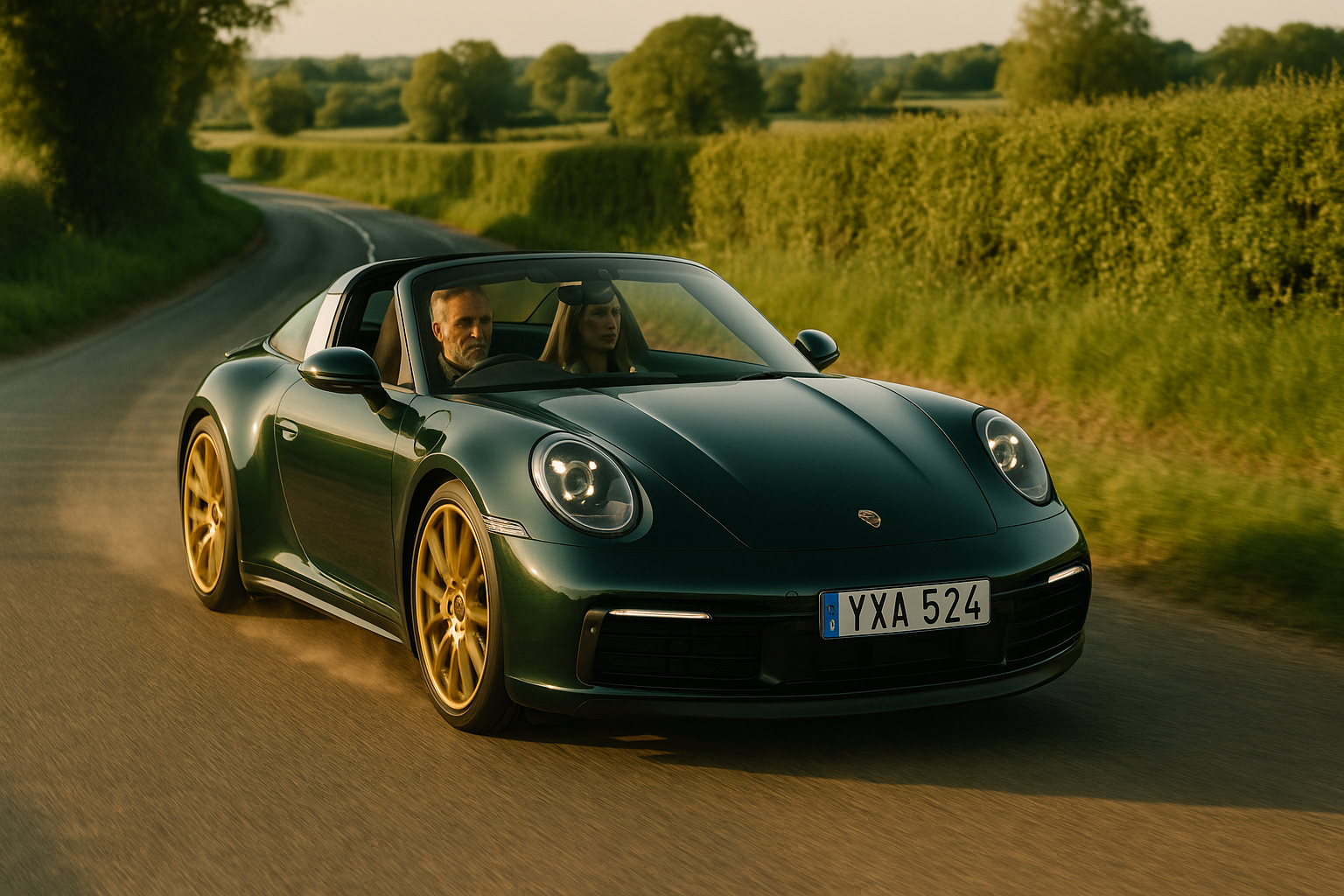
A deep metallic green Porsche 911 Targa with gold wheels drives through a sunlit, winding country road in late spring. The right-hand-drive car features a Swedish number plate. A grey-haired British man in his late 40s, wearing a dark jacket, is behind the wheel. A tall, blonde woman sits beside him. The road is dry with light dust rising from the tyres, and long shadows stretch across the tarmac. Mature hedgerows and soft green fields frame the scene in warm golden light.
Some couples go to B&Q. Others recalibrate their marriage on a B-road in June.

I recently got back from a couple of days away in Norfolk with a close friend who also loves his driving. We set out on a fantastic loop from Aylsham through Fakenham, Wells, and Cley – brilliant roads, good sightlines, measured effort, and our own playlists accompanying the sweat on the wheel and the red-hot calipers. It’s been seven years since we did something similar in Scotland on the North Coast 500, and while I’ve found a few roads round me in Surrey where I’ve had flashes of the same joy, doing it in perfect weather with a good friend is different. It’s memorable, visceral, and deeply satisfying.

Aside: The Horkey Kitchen at Bawdeswell is a worth stopping off point.

That trip reminded me what modern driving risks forgetting: rhythm, concentration, the way a great road stretches you just enough to feel vividly, physically present. A truth utterly ignored by the automotive press, which seems fixated on a frictionless future. Autonomy. Electrification. Over-the-air updates. The car, once a machine, is now a platform. A node on a smart grid. Another screen to poke and personalise. And if the future is to be believed, it’ll be a contactless glide from A to B – your vehicle knowing where you’re going, what mood you’re in, and curating the ambient playlist accordingly. Comforting, perhaps. But is that the future we really want?

Because here’s what happens when you flatten a journey into data points and strip the human out. You lose the sweat, the skill, the subtle joy of being in tune. What the current automotive vision tends to forget is this: flow beats frictionless. Every time.

Driving at its best is not about arrival. It’s about engagement. If you’ve ever taken the long way home just because the road was dry, the light was low and the playlist was perfect, you’ll know exactly what I mean.

Let’s be fair: 95% of driving is perfunctory. School runs. Trips to the tip. Visiting family. Airport drop-offs. Just get me there, and do it efficiently. That’s what satnavs are for, and they’re brilliant at it.

But just as we crave a real meal after a week of cobbled-together dinners, we also need room for the drives that feel like something. That remind us we’re not just being carried – we’re in it. That’s what this is about: reserving space for the exceptional.

Because flow isn’t just a productivity state. It’s the embodied feeling of rightness. An experience that draws on physical skill, real-time interpretation, being attuned to your environment. Strip that away, and something vanishes.

You can bolt as many sensors to the bumper as you like – flow isn’t something a car detects. It’s something a driver feels. But here’s the thing: technology doesn’t have to kill flow. It can co-create it.

The current HMI (Human-Machine Interface) paradigm presents a false binary. Either the driver is in control, or the system is. But there’s a third, more human path: co-piloting. Not Microsoft Clippy with a steering wheel, but a system attuned to how you want to feel on this drive. A route with rhythm. Camber. Flow. Roads that reward precision and tempo. Effort that meets intent.

When ease becomes the only design goal, something essential gets lost. And we’ve already seen what that looks like: In one eerily prescient experiment, researchers gave households a free chauffeur for 60 hours a week1 – as if driverless tech had already arrived. Public transport use plummeted. Total miles driven rose by 60%. Among retirees, it more than doubled. Why? Because friction disappeared. People sent cars to pick up friends, ran errands just because they could, and stopped weighing up whether a trip was worth it.

When mobility becomes passive, we don’t do less. We just do less meaningfully. Journeys blur. Movement becomes background noise. The vehicle ceases to be a site of agency or expression – it’s just another box we sit in while life happens elsewhere.

And that’s before we reckon with de-skilling. Driving draws on real-time judgement and physical awareness most of us rarely use elsewhere. Spatial reasoning. Risk calibration. Micro-adjustment. Automate that, and we don’t just lose control. We lose fluency.

Despite this, the appetite for engaged driving hasn’t gone – it’s just become more selective. The very existence of niche markets for classic cars, track days, and driving experiences proves it. That’s why designing for joy matters even more.

But this sits awkwardly alongside a cultural drift towards a one-size-fits-all mobility model – where driving is seen as a problem to solve, not a pleasure to preserve. It’s become unfashionable in some circles to even admit you enjoy it. As if to love driving is to reveal something suspect. But not all movement is equal. The same road can be a chore or a joy. It depends who’s driving, and why.

This shift in perception also affects how we measure success. The metrics used to justify infrastructure (usually based on time saved) miss the point. The real value lies in access gained, experiences unlocked, the long way round.

As behavioural economists have shown, effort often creates meaning. In a world of ‘frictionless’ experiences, friction can signal intention, depth, care.

Technology and craft, when designed with that richer journey in mind, can support and amplify, rather than replace. Like a great chef or a sound designer, it should highlight what matters and let the rest recede.

Imagine:

  • Edge AI that reads your rhythm.
  • Haptics that sharpen attention without nagging.
  • Context-aware routes that change with the light, and the sky.

This emphasis on the physical and the intentional becomes even more crucial because the more we strip away, the more we’ll crave moments that remind us we still exist – bodily, skilfully, viscerally.

Especially in a world where younger generations increasingly see driving as a chore, or opt out altogether, the ones who do drive will be those who want to. That makes the case for joy-built design even stronger.

Because let’s be honest: the real enemy of joy on the road isn’t speed limits or EV ranges or even other drivers. It’s waste. Wasted road. Wasted time. Wasted potential for a moment of synchronicity between human, machine, and landscape.

If the future of automotive is to feel like anything at all – if it’s to be more than a Netflix-enabled transportation pod – we need to stop designing for the eradication of friction, and start designing for the restoration of rhythm.

Not just arrival. But aliveness.

AI Disclosure: This piece was written with the assistance of AI, used as an editorial and thinking partner. All ideas, edits, and final phrasing are mine. Image creation was by AI, natch – ALT text included. Excerpt and tag lists were also optimised for best practice

  1. The study has its limitations of course. It took place in the US where driving is end-to-end whereas Europeans focus is on automation for the last-mile and the public transport is sufficiently better to expect more inertia in behaviour ↩︎

Tagged , , , , , , , , , , , , , , , , , , ,