Tag Archives: behavioural psychology

Life’s Too Short to Scrape the Lurpak. But Maybe That’s the Point

A nearly empty white Lurpak butter tub with a stainless steel knife inside sits on a light wooden kitchen countertop. Beside it is a small ceramic plate scattered with toast crumbs. Soft daylight falls from the left, casting gentle shadows across the minimalist, muted interior with wooden furniture and a blurred potted plant in the background.
Life’s too short to be buttering existential crises out of a plastic tub.

This morning I found myself scraping the bottom of a Lurpak tub.

A white, gently bowing receptacle with just enough residual butter to tease the knife, but not enough to make it worth the effort. And yet, there I was: wrist contorted, scraping sideways, skimming over craters of cold margarine laminate, determined to liberate one last smear.

For toast.

I paused, mid-scrape, and felt the creeping absurdity of it all. Why do we do this? This frugal choreography. This dignified desperation. Is it habit? Shame? Some Protestant hangover of moral rectitude that equates waste with weakness?

Or is it worse than that, is it training?

A kind of domesticated eco-asceticism, learned not out of genuine conviction but out of decades of thinly veiled moral instruction. Don’t waste. Save scraps. Rinse your yoghurt pots. Aspire to net zero in all things, including pleasure. Butter, it turns out, is not neutral.

I don’t want to be the kind of man who scrapes the last dregs of butter from the corners of a tub. It feels small. Slightly emasculating. A man reduced to margarine management. And yet, aren’t these the very values we claim to admire? Moderation. Responsibility. The quiet dignity of thrift.

There’s a strange modern tension here: the aesthetic of abundance, paired with the rituals of restraint. Middle-class frugality presented as virtue. A lifestyle of minimalism, yes, but premium minimalism. We don’t waste Lurpak because it costs £4.50 a tub. Because we bought the “Spreadable” version as a treat and now feel complicit in dairy decadence.

But scratch deeper and it’s not really about the butter at all.

It’s about effort. It’s about where we place it. We pour our energies into small, containable acts of domestic diligence because the larger systems feel untouchable. We cannot fix politics, housing, the climate, or the cultural entropy of our time, but by God, can we finish a tub of butter.

And maybe that’s OK. Maybe part of surviving modern life is choosing the scale at which we can still act meaningfully, however trivial it seems. Scraping the butter is absurd. But so is most of life, and at least this kind of absurdity ends with warm toast.

Still, I didn’t finish it. I threw the tub away, started a new one, and felt a small thrill of liberation.

No one applauds the man who knows when to stop scraping. But they should.

Tagged , , , , , , , , , , , , , , , , ,

Why UK Kids Can’t Have Bank Accounts Before Six – And Why That’s Silly

A close-up, hyper-realistic photo shows a wooden piggy bank with a coin slot on its back and a coin partially inserted. The piggy bank is positioned next to a smartphone displaying a children's banking app with icons for savings goals and coin graphics. To the right of the phone is a neatly folded stack of pastel-colored baby clothes, including a small pair of knitted booties, with a Vinted parcel label and barcode clearly visible. The scene is illuminated by soft, natural light, creating a muted, editorial feel.

Here’s a sentence that shouldn’t exist: our two-year-old has a savings pot inside her eleven-year-old brother’s bank account.

Not because we’re trying to confuse HMRC or because we’ve discovered some fintech hack that’s too good to share. Simply because no UK bank will give her an account until she turns six, and when she does, it will still be hamstrung by limits that assume every child’s money arrives in neat, predictable chunks from a parent’s allowance.

The set-up is simple. We sell her old clothes and toys on Vinted. It’s honest, traceable money, every transaction recorded by a platform that has its own anti–money laundering checks baked in. The items avoid landfill. The proceeds go to her future self. It’s the kind of wholesome circular economy PR departments love to posture about. And yet the only way to park that money somewhere with her name on it (sort of) is to create a ‘pot’ inside her brother’s Rooster account.

This is not a problem the Financial Conduct Authority asked the banks to solve. There is no specific regulation that says under-sixes cannot have a bank account. This is a product design decision, dressed up in safeguarding logic. NatWest’s own Rooster service told me:

We’ve had to introduce limits, with these limits created and set at what we believe is a generous amount for a child’s pocket money app… We recommend that you make fewer larger top-ups in the month, and then boost the money over as often as you like.Katie, 15.AUG.25

The logic, if you squint, is that transaction caps stop laundering. But laundering what, exactly? In our case: a baby’s outgrown sleepsuits. The “10 loads a month” cap on Rooster is not cumulative-value–driven (the actual pound-limit is much higher). It’s a blunt instrument, applied as though fewer transactions automatically means less risk.

In reality, this isn’t about AML at all. It’s about the convenience of enforcing one simple rule across the board rather than designing for the messy reality of modern family finances:

  • Parents with irregular incomes.
  • Blended households with multiple contributors.
  • Ad-hoc earnings from resale platforms.
  • Grandparents who send £5 here and there for birthdays or because they saw a cute jumper in M&S.

Under the current design, the system doesn’t distinguish between proceeds from a second-hand pushchair and proceeds from illicit activity. The compliance blanket is thrown equally over both.

The result: we’ve built a workaround. Her ‘earnings’ from Vinted go into his account, into her pot, under our management. One day, in about four years, we’ll withdraw the lot and hand it to her. Which is absurd, not least because we’ll have to move it in fewer than ten transactions to avoid tripping the same rules all over again.

If we were serious about aligning banking with real life, we’d have:

  1. A from-birth, save-only account – visible in the parent’s banking app, locked against spending, able to receive small, traceable contributions from approved sources.
  2. Transaction rules shaped by value and source, not arbitrary counts.
  3. A seamless graduation path at age six to a junior current account with a card and spending controls.

The point is not to hand toddlers contactless cards. It’s to start building the habits, and the visibility, early. Money in, money saved, money safe. The actual ‘banking’ part should be the least absurd bit of that equation.

This piece was written and fact checked by me and then sub-edited with the assistance of AI. The image was rendered by Gemini and excerpt, ALT tag were AI generated.

Tagged , , , , , , , , , , , , , , ,

Designing in the Grey Zone: UX Strategy Between User Needs and Compliance Risk

We want this to feel seamless … but we also need explicit consent, mandatory disclosures, manual checks, and legal disclaimers.

Every seasoned designer recognises this paradox. Designing in the grey zone where intuitive user intent meets institutional paranoia; this is the real art of UX. It’s here, away from idealised personas and tidy journey maps, that experienced designers earn their keep.

There’s an invisible brief beneath every customer-focused requirement: a shadow brief shaped by compliance, legal, and operational anxieties. Good designers learn not just to sense this, but to actively probe it. Ignore it, and your project spirals into endless revisions, stakeholder reviews where the work is designed by committee, subtlety is lost; engage it early, and you gain clarity – and allies.

Take pattern fatigue. Users tire of repetitive consent modals, disclaimers, and (in most but not all cases) friction-heavy journeys. Businesses, meanwhile, cling anxiously to these same patterns as safeguards against imagined or real regulatory backlash. But real trust isn’t built through relentless checkbox rituals. It’s earned through clear, respectful experiences that make the necessary feel intentional, not a cover-your-arse afterthought.

Collaboration here isn’t confined to design reviews or user testing, it happens in office kitchen conversations, Teams/Slack channels, and impromptu chats. You learn to engage risk, legal, product, and ops stakeholders early and often, folding their concerns into the design narrative without allowing the process to be swallowed whole.

I don’t just write about this stuff. I’ve done it.

In regulated finance journeys, instead of burying disclosures or making them intrusive, my team always sought to reframe the moment as part of proactive user education, clear, transparent language turned obligatory checkboxes into moments of genuine value.

For an automotive e-commerce flow, this meant legal mandated conspicuously disruptive copy and impenetrable ‘maths stacks’. But by carefully segmenting the messaging and testing contextual placement, the caveats turned into trust-enhancing affirmations rather than flow-breaking interruptions, and those maths stacks became useful summaries of the (complex) product the customer was buying.

Other projects at Aviva and Standard Life involved compliance from day one, not as gatekeepers but co-designers. The result, I hoped users would see, was surprisingly intuitive UX – and a more collaborative approach next time around. Aligning regulatory demands early creates space for creativity rather than stifling it.

Early in my career, it’s fair to say I viewed legal and compliance as blockers (and they saw digital as suspiciously nebulous, much harder to sign off than print). Now, I see them simply as constraints: like network latency, budget, or screen size. And like those, they can be designed-for intelligently and creatively.

Art moves in to Tate St. Ives at street level and must be able to move into the galleries at different levels. (c) Jamie Fobert Architects

I always come back to something Jamie Fobert said about designing Tate St. Ives. Parts of the building were shaped around a core problem: how to get large-scale artworks in, move them through the space, and install them cleanly. Instead of fighting the constraint, they made it central to the solution. Form followed function, but with elegance. That, to me, is how I work with compliance now. Not a hurdle. Just part of the brief.

Tagged , , , , , , , , , ,

The Great Touchscreen Con Job

Some mistakes happen in a moment. A quick lapse of judgment, an ill-advised decision at 3 a.m., an email sent to Reply All. Others take years, unfolding in slow motion as warning signs are ignored, reasonable objections are silenced, and people in boardrooms nod sagely at their own catastrophic short-sightedness. The mass adoption of touchscreen-only controls in cars falls into the latter category.

Volkswagen has now admitted the error of its ways, vowing that physical buttons are back for good. “We will never, ever make this mistake again,” said their Chief of Design, as if they’d been tricked into it by some mysterious force, rather than actively championing the change.

It raises a bigger question. How did it happen in the first place? How did entire teams of HMI experts, human factors specialists, and UX researchers – people whose literal job is to stop this kind of nonsense – allow it to happen? Were they asleep at the wheel, or were they simply drowned out by design teams infatuated with minimalism and finance teams rubbing their hands at the thought of fewer moving parts?

The answer, of course, is all of the above.

The cult of minimalism, confusing more screens with innovation

At some point in the last decade, car designers decided that buttons were offensive. They cluttered up dashboards. They broke the sainted, uninterrupted lines of modern interior design. Worse, they weren’t futuristic. The ideal was a sleek, unbroken surface, like an iPhone, only larger and more expensive to replace if it b0rked.

This obsession with minimalism went unchecked because it looked fantastic in concept renders. Screens glowing with digital promise, smooth and uninterrupted by the ugliness of function. Never mind that the only reason buttons existed in the first place was that they worked. Never mind that people could reach for a dial without taking their eyes off the road, adjusting the temperature by feel alone, a level of usability that no amount of software updates could replicate.

Rob Tannen, a human-centred design specialist, summed it up recently on LinkedIn: “Fundamentally, the problem with touch-based interfaces is that they aren’t touch-based at all, because they need us to look when using them.” In a moving vehicle, that isn’t just bad design, it’s dangerous.

The significant point here though is that this was not a revelation. UX researchers have known it for years. The car industry had, in fact, already worked this out in the 1980s, which is why it spent decades refining tactile, mechanical controls that allowed drivers to focus on the road and remain at arm’s length. But in their rush to be seen as technologically advanced, OEMs decided to throw that institutional knowledge in the bin.

The accountant’s dream, confusing cost-cutting with innovation

Touchscreens are cheap. They replace dozens of mechanical components with a single panel of glass, a bit of wiring, and some off-the-shelf software. For car manufacturers looking to shave costs wherever possible, it was an irresistible proposition. Instead of painstakingly engineered switches, they could throw everything onto a digital interface and call it an upgrade.

Charles Mauro, a veteran in human factors (HF), called this for what it was: “We only have touch screens in vehicles because such interfaces provide a marketing and sales boost to new cars by lending the impression of ‘high-tech’ and modern feature sets. From HF’s perspective, they remain highly impoverished interfaces.”

In other words, it wasn’t about what was best for the driver. It was about what looked best in a press release.

But removing physical controls isn’t just an inconvenience, it’s actively worse. Simple tasks that once took a split-second, a quick flick of a switch, a half-turn of a dial, became a (painstaking) exercise in menu navigation. Climate control settings buried in submenus. Hazard lights requiring two taps and a prayer. Windscreen wipers accessed through a system designed by someone who apparently lives in the desert (i.e. Tesla).

The real irony? Some of the most expensive, high-end cars, the ones that supposedly define luxury, ended up with the worst interfaces. A £120,000 SUV with a laggy touchscreen that freezes in winter. A luxury saloon where temperature adjustments require you to gesture-swipe on visuals of air vents. The tech-driven future, they said.

The Silicon Valley delusion

Blame Tesla. When the upstart EV brand introduced its monolithic, screen-heavy interior, traditional carmakers panicked. If Tesla was doing it, surely that was the future?

OEMs, desperate not to look outdated, decided they had to copy the software-defined model. Everything should be digital, infinitely updatable, infinitely customisable. Who needs buttons when you can have a dynamically shifting interface?

This was a critical misunderstanding of why Tesla got away with it. Tesla’s approach worked (to an extent) because the entire car was designed around it. But for traditional manufacturers, retrofitting touchscreen interfaces onto vehicles that had been developed with physical controls made for a UX disaster.

The dream was that everything would be intuitive. The reality was that even basic tasks became a chore. Ford, in an attempt to embrace this brave new world, introduced ever larger screens into its cars. The result, as The Verge put it, was predictable: “Surveys have shown growing customer dissatisfaction with in-car tech, especially touchscreen software. People are overwhelmed, and Ford’s response seems to be to add more screens, which is not a guarantee for success.”

The data problem

There’s a particularly dangerous kind of UX research that looks at how often people use controls and decides that if something isn’t used frequently, it should be buried.

This is how Tesla ended up hiding the wiper controls inside a screen menu. Their reasoning? “People don’t use them often.” A brilliant insight in California, somewhat less so if you live somewhere with rain.

This logic led to cars where drivers had to dig through menus for basic functions. The entire point of a car interface is that when you do need something, it should be immediately accessible and context really, really matters. Nobody wants to enter a submenu for demisters when their windscreen is fogging up at 70mph. Auto Express’s report is well worth a read here

The Return of Sanity

Volkswagen’s public climbdown marks a turning point. Hyundai has followed suit. The backlash has been strong enough that manufacturers are now scrambling to put buttons back in their cars, pretending that they always intended to.

But it wasn’t customer complaints that forced the change. It wasn’t common sense prevailing. It was regulators.

Euro NCAP has mandated that, from 2026, cars will need physical buttons for key functions to qualify for a five-star safety rating. The industry had spent a decade ignoring drivers, but when the threat of lower safety scores loomed, suddenly they rediscovered their enthusiasm for good UX.

Where Do We Go From Here?

The great touchscreen experiment is over. Car interiors are moving back towards hybrid interfaces, a balance of digital and physical that prioritises usability over showroom aesthetics. Manufacturers are rethinking software-defined controls, realising that while over-the-air updates are useful, core functions need permanent, intuitive access.

Most importantly, UX research in automotive needs to be taken seriously again and their voices heard right up the product development and engineering chain. Not just as a box-ticking exercise, but as a genuine guide for what works.

For now, though, it’s a relief to know that the button is making a comeback. It turns out that some of the most futuristic technology in modern cars was there all along.

AI disclosure: Some article research was supported by AI, themes consolidated, article excerpt was AI generated. Article copy entirely author’s own.


Tagged , , , , , , , ,

Amazon’s UX: Why Customers Ignore the Chaos

Amazon’s interface is a mess. Everyone knows it, doesn’t matter if you’re in the industry or you just use it to buy lightbulbs, the odd book and some fancy Tupperware. It’s the digital equivalent of a hoarder’s house, clutter everywhere. A friend of mine once memorably described looking for something as like “rummaging through a warehouse with a torch”, but [she does it because] “I know the bloody thing I want is in there somewhere”. On any given part of the site there’s inexplicable stacks of unrelated items, and a sense that at any moment, something might fall on you. My particular hate are sponsored listings, intruding like pushy sales reps with their irrelevant nonsense while you’re on the way to buy the actual thing you searched for (although sometimes the actual thing turns out to be a not-quite-there copy from some random far-east factory). Genuine customer reviews also get buried under an avalanche of SEO-stuffed nonsense, and yet, dear reader… here I am, ordering 90% of what I buy from Amazon. And you do too.

However frustrating the experience, it isn’t bad enough to drive people away. Fast delivery, sheer product choice, and a checkout process so frictionless it should be flagged with Gamble Aware. All of this outweighs the UX sins.

So, Does UX Even Matter?

It is a question worth asking. If a platform’s core proposition is so compelling, with cheap prices, instant gratification and no meaningful alternative, does the user experience really determine success? Or does it just need to be functional enough?

The Amazon Conundrum

Armchair critics love to dissect Amazon’s UX. In the dark corners of the UGC web, Reddit threads are full of users raging against the chaotic interface. Tech journos lament the aggressive Prime pushing, the pay-to-win search results. On paper, it’s a usability horror show. But let’s be clear, Amazon isn’t neglecting UX. It employs entire teams of UX designers, researchers, and engineers who are constantly refining the experience. Not to make it more elegant, but to make it better at selling things. If adding another sponsored listing increases revenue, they’ll do it. In 2022 alone, Amazon made over $31 billion from its advertising business, largely driven by these placements, making it a core part of their revenue model (Vox). If customers still find something to buy despite the friction, then as far as Amazon is concerned, the system is working just fine. The difficulty we have as UXers is understanding and reconciling this. Because we see ‘Sponsored’ listings trump the actual best-result search listing we say “This is wrong, users hate this!” but somewhere deep in Amazon HQ is the data to say, “You know what, they actually don’t, and here’s some more $” (EcommerceFuel and others provide further context on how Amazon’s sponsored listings work and why they persist). The same logic applies to other blunt instruments like relentless pop-ups (deeply irritating but demonstrably effective at nudging hesitant users into making a decision) and those blinking, anxiety-inducing countdown timers all over that Instagram brand’s shop aren’t there by accident either.

When UX Takes a Back Seat

Of course, Amazon is hardly alone. Plenty of other sites with objectively terrible UX remain dominant because their value proposition is simply stronger than the frustration they cause:

  • Booking.com drowns you in pop-ups and ‘Only 1 left at this price!’ warnings. Yet its vast selection and competitive pricing make it impossible to ignore.
  • British Airways’ website looks and feels like it’s been trapped in 2009, but people still book flights because, they will always believe the brand stands for something British and the pilots are the best trained and most decent in the skies.
  • Vinted The latest upstart eCommerce brand is having a runaway success in the UK but this is absolutely down to the simplified sell-send logistics and payment process, and definitely not to the bloody awful filtering and product exploration UX (seven different ways to filter on Ralph Lauren sweaters anyone?).
  • GP surgery websites, National Rail, car park booking systems, there’s a vast ecosystem of poorly designed necessities that survive because users effectively have no choice or poorly rationalise their value/essentialism.

This phenomenon isn’t anecdotal or lost on UX thinkers. As David C. Wyld argues in The Endless Battle Against Bad UX, poor usability is pervasive in major companies, and fixing it isn’t always a top priority. Similarly, The World is Running on Bad UI (Michal Malewicz) notes how many essential services and platforms operate on clunky, outdated interfaces yet remain functionally irreplaceable. Their insights reinforce the central argument here: bad UX doesn’t necessarily mean bad business.

The Captive Audience Factor

The obvious point here is that there is a difference between platforms like Amazon, where the UX is frustrating but functional, and services where users are stuck with whatever’s available. The difference with Government portals, legacy corporate systems, anything remotely tied to infrastructure is that these things aren’t just designed badly; they are fundamentally unmotivated to improve.

It’s not even a matter of UX being ignored (again, plenty of these organisations are populated by skilled and well-meaning design folks), it’s often a mix of limited budgets, outdated tech stacks, bureaucracy (many hands), and the sheer pain and complexity of rebuilding something that’s been patched together over decades.

The same logic applies to countless internal systems in large organisations, where usability takes a backseat to bureaucratic inertia and legacy technology. Everyone grumbles about it, but change is slow, and innovation rarely prioritises the dull but essential parts of work life. Just as no one is investing to replace the office microwave that’s been there since the turn of the millennium, so we continue to suffer through whatever shitey interface we’re given.

The Reluctance to Overhaul

Could Amazon wholesale overhaul its UX if it wanted to? Technically, yes. But would it be worth it? Probably not. The site is a sprawling ecosystem of millions of products, channels and third-party sellers, advertising deals, and logistics chains. Trying to impose a sleek, minimalist interface would mean unpicking the very mechanics that drive sales at an enormous cost.

The same goes for other massive platforms. The bigger and more layered a system becomes, the harder (read more expensive) it is to rebuild from the ground up. This is exactly the scenario I described in The Local Maximum Problem, where businesses become trapped in cycles of micro-optimisation rather than taking bold steps toward meaningful UX improvements. Businesses, especially ones as enormous and entrenched as Amazon, often optimise for small, short-term gains instead of taking the risk of a complete overhaul. They’ve reached a peak where micro-adjustments keep the machine running, even if they don’t solve fundamental UX flaws. Redesigning from scratch is a leap into the unknown, and when the current setup is still printing money, who would take that risk? Maybe they update a search filter. Maybe they tweak the layout slightly. But the underlying experience remains a Frankenstein’s monster of competing priorities.

So, Does UX Matter?

Yes, but not in the way purists would like to believe. Good UX reduces friction, increases trust, and improves efficiency, but it doesn’t always dictate whether people use a platform. When the value proposition is strong enough, users will tolerate a lot.

The idealistic view is that platforms should improve out of respect for their users. But what do you think? Have you ever abandoned a platform because of its terrible UX, or do you find yourself sticking with frustrating experiences because the value proposition is just too strong? Perhaps if people keep clicking, why fix what isn’t broken?

Tagged , , , , , , , , , , , , ,

Asics Overcomplicates the Runner’s Journey

What’s worse than realising your favourite running shoe has finally given up the ghost? Watching someone else avoid that realisation for 18 months and risk an almost inevitable injury as the shoe disintegrates before our eyes. That someone, in this case, is the mother of my children, and the dearly departed in question is her much-loved, overworked Asics Gel-DS Trainers. Those shoes have put in a hell of a shift. Thousands of kilometres on pavements, parkruns, and everything in between, and she’s been putting off replacing them because Asics, in their infinite wisdom, decided to discontinue them. Ironic, really, considering they now offer what seems like an ever-expanding collection of new models that are aligned to a hundred sub-genres of our sport.

So, armed with determination and a misplaced sense of optimism, I ventured onto the Asics website, thinking, “How hard can it be to find a suitable replacement?” Fool. Absolute fool.

What followed was not so much a straightforward shopping experience as a complex game of hide-and-seek with 100+ models of women’s running shoes. I began narrowing things down: size 5.5—okay, now we’re at 80 options. Neutral pronation—down to 54. Road running—down to 46. Surely, at this point, I’d found a clear path. Instead, I was still faced with an onslaught of variants. The Metaspeed, for example, comes in Edge+ and Sky+ (for stride runners and cadence runners, respectively). Then there’s the Nimbus with a Platinum version, because apparently, even running shoes need luxury trims these days. Add in the Cumulus GTX, Lite-Show, and Noosa Tri, and it quickly started to feel like I’d stumbled into Asics’ fashion line instead of a practical search for neutral road shoes.

The Asics Maze
Even after filtering, I was still staring at something like 46 items. Surely, price could help narrow things down? Not quite. More expensive didn’t necessarily mean better, and so using price as a guide only added to the confusion. Was the extra cost because of space-age tech, or was it just a fancy colourway? No way to tell.

Take the Metaspeed and Superblast—both at the top end of the price range. Are they substantially better than the Gel-Pulse or Magic Speed? It depends on what you’re after. The pro models may have carbon plates and advanced cushioning, but that doesn’t mean they’re always the right choice for someone looking for a lightweight, fast shoe for 10k runs.

In the world of running shoes, price can mean anything—or nothing at all. Sometimes minimal, no-frills shoes can be cheaper simply because they don’t have much in them. Other times, pro-level shoes are expensive for performance reasons. Either way, price is a poor guide to what’s actually suited to you.

The Absurd Complexity of Asics’ Product Strategy
By this point, I was beginning to wonder who Asics had in mind when they designed this labyrinth of choice. Surely, even they must know that offering this many variants doesn’t create more positive choices—it just creates more confusion. I’d managed to reduce my options to 10 models across 16 variants, but there was still no sign of the shoe closest to the Gel-DS Trainer—the GT-2000. Apparently, Asics decided it belongs in the “stability” category, even though it offers nearly the same stability, weight, and cushioning as the Gel-DS. So there it sat, hidden in plain sight.

From a product strategy perspective, this is inefficient at best and counterproductive at worst. Developing, marketing, and maintaining so many similar models must be both expensive and confusing for the customer. Asics are doing a fantastic job of overwhelming the very people they’re trying to help, all while bloating their own production processes.

Fixing the Problem
So, what’s the fix? It’s not rocket science. What they need is a simplified, user-friendly approach that doesn’t leave customers feeling cognitively drained before they’ve even tied their laces.

Let’s start with better filters. The current system is too blunt. Instead of “road” or “neutral,” how about additional more useful filters like “lightweight,” “minimal cushioning,” or “designed for 10k runs”? Filters that speak directly to the practical needs of runners would make the entire process far more intuitive.

And, of course, an AI-powered product recommender would go a long way. Imagine inputting a few key details—distance, surface, weight preferences—and getting a personalised recommendation that actually fits your needs. No more second-guessing whether the Metaspeed Sky+ is right for you or why the GT-2000 doesn’t even show up. Other industries have embraced AI to simplify decision-making, and there’s no reason Asics can’t do the same.

Finally, streamlining the product range. Asics just doesn’t need so many variants of the same shoe. And when you consider they’re competing with the likes of Nike, Adidas, Hoka, and others, all with their multiple model variants chasing the same customer, it makes even less sense. Simplifying their product line would not only help the consumer, but it would also cut their own operational costs. Less clutter, more clarity—it’s a win-win.

In Summary
In the end, trying to replace the Gel-DS Trainer wasn’t just about shoe shopping—it turned into a case study of how not to design a user journey. Asics, with their 100+ models and endless variants, have created a labyrinth that even seasoned runners struggle to navigate. And in doing so, they’ve not only alienated customers but also made their own operations less efficient.

What Asics needs is a return to basics: a simplified product range, a streamlined user experience, and filters and tools that actually reflect the way runners think and shop. Less focus on obscure variants, and more on clear, understandable options that meet practical needs. An AI-powered recommender and better faceted filters are two easy steps to fix this.

Because, let’s face it, nobody should need a flowchart to buy a pair of running shoes. In a world where brands like Asics are meant to help runners perform better, they have forgotten the most basic rule: make the choice simple—and let us make the running bit as hard as we like.

Tagged , , , , ,

The Complexity and Nuance in Human-Centred Design: Beyond the ‘Average’ User

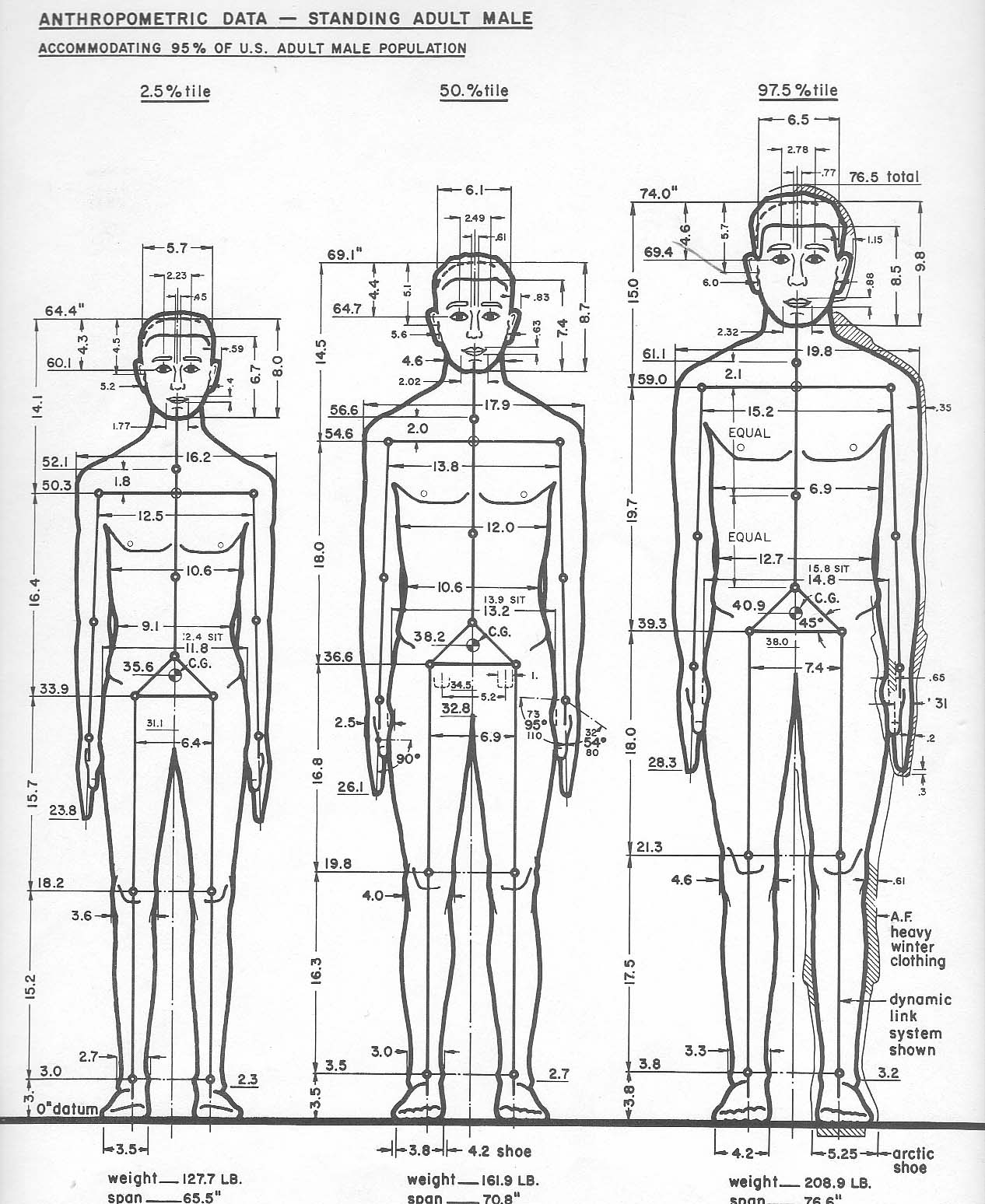
The Measure of Man; Human Factors in Design, by Henry Dreyfuss

Our practice of human-centred design often grapples with a paradoxical question: “By designing for everyone, are we inadvertently designing for no one?” This post aims to dissect this conundrum, exploring the pitfalls of designing for an ‘average’ user, examining the balance between quantitative and qualitative research in UX design, and deciphering the complexity of individual human behaviours and decision-making processes.

The Pitfalls of Average-Based Design

Designing for an average user is common shortcut (even where an average is a persona), but history provides compelling evidence of its limitations. The U.S. Air Force’s 1950s endeavour to redesign aircraft cockpits for the ‘average’ pilot led to startling revelations. Researcher Gilbert S. Daniels discovered that none of the pilots conformed to the average across ten measured dimensions, highlighting the diversity in human physicality and producing a cockpit which, literally, suited no-one. This example resonates profoundly in digital design, where interfaces and experiences cater to an even broader spectrum of cognitive and emotional diversity. When design targets the average, it often misses the mark for most users, leaving out those who fall outside the narrowly defined average parameters.

The Role of Research in UX Design:

In UX design, data-driven insights are invaluable. Quantitative research, with its large-scale surveys and analytics, offers a bird’s-eye view of user behaviour, identifying common patterns and trends. This approach, however, can overlook the rich, nuanced experiences of individuals. Qualitative research fills this gap by delving into the subjective, personal experiences of users. Interviews, focus groups, and ethnographic studies offer a deeper understanding of the motivations, frustrations, and desires that drive user behaviour. Balancing these two research paradigms is crucial in creating digital experiences that are not only statistically sound but also emotionally resonant and personally relevant. Of course, comissioning proper quantititve research is a much harder challenge with our clients than using online tools to gobble up the quant or semi-qual research that gives us only part of the picture.

Understanding the Fluidity of User Decision-Making:

The variability in human behaviour is strikingly evident in decision-making processes and something we’ve become quite obessed with in my world of automotive consumer behaviour. Consider the journey of purchasing a premium car. Initially, a prospective customer might be driven by impulse and aesthetics, attracted to sleek designs and innovative features. However, as the decision process evolves, practicality takes precedence. The customer mindset evolves, they begin to weigh technical specifications, practicality, economy, customer service reputation, and value for money. This transition from an exploratory to a pragmatic mindset within the same individual illustrates the fluid nature of decision-making. It also contrasts sharply with the variability across different user demographics, where factors like age, cultural background, and technical familiarity significantly influence purchasing behaviour. It’s why my team and I don’t work with demographic personas and instead talk about the motivations and needs of a customer at specific stages in the customer journey.

Embracing Flexibility and Inclusion in Design:

To address this complexity to any degree, designers must pivot towards creating flexible and inclusive interfaces. In practical terms this involves designing for a range of abilities, knowledge and preferences, ensuring that digital products are accessible and usable by as many people as possible, reflective of how they will change. Techniques like progressive and responsive design, which allows content to adapt to different screen sizes and orientations, and adaptive user interfaces, which can adjust to a user’s specific needs and preferences, are essential. Personalisation also plays a key role, offering users the ability to tailor their digital experiences to their unique tastes and requirements and for content providers to reflect the journeys and interactions we know users have already undertaken. This might mean that the product page we show you the first time you visit us is presnted in quite a different way to the one you see in subsequent visits, or if we learn something more about you from other interactions.

TL/DR; Conclusions:

The challenge of designing for a diverse and dynamic user base is daunting yet rewarding. By recognising and embracing the multifaceted nature of human behaviour and decision-making, designers can move beyond the limiting concept of the ‘average’ user. Integrating both quantitative and qualitative research, acknowledging the unpredictability of human behaviour, and adopting principles of flexible and inclusive design, are key to creating digital experiences that resonate on a broader scale. In doing so, we not only make our designs more accessible and relevant to a wider audience but also acknowledge and celebrate the uniqueness of each individual. This is the essence of true human-centred design – where every user matters, and design is a reflection of the breadth and depth of human diversity.

Tagged , ,

The Liberating Power of Owning Your Failures in Design

Embrace the Unknown to Foster Authenticity, Growth, and Innovation

Confidence and expertise are hallmarks of success in the design world—whether you’re an architect, a UI/UX designer, or a graphic artist. But let’s face it, everyone has gaps in their knowledge and skills. Moreover, in a field that is evolving at a lightning-fast pace, it’s simply impossible to know everything. So, why are we so afraid to admit either that we don’t have all the answers or that the solution we came up with was plain wrong?

I recently came across two compelling articles that made me rethink this attitude of infallibility that we so often chase in our professional lives. The first, from Behavioral Scientist, explored the psychological benefits of admitting when you don’t know something. The second, by Paul Boag on Boagworld, delved into user interface design, highlighting the limitations and common errors even seasoned designers make. It struck me that the fusion of these insights can offer an invaluable lesson for design professionals: Embrace your failures and gaps in knowledge to pave the way for growth, innovation, and a more genuine connection with your audience.

The Psychological Upsides of Saying “I Don’t Know”
Let’s start by looking at the innate human fears of admitting we don’t know something. It’s as if acknowledging our ignorance is tantamount to admitting incompetence which would understandably deemed unacceptable in a professional setting. However, studies show that the opposite may be true and this should be something to acknowledge readily. Recognising the limits of our knowledge can increase our credibility and encourage more cooperative behaviour from others.

Not only does admitting you don’t know help you internally by freeing up cognitive resources that would otherwise be spent on maintaining a façade, but it also positively impacts how others perceive you. Psychologically, it humanises you, making you more relatable and approachable. Additionally, it leaves room for collaboration, inviting others to contribute their knowledge and perspectives.

Applying This Wisdom to the World of Design
Now, let’s tie this back to design. Like many fields, the world of design is filled with unspoken norms and unwritten rules that everyone is supposed to know but no one talks about. Whether you’re presenting at a prestigious design conference or showing your portfolio in a job interview, the pressure to showcase a spotless track record of success can be overwhelming.

However, by taking the bold step of highlighting not just your successes but also your failures, you invite conversation, collaboration, and critique. Most importantly, you stand to learn and grow both professionally and personally and, crucially appear human and relatable.

Case Study: the Millennium Bridge
Take, for example, the initial failure of the Millennium Bridge in London, which had to be closed just days after its opening due to swaying. The teams involved have variously acknowledged the collective failure that led to the extensive corrective solution and through the transparent sharing and public analysis of the problem the engineering, architecture and design team helped the community learn valuable lessons about the complex interplay of materials, design, and human behaviour – lessons that no doubt enriched future projects. Their openness about this failure not only humanised the individuals involved but also served as a learning experience for aspiring architects and designers.

Case Study: Me
I have had the task to redesign and rearchitect the navigation of Jaguar and Land Rover‘s website navigation on two occasions and on both attempts, I’ve been unhappy with the outcome. In these instances we variously used analytics to determine the most valuable content, we used heatmaps and click maps. We undertook card-sorting exercises, did desk research and relied on benchmark reports from the likes of Psyma and JD Power. We deployed good designers and UX architects on the job and a copy team. Even so, the end results have felt underwhelming and suffered from inconsistencies across international markets and when viewed on a wider variety of devices (viewports). We got it wrong, twice. We’re pretty sure now we know what we (as a wider team) got wrong and we’re excited about the future versions we’ll be deploying. Part of what I learned in the process has been to trust my gut as an experienced UX architect and the paradox that sometimes too much research, harvested with different agendas and inconsistently interpreted, can significantly muddy the waters.

Owning Your Failures Online
In the age of social media, where a curated image can overshadow the messy, intricate reality of professional life, owning your failures becomes even more crucial. Posting about your design challenges or projects that didn’t go as planned provides a more authentic view of your journey. This transparency not only humanises you but also makes you more relatable to others who are grappling with their own challenges, particularly at the start of their career or when wrestling with imposter syndrome.

Embracing failure and admitting gaps in your knowledge isn’t a weakness; it’s an essential part of growth in the design profession. Acknowledging our limitations fosters a culture of collaboration, innovation, and authenticity. Rather than just flaunting your successes, own your failures as well—they’re valuable learning experiences that contribute to both your personal growth and the broader design community.

To quote the brilliant designer and educator, Paula Scher, “It’s through mistakes that you actually can grow. You have to get bad in order to get good.”

Now, isn’t that liberating?

Tagged , , , ,

Listen less, observe more. Human-centred designers must ask deeper questions

One of the most oft-repeated tropes of human-centred design is that we must pay attention to a person’s needs. These needs are often said to be identified through the observation of past behaviour. In digital (whatever that means these days) this is typically through the gathering of usage data. Sit in any pitch or briefing and it won’t be long before someone starts talking about dwell times, form drop offs and so on an so forth. Often a well-meaning ‘user experience’ staffer will pipe up about the need to develop personas, and a marketeer will add “based on our segmentation of course!” “of course!” they reply. Data is incontrovertible.

Really, businesses don’t like anecdotes. They’re not keen on stories (even if the managers are consuming books on storytelling and the engineers are developing use cases), so they rely on the known knowns – how people are using their site or service. It’s this, they say which informs us how people will use our experiences in the future.

I’m unconvinced. Increasingly I find myself resisting the temptation to read much into past behaviour. The empirical psychologist in me knows that, to be a predictor of future behaviour, fellow researchers have come to some agreement that there really are quite strict conditions for this to be the case:

  • The behaviour has to occur rather often (i.e. it’s high frequency).
  • The prediction is most accurate if based on a short time frame.
  • The predicted situation must be a close match for the past situation that the observation was made from.
  • The behaviour must not have been influenced by negative or corrective feedback.
  • The person must be unchanged and, finally,
  • The person must be generally consistent with their behaviours.

That’s quite a set of experimental conditions to maintain. Consider this, if your customer bought from your site or interacted with your brand once before, can you honestly assume that they will meet all those conditions on their return visit? Even with high-traffic repeat visits I’d contend that there’s sufficient variance to make predictions at the very least, wobbly. Add in a timeline of a few weeks or months (like financial services sites, for example) and your prediction is looking essentially worthless.

Demographics are not behaviours
Quite apart from the predictive past performance within your own brand experience, what does this mean in terms of inferring behaviour from others’ actions? One of my bugbears is the regurgitation of segmentation and demographic-led personas. Passed on from media buying and market research these exhibit the classic failure of data vs. insight, that is they offer no illumination. As an identical twin who shares the same postcode, age, socio economic group and racial profile as my brother, the lazy marketeer assumes I have the same needs and behaviours as he. Though there is some cross-over, there is much that is also different and to paint with broad strokes is to miss the kind of detail in human-centred design that creates real breakthroughs. Repeat after me: demographics are not behaviours.

In 2016 where profiling and polling were shown to be so woefully ineffective at determining voter action (c.f. Brexit, Trump), isn’t it time we took a long hard look at the way in which we interrogate and model human behaviour? Fortunately some are doing this and we might look to important contexts like criminology, where they are identifying the desistance curve as offenders age and applying Bayes’s theorem to calculate offenders’ likely behaviour.

Will it rain today?
Where this leaves us is in the area of accuracy. Ultimately, as Rory has asserted in the past, analogous to our weather forecasting, we’re getting better at predicting short term behaviours but still a long way off high-fidelity predictions for weeks and months ahead. What’s helped Dare and other progressive human-centred design teams is looking at what are the stable traits of human behaviour and, furthermore, rigorously considering what is the relevance and integrity of data that forms the inputs of our predictions; we should never draw general conclusions from specific observations and it is this inductive reasoning that plagues our profession.

Nate Silver’s seminal ‘Signal and the Noise’ is undeniably popular and his models had much early success but criticisms begin to be levelled quite fairly when attempts are made to model personal and social behaviour not financial markets. I wonder if, dear reader, you’ve read Taleb’s “Black Swan“? (If you have I wonder if you read all of it? I’ve met few people that have and if you’re like me you found it’s autobiographical style impenetrable, obfuscating and bombastic. Even the Wikipedia summary suffers a similar fate) in short Taleb makes the same point, we care way too much about the inputs to our black box of analysis and truthfully understand very little of what’s going on in incredible complex systems. Taleb also points us at another user-centred design bear pit: the narrative fallacy. We construct user journeys, use cases and flows in narratives that serve to over emphasise what we think we know and bring with them all the confirmation bias of author and reader combined. How often do we still read that it’s important we design brilliant experiences that delight? You’ll see testimonials plastered on the walls of Customer Experience Officers’ offices and headline grabbing responses from frontline staff going above and beyond, and yet research has shown for some time that exceeding some expectations does no more for loyalty than a comprehensive approach to meeting most of them. But it’s just such a nice story isn’t it?

I don’t believe that the way human-centred designers unquestionably use the tools our industry have been using for the last 20-odd years gets us to great solutions.

I believe we need, like Khaneman did, to take the lessons from Taleb and stir in even more psychology, evolutionary psychology.

The answers are in our past, our prehistoric past
I’ve found comfort in developing an approach based on two seminal statements on consumer behaviour: The late David Ogilvy’s famous quote questioning the value of market research: “people don’t think how they feel, they don’t say what they think and they don’t do what they say.” and further Theodore Levitt’s “People don’t want to buy a quarter-inch drill, they want a quarter-inch hole“. I would go one step further than Levitt and suggest that they want to hang that shelf that their spouse has been hassling them about so they can unlock a little more affection. Our modern age skulls house stone age minds and, as far as I’m concerned, a ludicrously overlooked truth is that we are a species that was for a very very long time motivated by procreation, the next meal and the next opportunity to rest. These basic needs of simple satisfaction surely form the basis of our the vast majority of our motivations and when we understood the roots of our behaviour we begin to unlock some truly creative solutions to our clients’ problems (there’s a reason everyone’s talking about Lagom and Hygge, simple satisfaction is incredibly human). We don’t get there by asking our customers this stuff, we get there only through anthropology and ethnography level observations: facial coding, eye tracking, galvanic skin response, neuromarketing. I’ve yet to see a CV where a UXr tells me they’re fascinated in anthropology or they’re fluent in FACS taxonomy, when I do I’ll hire them.

Research and analysis like this doesn’t come cheap and it doesn’t come quickly but tools like iMotions and IBM Watson have the potential to do for behaviour modelling what supercomputers have done for weather forecasting. Interpretation by inquisitive and analytical strategists that are comfortable asking ‘5 whys‘, doing field observations and contextual inquiries will guide us far better than fire hosing strategy and Ux teams with web analytics. To be clear, I am not dismissive of the role of usage data, I simply insist that it augments a broader collection of data gathered from IRL observations and a contextual understanding of human behaviour.

Bury the cliches
Henry Ford never said he didn’t listen to customers (I happily correct anyone who regurgitates the Faster Horse quote), Schiller never said Apple don’t do customer research (rather they do deep ethnographic studies and are ferociously tracking observed behaviour). I’m not saying we won’t learn from customer behaviour but rather, in order to get us to innovative, creative human experiences and behaviour change we must go beyond a facile and shallow observation of customer segments. We must build intelligent teams, use tools and encourage methodologies that give us the time to build upon the evolutionary roots of human behaviour and, whilst doing so, accept that our view extends no further than the horizon, we are powerless to know if it will snow next Christmas.

In a future post I will explain why I believe an automated approach to predicting and ‘optimising’ human behaviour through so-called personalisation offered by web platforms is not helpful at advancing our online experiences.

Tagged , , , , , , , , , , ,

It’s really easy to make stuff persuasive: A story of linguistics, prototypes and Dare.

Picture from Fine Country Lifestyle – Devon Farm Shop

I’ve done the same presentation about psychology, seduction and persuasion several times. It changes a bit here and there depending on the audience. I include a few more contemporary examples, add a few gags and throw in the odd bit of data to back things up.

At one part of the presentation I talk about how adding largely meaningless adjectives to products makes them more appealing – so pepper becomes hand-cracked pepper or we add a provenance like Suffolk honey. I’d always think of these off the top of my head during the presentation and, for the sake of a little humour, would try and invent outlandish examples to make the point (an in so-doing probably dilute it). Then last year I was watching the inestimable Stewart Lee when he amusingly parodied the craft-beer industry with some ludicrous names: Gandalf’s Memory Stick, Hogwarts Bukkake and it inspired me to keep doing the same gag.

I must have been holding on to this idea for a while and I got chatting to Dare’s technical director, Charlie, in a cab. Charlie’s got an academic background in English and a similar sense of humour so we naturally came round to the idea that this generation of novel food labels could be done in a random fashion. It seemed so simple to concoct the recipe: take a foodstuff, add a method and a provenance and the result takes an ordinary staple and turns it into a farm shop or artisan product that can be sold with a healthy mark-up.

Persuasive marketing nomenclature, automated with a tinge of comedy.

So we (well he) started building it. A simple JavaScript took items from three arrays (lists of data) and combined them at random in the order: Provenance, Method, Foodstuff. It worked quite well. But, thinking about the old adage of garbage-in, garbage-out, we noticed that some of the combinations didn’t work.

Does it feel right?
At this point we should stop and consider what we mean by work. It’s quite subjective, but you have to think about it a bit. The comedy is about the combinations appearing almost right but a bit outlandish. If you go too far toward the outlandish then it just feels wrong. In some cases this is obvious – the pairing of methods with foods that don’t make sense hand-reared houmous, pulled briochegrass-fed asparagus. So we started to think about what it was about these pairings that made them wrong and how we could eliminate them. Do you, for example, identify a matrix where methods applicable to foods are deemed ok/wrong? So hand-reared is relevant to all animal products? line-caught is relevant to seafood only? Or do you simply manually edit the list to exclude methods that are too niche? The trouble with doing that is that you reduce the serendipitous moments that make this work. Trying to avoid creating a behemoth that relies on learning or crowd-sourcing inappropriate pairings I set about building an Excel sheet with a series of lookup tables that allowed me to fettle with the source lists and try out combinations without relying on a very busy Charlie to repopulate his script.

Syntax is important
Creating the spreadsheet opened up even more questions. Taking a leap from an unconnected musing I had on Twitter last week, it occurred to me that order – syntax – is an important part of the output. Food will always come at the end but does changing the position of provenance affect the humour or the apparent luxury of the item? To use an example, is Newlyn fried corn a different product to fried Newlyn corn? So the method seems more artisan and niche if it’s Newlyn fried (presumably only a handful of people know how to fry the Newlyn way) as opposed to the corn being from Newlyn and then simply fried? It’s almost the difference between an item being at the bottom of the prestige retail hierarchy and the top.

Aside: Could you put the following retailers in hierarchy of perceived prestige? Tesco Finest, Waitrose Seriously, Marks & Spencer, Whole Foods, Borough Market, Artisan Farm Shop, Selfridges …

Provenance and terroir
Looking at the list we’d made for provenance it was clear there were two things going on. Once was about the association a place had with the growing or raising of food and the other was about what this meant by association. So the concept of terroir is that the geography, geology and climate of a place affects a foodstuff. It’s hugely important in wine and coffee to know the place it’s come from, but also in items like meats or vegetables (Hereford beef, Norfolk turkey). It gets more complicated when you add in the method of preparation or the regional significance of a recipe (A Bakewell tart, a Cornish pasty) or get super-niche and choose a specific producer Blacker Hall quiche. Consequently, the list we compiled is composed of places that have strong associations with food – largely agricultural counties, coastal locations and regional recipes. I then scoured a list of Britain’s top 50 farm shops and delicatessens for examples of artisan-sounding producers

What’s a method, what’s a foodstuff?
Related to our thinking about ordering and the awkwardness of pairings it became apparent that the foodstuff could be the array that includes a variety of methods specific to that food. So, instead of simply putting pork we could add pulled pork to the list. We could have scallops and hand-dived scallops. This would mean that we wouldn’t need to worry about hand-dived pork coming up but we could keep the fancy-pants descriptor of hand-dived to make the scallops seem more interesting. It’s fair to say it had stepped away a little from the original plan to have a simple 1+1+1 = 3 pattern (but that was about to have another twist anyway). We started to think a bit more about what constitutes a food and that complicated dishes don’t work so well as items that are atomic or simple but this wasn’t clear cut. Bakewell vanilla-infused cupcakes works but Jersey broiled yoghurt doesn’t. For every decent example involving brioche, sourdough, quiche, pasties there were far more decent examples involving single ingredients – asparagus, quinoa, lentils, beans, chicken. Once again, order plays a part here and having categories might help solve this. Hold that thought.

Something extra
Finally, after about two days fiddling about in Excel and chatting to Charlie we decided to throw in another part to the concatenated string, a garnish perhaps. We had a randomly-appearing descriptor that affected the overall product. It could be vegan or gluten-free or giant. So, not so-much a method or a provenance but in the spirit of the type of thing that gets added to nomenclature to change the perception Clearly the taxonomic importance of vegan/gluten-free over micro/giant is worth bearing in mind. It many cases it works wonderfully: Giant sugared Herefordshire pudding in others not so well Salt-Baked Pommery Vegan Steak Pies, so it’s fair to say that becomes a matter of user preference. Which leads us neatly on…

Getting it out there
After a while you realise there’s loads more you can do and several of these things made great sense. I always loved the Urban Spoon app that helped you find a restaurant matching a series of criteria at random, the trick was that you could lock down the most important part of your criteria – for example price, and then leave the random bit to choose the genre, location or both. It strikes me that this might be a nice add-on to our generator. You might lock-down the foodstuff and just play around with random combinations of qualifiers – the most fancy chicken product you can find for example. Then there was the consideration that this could have a crowd-sourced element; users could work in volume to rate the best combinations or highlight ones that don’t work. Clearly this would mean a lot more coding effort than we could afford to spend. What about supporting unique URLs for each combination so they could be shared or copied straight into a tweet link. And finally, what about categorisation? would this be better if you could focus-in on drinks, ingredients or prepared products like quiche, cakes, pastas.

Everything’s a remix
Back to reality and I realised fairly early on that this wasn’t that new. There are about ten thousand ‘generator’ sites that compose sitcom and film character names, craft beers and, perhaps channelling a little of the Bill Bryson observation on British place names, a village name generator. What I rather like about all this is that it seems to be most effective with our wonderful language here in Britain. I hastily trimmed out provenances that weren’t British and have tried to keep the foodstuffs a little native, scattering a bit of brioche or salami here and there does work but one must be parsimonious. when the strings get a bit long and they pick up quite specific methods like -infused or cold-pressed it can definitely feel a bit Heston Bloodyhell (sic)

To what end?
So, where does this leave us? Perhaps one day Charlie and I will get a public facing version up, designed hopefully around a style that befits the point-of-sale references we see in hipster marketplaces. A tool that uses some of the functionality we’ve mused about and ultimately becomes a playful little twitter stream. I like the idea that you could run this for 6 months with a voting mechanic, gather the data and establish a shop somewhere in a quaint Cotswold market town (Greater Drowsisle?) that sells products derived entirely from this output.

In the meantime it has given me a great chance to revisit ontological thinking, nomenclature and linguistics and logic. Any opportunity to play around in those fields can’t help but contribute to my understanding and enjoyment of the job I do on a daily basis.

A selection of how it works (or doesn’t).

  • Irish air-dried kale
  • Ballymaloe thin-sliced mackrel
  • Hand cut Suffolk micro couscous
  • Fermented Worcestershire buffalo
  • Pressed Derbyshire giant pheasant
  • Castleford dried rye bread

UPDATE: Now showing on Twitter@shinyplums
UPDATE:
A Daily Mail headline generator and a direction to consider the writings of Brian Wansink concerning food psychology , thanks to Juliet Hodges.

UPDATE: Try it out for yourself with our artisinal food generator

Tagged , , , , ,