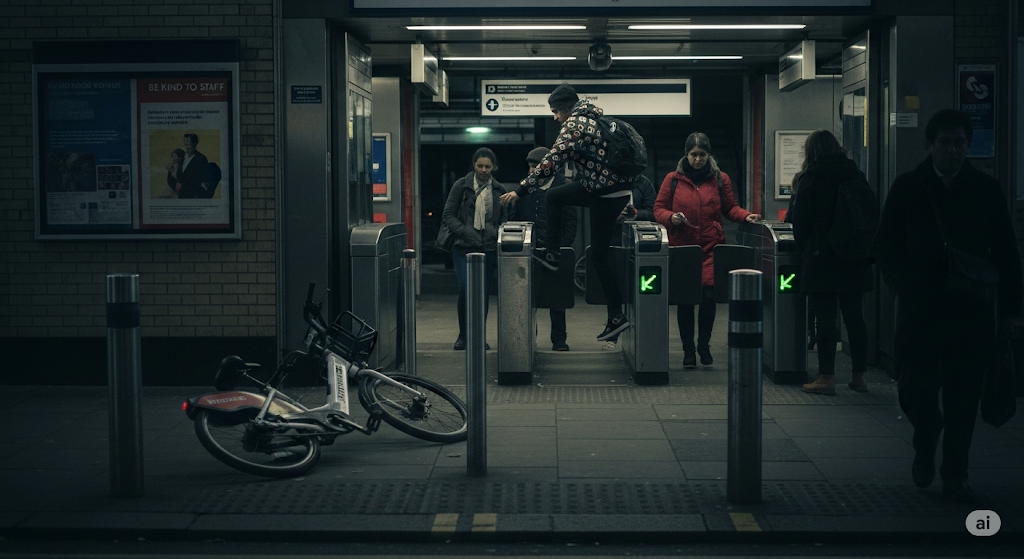
The real scandal isn’t the kid hopping the Tube barrier. It’s the fact no one even looks up.
London’s decline into low-level disorder hasn’t happened overnight, and it hasn’t happened through some grand cultural collapse. It’s been a slow demagnetising of civic expectation, one graffitied carriage, one dumped rental bike, one unchallenged fare-dodger at a time.
And for all the commentary, the plans, the posters, the social media pleas from Sadiq Khan gently asking us to be kind to TfL staff, the system continues to fray. Because it’s not just about policy. It’s about psychology. A city, like a child, becomes what you quietly tolerate.
Take a stroll through Camden. Or Putney. Or Vauxhall, or Shepherds Bush. It’s not just the spike in phone thefts or fare evasion. It’s the collective flinch away from even acknowledging it. Authority is outsourced, first to security guards who are contractually told not to intervene, then to CCTV operators watching with all the urgency of a screensaver. The presence of order exists only in post-event paperwork.
This isn’t a new problem. Every generation thinks it invented disorder. But what marks this moment is the collapse of presence. The people who once embodied low-stakes authority – ticket inspectors, bus conductors, even the occasional stern-faced commuter, have all retreated. And without those micro-moments of correction, the boundary dissolves.
Because there was a time, not utopia, not Victoriana, just the mid-2000s, when the Tube was cleaner, antisocial behaviour meant something, and fare dodgers looked over their shoulders. And crucially, someone would have said something if you left your bike in the middle of the pavement.
Now? Saying something feels like an act of madness.
Even a relatively fit man in his forties (ahem, let’s say one with the outline of muscle memory from rowing and once-upon a time lifting in the gym) thinks twice. Not because he’s afraid of being shouted at. Because he might get stabbed. Not metaphorically. Actually stabbed. By a 14-year-old with a 9-inch blade and nothing to lose.
So we look away. We (not I, reader) film instead of act. We turn up the headphones and pretend not to see. Because the calculus has changed. What used to be a moment of friction – “Oi, pack it in” – has become an existential risk assessment. Is this worth dying over?
Yes, austerity hollowed out visible staffing. But not every act of disrespect can be blamed on poverty. You can’t say the teenager in £100 sliders and a Balenciaga hoodie is evading the fare because the system failed him. Nor that the grad in Clapham dumping a Lime bike across the pavement is a victim of systemic neglect.
This isn’t all about deprivation. It’s about detachment. From consequence. From collective norms. From the sense that shared space has shared rules.
So what do we do? Because the answer isn’t doubling police numbers or shaming people on social media. Culture doesn’t change through crackdowns. And civic behaviour isn’t restored by a stronger PR campaign.
You don’t police culture. You design for it.
London’s problem isn’t just one of law or design, it’s one of contrast. As other towns and smaller cities have quietly levelled up, the capital has coasted on past prestige. Behavioural standards lag not because Londoners are worse, but because London is no longer best. The Tube is better, but the civic fabric? Worn thin. What once justified the stress (the vibrancy, the culture, the sheer aliveness) now feels out of balance. You dodge fare evaders and dumped e-bikes, but for what? A Pret subscription and an off-peak West End ticket? Meanwhile, Sheffield has sourdough, Manchester has swagger, and Kent has all the ex-London chefs who could no longer justify paying £3,500 a month to fry mushrooms near a bin store.
That’s where behavioural science (and, yes, some gentle psyops) comes in.
Behaviour is context-dependent. What people do in public space is shaped by cues, affordances, and social norms more than personal ethics. If the system is designed to look away, people will act accordingly. So design it to notice. Design it to remind. Design it to suggest.
This doesn’t mean building a digital panopticon. We already have that. London has more CCTV coverage per square inch than any city outside China. But the surveillance is abstract, remote. We’re watched, but not seen. There’s no friction. No microdose of shame. No moment of hesitation.
What we need to rebuild is civic equivalent of a raised eyebrow.
Start small. Use nudges that aren’t insulting. Place messages where norms are breached, not in corporate safe zones. A sign at the Tube barrier isn’t for the person tapping in, it’s for the kid about to hop it. Use tone accordingly.
Bring back the sense of being noticed. Not punished. Not tracked. Just observed.
We could do worse than call in Rory Sutherland and a few behavioural strategists with teeth. The work they’ve done on transport psychology (understanding how we navigate space, status, and visibility) is ripe for civic deployment.
Imagine a pilot scheme on the Bakerloo Line that doesn’t install more barriers, but changes the posture of the space. Mirrors. Eye-level signage. Floor friction that makes hopping awkward. Subtle lighting changes that simulate visibility. Staff trained not to chase, but to notice.
We could run this for twenty years. Quietly. Iteratively. Without press releases.
The point isn’t to eliminate every act of disorder. It’s to rebuild a culture that expects better.
Because somewhere along the line, shame became taboo. Correction became aggression. We outsourced authority to laminated posters and video cameras and hoped it would be enough. It wasn’t.
Civilisation is not a vibe. It’s a ritual.
And it’s time we noticed what we’re no longer willing to defend.
AI disclosure: AI used to sub-edit the copy and perform factual research which was cross-referenced manually. AI generated the image (obviously), excerpt and tag list to enhance exposure.




Absent Dads, Absent Truth
The Mayor of London has been urged to “champion relatable, positive male role models” to stop boys being radicalised online, which is exactly the sort of thing you suggest when you’ve already decided not to talk about the real problem.
Instead of facing the collapse of family structures and the chronic absence of fathers in too many boys’ lives, we get a proposal for an information campaign. A Toolkit. A few posters. Maybe Southgate can record a reassuring YouTube video.
Apparently, the hope is that if we churn out enough branded content about ‘healthy masculinity,’ it will somehow fill the gaping hole left by Dad never being there at all. As if boys are just a design challenge, a user group to be nudged away from extremism by better comms.
Of course, and I can’t stress this enough, some fathers should not be in their children’s lives at all. Where there is violence, cruelty or fear, absence is protection. A boy and their mum are better off fatherless than poisoned by a man who teaches him that domination is love. No argument there. None.
But that’s not the majority story.
The real crisis is the steady normalisation of fathers absenting themselves, through neglect, indifference, casual abandonment, and the refusal of politicians to say so, for fear of sounding judgmental.
You don’t fix fatherlessness with a toolkit.
But modern politics is allergic to root causes. Safer to pretend it’s a branding issue. Safer to talk about awareness, feelings, “positive role models.” Anything except the one thing that actually matters: Dads. Ordinary, everyday Dads, who stay, love, protect, and teach, often imperfectly, but crucially.
Until then, you can print all the Toolkits you like and put out the PowerPoints in a special school asssembly. The boys will still go looking for their fathers, and if they don’t find them at home, they’ll find them online.
And that won’t be Gareth Southgate.