Tag Archives: scarcity

Predictive Luxury: When the Algorithm Decides You’re Worth It

The paradox of modern luxury is that the more precisely it knows us, the less we seem to want it.
AI-driven personalisation flatters our taste so efficiently that desire itself begins to flatten. You open an app and there it is – the jacket you’d half-imagined, or the playlist that mirrors your mood before you’ve named it. The system anticipates, arranges, and completes. It feels frictionless, even generous.

But when everything fits this neatly, what’s left to reach for? Desire once depended on a perceptible gap, the space between wanting and getting. Now that gap has been optimised away. We no longer aspire; we’re simply anticipated.

Behind that easy charm sits a machinery, an industry, of prediction. Every scroll, hover, and hesitation becomes a confession. From these micro-gestures, the algorithm builds a probabilistic portrait: accurate enough to sell to, not to know.

This is predictive luxury – the luxury of convenience. It packages aspiration for the mass-affluent, translating status into data. The product is still expensive, but the experience is engineered for scale: “exclusive” taste delivered by statistical consensus. What once required discernment now arrives pre-approved.

To be clear, this isn’t curation. It’s correlation. Your discernment becomes the weighted average of everyone who clicked before you. Luxury houses once guarded their ateliers; now they guard their datasets. What was once stitched by hand is now inferred by pattern.

The shift sounds harmless until you notice what it removes.
Aspiration (the slow, self-defining kind) relies on uncertainty. We learned our taste through trial, boredom, and even embarrassment. Those edges are gone. There’s no risk in going to the restaurant where the algorithm has all but booked you the table. The algorithm keeps our preferences in a holding pattern, replaying what we’ve already confirmed, always within one standard deviation of safety.

The Predictive Plateau: a system that sells us the most probable choice, not the most interesting one. Left unchecked, it narrows the collective palate. As I argued in Luxury UX: Beyond Veneer, lasting equity comes from structure and restraint, not surface gloss. The real risk for luxury brands isn’t technological obsolescence but aesthetic homogeneity, a market trained to prefer the median.

Prediction is never neutral. Behind every act of personalisation sits a hierarchy of visibility, whom the machine believes is worth showing first. The more data you surrender, the clearer your silhouette in its model; those who resist become statistical ghosts.

There’s a quiet economics to this. By automating inequality, the algorithm devalues any form of wealth it cannot quantify or identify. The ultimate luxury, then, is to disappear from the data entirely, to operate through introductions, word of mouth, and private networks. The truly exclusive product is the one the algorithm cannot find, let alone recommend.

And yet there’s still one lever left: intentionality. The deliberate pause before purchase. The refusal to click “similar items”. The act of finding something the algorithm couldn’t possibly have foreseen. In a world of predictive luxury, this is not passive rebellion but an active aesthetic stance, a luxury of choice by will.

The smartest brands will design for this intentionality, not against it. They’ll reintroduce or retain friction as a feature: the waitlist, the mandatory consultation, the garment that demands to be felt. These are not inefficiencies but signals of depth, proof that the experience values attention over automation.

For all its precision, predictive luxury leaves a vacuum at the top. Once algorithms have colonised the middle (the mass-affluent market chasing “smart” recommendations), genuine exclusivity must move elsewhere. Increasingly, it drifts back to what machines can’t do: interpretation, eccentricity, the unrepeatable judgement of people who know.

That’s where true luxury now lives, in human-centred unpredictability. The ultra-wealthy and the culturally literate aren’t rejecting technology; they’re augmenting it. Data may light the runway, but the finale still belongs to the artisan, the editor, the quietly idiosyncratic expert who can surprise you in ways no model can.
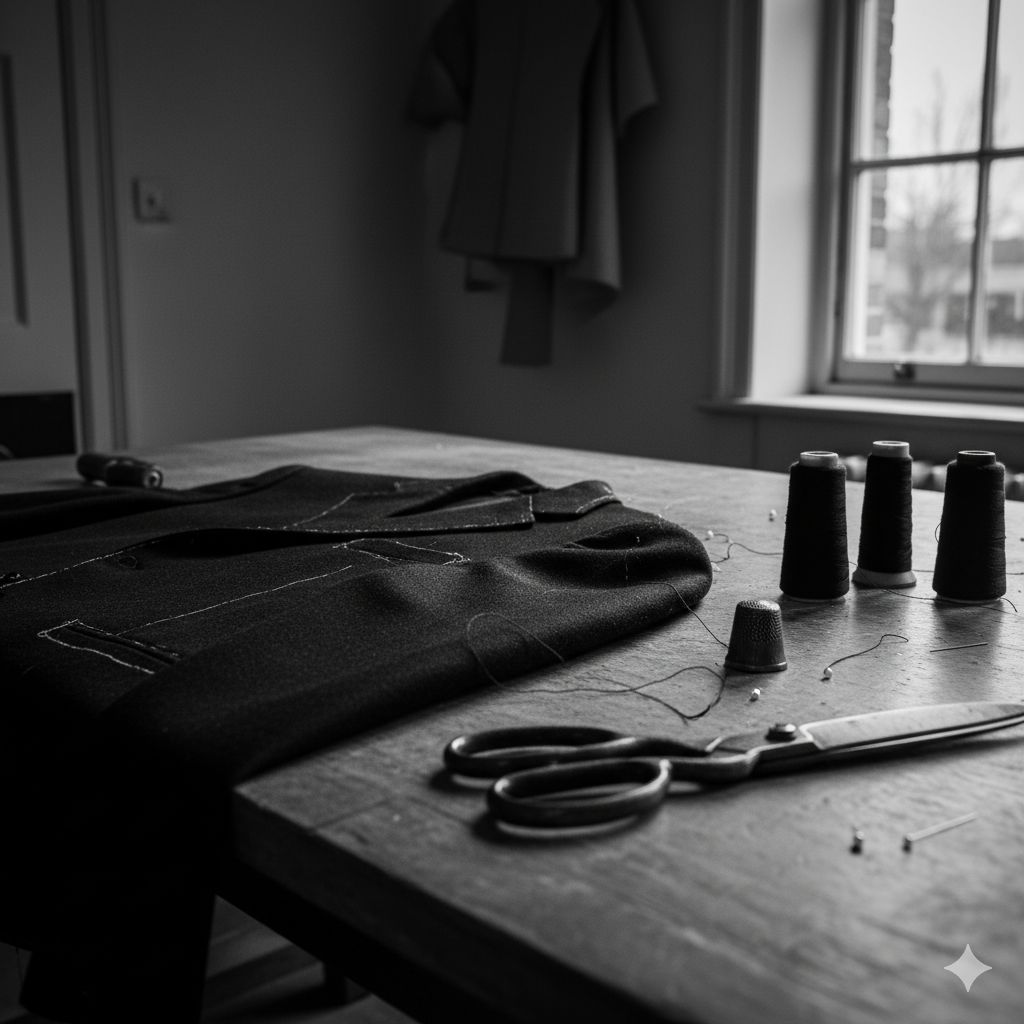
Close-up of a tailor’s worktable lit by soft natural light, showing thread spools, scissors, and a half-finished jacket with a visible imperfect seam — an image symbolising human craftsmanship and intentional imperfection in contrast to algorithmic precision.

British luxury has long understood this. Our best exports – Savile Row, Bentley Mulliner, McQueen, Hockney, Grayson Perry – thrive on that narrow line between discipline and disobedience. Their genius isn’t efficiency but editing: knowing when to break symmetry, when to leave the imperfect seam that proves a hand was there. The imperfect seam is a brand’s deliberate investment in unscalable production – the final, physical proof of value when all scalable processes have been commoditised. Curation, as I’ve argued before, isn’t collection. It’s the art of choosing what not to automate.

The challenge for brands now is to build value not through correlation but through judgement. To shift from efficiency to experience, from prediction to anti-prediction. Their next digital frontier isn’t better personalisation; it’s deliberate unpredictability, the algorithm that refuses to close the loop. Designing such friction isn’t romantic contrarianism; it’s the only sustainable strategy for generating new forms of scarcity, and with them, price elasticity.

Because in an economy obsessed with knowing what comes next, the rarest thing a brand can offer is the pleasure of not knowing, of being surprised, seen, and momentarily off-script. That’s the new exclusivity. That’s predictive luxury, undone.

Acknowledgements: This piece was partly inspired by Antonia Hock’s recent post on invisibility and the next era of ultra-luxury.

AI: This piece was refined with AI, for the image prompt, tags, excerpt, and a little sub-editing. The ideas, references, and rhythm are mine. You can still see my hand.

Tagged , , , , , , , , , , , , , , , , , , ,

I don’t Like numbers

There’s a not-unreasonable perception that agencies are staffed with people who are preoccupied with the new and trendy. At Dare it’s fair to say there are gentlemen that don’t wear socks. There are girls who were in maxi-dresses last year and preposterous jumpsuits this year. There are even people that wear hats and scarves in June. But that’s just textiles. When it comes to digital I’d challenge you to find a more cynical bunch. Propose an idea in an internal meeting to make use of the latest in social networkery and you’d better have some solid evidence to prove it works because you are going to face a barrage of critical analysis from 24 year old juniors to 45 year old seen-it-alls.

With this in mind it’s been a matter of debate this week that perhaps the sheer volume of requests we get from clients asking us to take them (for example) from 10,000 to a million fans on Facebook, is getting to be a bit of a problem. I mean, how important to a brand is a Facebook fan?

Consider an example from Taco Bell in the states. During a spell of bad news for the Mexican fast-food chain where they were challenged on the volume of beef in their Tacos, the Yum! brand reached out to their fans as part of a $4m ad campaign. Presumably these people – who let’s remind ourselves had actively said they were fans of the brand on Facebook, would be up for some positive activity? Over the period in question they’d swollen their fanbase from 500k to 6 million.  Jonathan Blum explains that they offered these fans free food … hey friend, come get some free tacos, on-the-house.

What happened was that just 200k people did. That’s 3%.

97% decided not to take-up the offer of free food from a brand they liked.

When you can’t even give away free food to people who like you, how can you possibly expect people to pay for it? But we’re being asked to generate bigger fan numbers with the assumption that this equates to more sales somewhere down the line.

So, what’s at work here? Why did so many people look the gift horse in the mouth and walk away? What are the implications?

Friction
I don’t know how the mechanic was resolved logistically. It would have to be easy to redeem the offer. If you’re on Facebook it’s not that likely you’re in Taco Bell right then or perhaps even in the frame of mind for a taco. You might see the offer but unless it’s promoted in-store and can be obtained and redeemed at the point of transaction then there’s sufficient friction that customers (fans) are less likely to follow through with the process. It doesn’t take an expert in ethnography or service design to see that printing a voucher at home and remembering to take it next time you get a taco is a bit clunky.

Mixed messages
On the one hand there’s a lawsuit alleging your food is only 50% beef and at the same time you’re offering it up for free. What does that say about the quality and the value you place on your product? Does it display confidence in your taco or does it smack of desperation?

Like ≠ like
Perhaps we don’t actually care that much about the brands we like. Like has become a substitute for ‘join in’ on Facebook. In order to see or interact with content we have to Like it. We might not actually like the nrand but are just intruiged to see what the fuss is about – Like has become nothing more than a threshold. The freedom with which likes are handed out has devalued them; it was presumed that the peer pressure of being seen to like something you clearly wouldn’t would act as a moderator. For example, I might want to see what all the fuss is about Justin Bieber’s page but to like him would be to broadcast that to much derision amongst my friends. The reality is that I can hide this like instantly to spare my blushes but still it counts as another positive vote for the precocious little twerp. Many of those 6m Taco Bell fans aren’t real fans then, they’re just people who had a passing interest or were perhaps mindlessly clicking away on anything they recognised. What would scarcity do to modify this behaviour? Perhaps if we could only issue three likes per week we might think more careful about where we used them.

They just didn’t see it
Data at AllFacebook.com suggests that the magic of EdgeRank (Facebook‘s ostensibly-intelligent method of prioritising content for you) means that  only 3%-7.5% of fans actually see business page posts in their feed. The reasons for this are not entirely understood (Edgerank isn’t transparent) but brands that are posting infrequently or with low-engagement content for example aren’t going to be helping themselves.

But but but…
What about those people that did take up the offer and do see the posts? Their numbers may be small but are these the mavens and connectors, the influencers? Before we entirely dismiss the idea of the fan we should at least acknowledge the benefits of the engaged superfan.

Part of the problem is that Facebook’s irritatingly quantifiable. Chief Marketing Officers and their subordinates can hang their targets on tangible numbers – more fans, beat our competitors, more likes than last year etc. etc. This is data they can see daily, it’s not something they need to commission research for or wait until the next quarter. He or she can log-in at home or in the office and beat their agency with a stick as the numbers rise and fall in real-time. Trouble is, the acquisition of these fans costs money (c. £10 per fan in marketing spend some say), even more when you’re honest and realise that something like 1/10 fans is likely to be a truly engaged one.

It’s because of these superfans that I’m reluctant to call bullshit on the whole Facebook thing. It’s still important to (ahem) fish where the fish are. There are plenty of us swimming about in the big blue sea, but just trying to get loads of us into your net and assuming we’ll all eat your taco… (this isn’t working is it?)

Let’s just teach some of this to our clients and make sure that proposals aren’t about numbers but are about genuine engagement, conversations that are acted upon and activities like voucher redemption are as free from friction as possible. Let’s not go around issuing desperate calls for people to share, let’s think instead about strong scarce engagement ideas for some brands and tactical offers in volume for others. I’m glad I’m surrounded by so many cynics, I just wish they’d wear better clothes.

Tagged , , , , , , ,