Tag Archives: modern culture

Ghosts in the Picture Book

The other day, I was reading a children’s book with our daughter when I saw it: a corded telephone. Black, wall-mounted, with a dangling spiral wire. The sort of phone that last rang in anger sometime around the Blair years.

Roger Hargreaves's; Little Miss Neat picks up vintage style corded black telephone.
The Telephone rang. Little Miss Neat picked it up.

A few mornings later, it happened again, Baby Club on the BBC, all primary colours and soft clapping, and there, on the play mat , was a car. Not one she’d ever recognise. A boxy saloon. Straight-edged. Round headlights. The kind of thing you’d find idling outside a golf club in 1987.

What’s odd isn’t that these images exist, they’re charming, even lovingly drawn. It’s that they still feel like the default. Most phones today are glass bricks. Most cars look like they’ve been inflated rather than put together in a factory.

But when we illustrate for children, we reach back, not to what they know, but to what we remember. This isn’t a developmental crisis. Children don’t need realism to read meaning.

Jean Mandler’s research (thank you ‘Ai research team’) showed they use schematic categories, “car,” “dog,” “phone”, not photoreal recall.

Furthermore, Ellen Winner proved they can grasp symbolism early on (i.e. hey don’t need realism to understand things). So, no one’s confused. That’s not the point. The point is that these images persist, long after their referents have disappeared. The floppy disk still means save. A film reel still means video. A telephone still curls like a question mark.

We say it’s just design shorthand, but it isn’t. It’s something stickier.

These are the ghosts of our interfaces, icons of touchpoints no child will ever touch.

Gunther Kress‘ observations describe how meaning doesn’t update on command. It drags history behind it and changing the meaning of symbols requires overcoming an awful lot of cultural inertia. And children’s media, shaped entirely by adults, ends up as a kind of curated hauntology: a world that looks nothing like theirs, but everything like ours did, right around the time we were their age.

They swipe past rotary phones, expect Santa to come down a chimney no longer connected to a fireplace, draw little square cars with four doors and no raised suspension. It’s sentimental and not remotely sinister but it does mean they grow up consuming artefacts of use they’ll never need.

And maybe that’s fine. Maybe it’s like castles in fairy tales. But it’s hard not to feel the ache of it, that their books are filled with our objects, our past, our cultural residue.

Perhaps more concerningly, they’re not learning to navigate the world as it is. They’re learning to decode the leftovers of how we once did.

So I find myself wondering now what a picture book drawn from today would look like. Would the car even be recognisable? Would anyone bother sketching a glass rectangle phone? Or would the page just show a toddler, alone, swiping at the air, waiting for something to respond.

AI: This piece used AI to help me research the psychology references and summarise their observations. I used it for the tags, excerpt, and a little sub-editing. The ideas, references, and anecdotes were all mine.
Tagged , , , , , , , , , , , , , , , ,

The Week Away That Never Quite Happens

Every few weeks at this time of year, my thumb betrays me. It hovers over a post of a cabin somewhere on the edge of a loch or moor, all shō sugi ban cladding, light oak, mid-century desks and ‘vintage’ lightbulbs, and presses like. The algorithm now thinks I’m the sort of man who wears wool socks and writes preposterously neatly in propelling pencil beside a woodburner. It’s not entirely wrong.

There’s something magnetic about those images: the design-led minimalism that’s somehow still warm; the promise of solitude that doesn’t look lonely. I imagine a week in one of them — laptop off, phone on airplane, words finally unspooling in peace. I can practically smell the Danish oil.

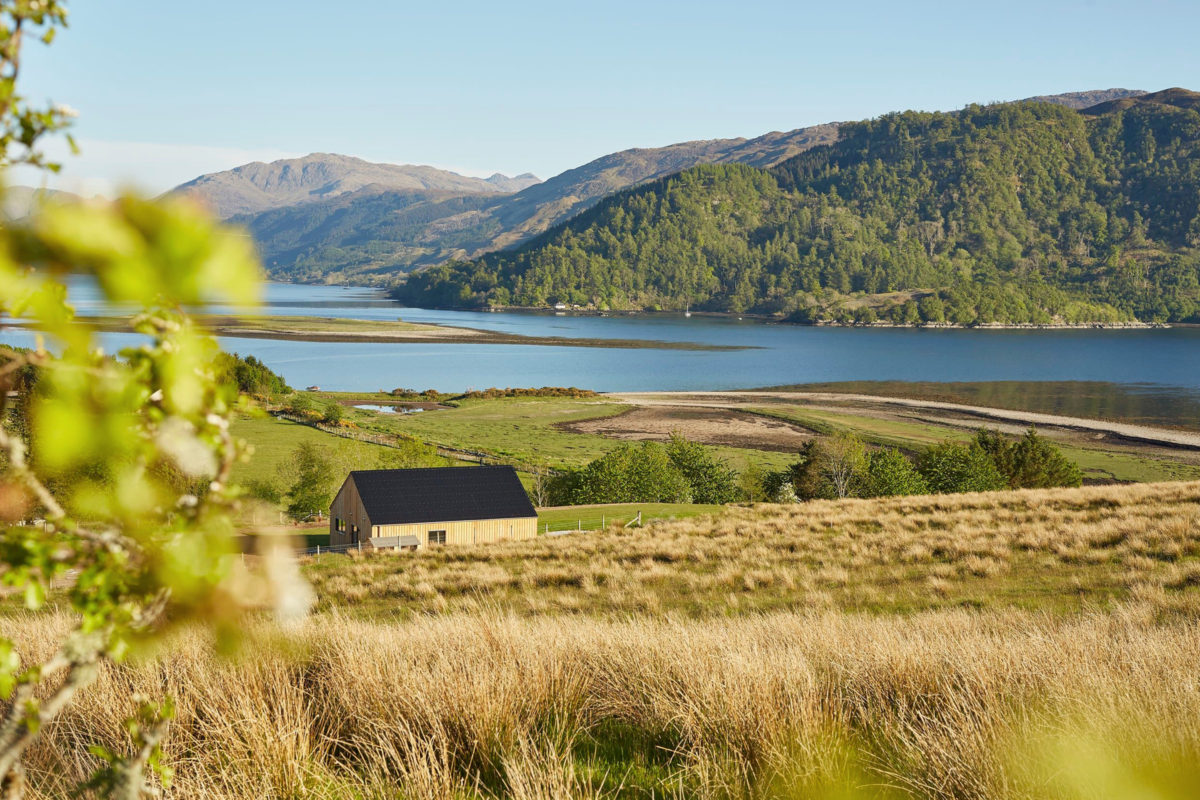
A lone Scandinavian-looking cabin from 57 Nord contemplates its life choices above a Scottish loch, surrounded by smugly photogenic hills pretending it’s always this sunny.
The luxury of slow living at 57 Nord: 57nord.co.uk .. a cabin I adore, can’t afford and will never book

This time of year encourages such delusions. There’s just enough light in the mornings to feel alive, but enough dusk to make retreat seem reasonable. You could slip away for a week and no one would really notice. The trees are almost bare, the pubs half-empty, and the countryside looks half-finished, as if waiting for someone to turn up with a notebook.

In my head, I’m dictating into my phone while trudging through leaf-sodden lanes or across a windswept upland. Evenings mean simple food, one-pot stews, bread, the sort of red wine you can chew, and perhaps the odd night at a pub, purely for proof of humanity. I’d come back leaner, calmer, possibly holding the first chapter of The Book*.

Except I never go. Yes, a little because of fear or money (and the logistics of family life) but mostly because the fantasy works too well.. The idea of the week away does its job before it begins: it restores a sense of possible order. Just imagining the solitude feels productive, which is as close to it as most of us ever get.

What makes us crave it? Age, maybe – the mid-life suspicion that our attention’s been pawned off to apps and admin. Or perhaps it’s just winter and that soft command to draw inwards, to tidy one’s psyche before spring. Either way, the idea of leaving it all behind has become one more thing to scroll through, admire … and postpone.

I like to think it’s not laziness but calibration by which I mean a quiet audit of what would actually change if I went. Would I write more? Probably not. Would I look less at my phone? For a day, perhaps two. Mostly, I’d just be somewhere else doing the same gentle dance of distraction, albeit with better lighting and a view.

Still, the fantasy has its use. It reminds me there’s another tempo available, one I could, in theory, choose. And maybe that’s enough for now. Some people meditate. I browse cabins I’ll never book. We each find our way back to silence, even if it’s only through the screen.

AI: This piece was refined with AI, for the image prompt, tags, excerpt, and a little sub-editing. The ideas, references, and rhythm are mine and were composed in Surrey, not Scotland.

* this is my first public announcement that I do have a (non fiction) book in mind. It may also be the only time I ever mention it.

Tagged , , , , , , , , , , , , , , , , , ,