Tag Archives: design strategy

I went back to Uni. What I learned on my Human-AI Interaction course.

The bit that mattered was never the screen.

Take this example. You’re looking to buy a used car. You shortlist three cars and start nudging the finance up and down. Nothing dramatic, just enough to see what an additional £30 a month buys you. A slightly newer plate perhaps. Fewer miles. A bit more punch, or practicality.

Then you click through to a retailer. Your shortlist disappears. Your modelled finance examples disappear. You’re on a blank form, being asked questions your behaviour has already answered. Nothing failed in any obvious way. The system simply dropped the ball precisely at the point it needed to hang on to it.

That is still how a great deal of digital experience works.

You can now generate a respectable interface in seconds, in Figma Make or hell even Gemini. It’ll be clean, structured, and broadly acceptable. Enough hierarchy to feel coherent, enough restraint to avoid embarrassment. It looks like design, which is why people are getting carried away and, frankly, why people are being laid off.

There is too a growing belief that interfaces are becoming fluid. Instead of designing fixed screens, we define components and let agents assemble the right interface on demand. Ask for something, get a form. No navigation, no structure, just translate intent directly into interaction.

Concepts like this are gaining column inches, conference talks and LinkedIn views because they’re brief and intelligible. However, as soon as the interaction extends beyond that moment, the weaknesses become apparent. Context isn’t carried forward properly. Earlier decisions aren’t respected. The system produces something plausible but slightly off, and the user ends up repairing it, effectively doing the work we’d hoped to have eliminated. The surface has improved. The underlying behaviour hasn’t.

Over the past eight weeks, I’ve been working through a Human–Computer Interaction and AI course with the University of Cambridge (Advance Online), and it has been mildly uncomfortable in the way good things often are. It stripped things back to a version of UX that feels almost unfashionable: define the problem before you touch a solution; model the system in terms of what it actually does, not how it looks; decide where control sits between human and machine and how that moves about; draw a boundary and accept responsibility for what happens inside it; then prove the thing works rather than just assuming it does.

As I worked through the modules, it was charmingly familiar and obvious that none of this was new. It just hasn’t been particularly visible for a while. The industry has been busy polishing UI surfaces and calling it progress. AI hasn’t changed that per se, but has made the gap harder to ignore. You can now generate something that looks finished without having done any of the thinking that would make it hold together.

That’s also why a lot of current AI design work feels slightly misplaced, and why the obsession with UI product designers irritates me. There are people doing very good work on interfaces and component systems. Zander Whitehurst is one of them, and they look excellent. But that work sits downstream of where the real difficulty now is. You can refine the surface as much as you like; if the system doesn’t carry intent, it won’t survive contact with actual use.

The “democratisation of design” line doesn’t stand up to the faintest scrutiny. Sure, more people can produce interfaces, and there’s been a lifting of all boats in terms of aesthetics. That’s true. Almost none of those interfaces are grounded in any understanding of what the user is actually trying to do. They meet a baseline. They look competent. They solve very little.

What has been democratised is production.

The discipline that underpins it, the work of defining what matters, what to surface, what to hide, what to carry forward, and where the system should stop and ask, has not been automated. It has been skipped.

The shift to intent-based interaction makes that gap more obvious. You are no longer stepping through a process one action at a time. You state an outcome, and the system attempts to get you there. That changes the shape of the problem. The system has to interpret intent, apply constraints, decide what to do next, and show enough of its reasoning that you can tell whether it has misunderstood you. When it gets that wrong, it doesn’t look like a broken interface. It looks like a reasonable answer that doesn’t quite fit, which is both harder to spot and harder to recover from.

This is where the work is moving.

If interfaces can be assembled on demand, the value shifts into what sits behind them: how intent is captured, how memory is handled, what the system is allowed to assume, when it must ask, and how it behaves when it reaches the edge of its understanding.

Friction becomes part of that. For routine actions, speed is fine. For anything with consequence, removing every pause produces something that feels smooth and behaves carelessly. A system that never slows you down also never asks you to think.

There is a second effect that is easier to miss. If the system does more of the execution, the user does less of the thinking that used to go with it. Over time, that changes behaviour. Trade-offs become less visible. Assumptions go unchallenged. Outputs are accepted because they look plausible..

You end up with users who are comfortable approving things they don’t fully understand.

The risk here isn’t replacement. It’s avoidance. If the problem isn’t defined, if the constraints aren’t understood, if the system isn’t designed to carry intent across time, then the speed of output doesn’t help. It just produces more surface, faster, over the same unresolved issues.

That is already visible. The used car journey doesn’t fail because the interface is ugly. It fails because no one took responsibility for the whole. The same pattern is now being reproduced with better tools and more convincing output.

If that continues, the work doesn’t disappear.

It just gets left to the user.

AI: I used ChatGPT to tidy up some grammar and I used Gemini to pick some holes in the piece to strengthen the arguments.
Tagged , , , , , , , , , , , , , , , , , , ,

The Cost of Looking Away

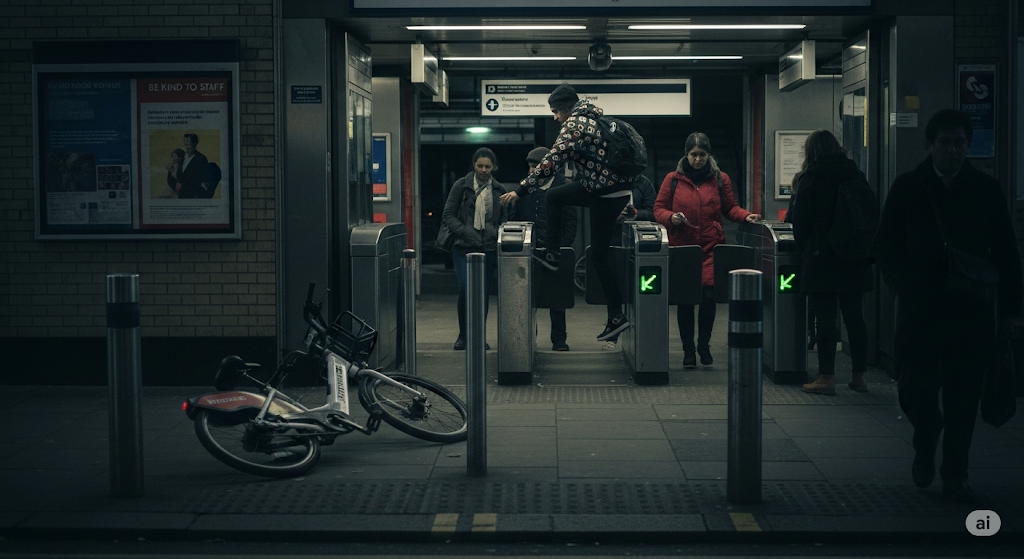
A dimly lit London Underground station entrance at street level in the early evening. A rental e-bike is on its side across the grimy pavement in the foreground. In the background, a young man in casual streetwear jumps over a fare gate. Other commuters in the background are looking away. The scene has a cinematic, slightly desaturated look. You can see wear on the station barriers and a faded "Be Kind to Staff" poster.

The real scandal isn’t the kid hopping the Tube barrier. It’s the fact no one even looks up.

London’s decline into low-level disorder hasn’t happened overnight, and it hasn’t happened through some grand cultural collapse. It’s been a slow demagnetising of civic expectation, one graffitied carriage, one dumped rental bike, one unchallenged fare-dodger at a time.

And for all the commentary, the plans, the posters, the social media pleas from Sadiq Khan gently asking us to be kind to TfL staff, the system continues to fray. Because it’s not just about policy. It’s about psychology. A city, like a child, becomes what you quietly tolerate.

Take a stroll through Camden. Or Putney. Or Vauxhall, or Shepherds Bush. It’s not just the spike in phone thefts or fare evasion. It’s the collective flinch away from even acknowledging it. Authority is outsourced, first to security guards who are contractually told not to intervene, then to CCTV operators watching with all the urgency of a screensaver. The presence of order exists only in post-event paperwork.

This isn’t a new problem. Every generation thinks it invented disorder. But what marks this moment is the collapse of presence. The people who once embodied low-stakes authority – ticket inspectors, bus conductors, even the occasional stern-faced commuter, have all retreated. And without those micro-moments of correction, the boundary dissolves.

Because there was a time, not utopia, not Victoriana, just the mid-2000s, when the Tube was cleaner, antisocial behaviour meant something, and fare dodgers looked over their shoulders. And crucially, someone would have said something if you left your bike in the middle of the pavement.

Now? Saying something feels like an act of madness.

Even a relatively fit man in his forties (ahem, let’s say one with the outline of muscle memory from rowing and once-upon a time lifting in the gym) thinks twice. Not because he’s afraid of being shouted at. Because he might get stabbed. Not metaphorically. Actually stabbed. By a 14-year-old with a 9-inch blade and nothing to lose.

So we look away. We (not I, reader) film instead of act. We turn up the headphones and pretend not to see. Because the calculus has changed. What used to be a moment of friction – “Oi, pack it in” – has become an existential risk assessment. Is this worth dying over?

Yes, austerity hollowed out visible staffing. But not every act of disrespect can be blamed on poverty. You can’t say the teenager in £100 sliders and a Balenciaga hoodie is evading the fare because the system failed him. Nor that the grad in Clapham dumping a Lime bike across the pavement is a victim of systemic neglect.

This isn’t all about deprivation. It’s about detachment. From consequence. From collective norms. From the sense that shared space has shared rules.

So what do we do? Because the answer isn’t doubling police numbers or shaming people on social media. Culture doesn’t change through crackdowns. And civic behaviour isn’t restored by a stronger PR campaign.

You don’t police culture. You design for it.

London’s problem isn’t just one of law or design, it’s one of contrast. As other towns and smaller cities have quietly levelled up, the capital has coasted on past prestige. Behavioural standards lag not because Londoners are worse, but because London is no longer best. The Tube is better, but the civic fabric? Worn thin. What once justified the stress (the vibrancy, the culture, the sheer aliveness) now feels out of balance. You dodge fare evaders and dumped e-bikes, but for what? A Pret subscription and an off-peak West End ticket? Meanwhile, Sheffield has sourdough, Manchester has swagger, and Kent has all the ex-London chefs who could no longer justify paying £3,500 a month to fry mushrooms near a bin store.

That’s where behavioural science (and, yes, some gentle psyops) comes in.

Behaviour is context-dependent. What people do in public space is shaped by cues, affordances, and social norms more than personal ethics. If the system is designed to look away, people will act accordingly. So design it to notice. Design it to remind. Design it to suggest.

This doesn’t mean building a digital panopticon. We already have that. London has more CCTV coverage per square inch than any city outside China. But the surveillance is abstract, remote. We’re watched, but not seen. There’s no friction. No microdose of shame. No moment of hesitation.

What we need to rebuild is civic equivalent of a raised eyebrow.

Start small. Use nudges that aren’t insulting. Place messages where norms are breached, not in corporate safe zones. A sign at the Tube barrier isn’t for the person tapping in, it’s for the kid about to hop it. Use tone accordingly.

Bring back the sense of being noticed. Not punished. Not tracked. Just observed.

We could do worse than call in Rory Sutherland and a few behavioural strategists with teeth. The work they’ve done on transport psychology (understanding how we navigate space, status, and visibility) is ripe for civic deployment.

Imagine a pilot scheme on the Bakerloo Line that doesn’t install more barriers, but changes the posture of the space. Mirrors. Eye-level signage. Floor friction that makes hopping awkward. Subtle lighting changes that simulate visibility. Staff trained not to chase, but to notice.

We could run this for twenty years. Quietly. Iteratively. Without press releases.

The point isn’t to eliminate every act of disorder. It’s to rebuild a culture that expects better.

Because somewhere along the line, shame became taboo. Correction became aggression. We outsourced authority to laminated posters and video cameras and hoped it would be enough. It wasn’t.

Civilisation is not a vibe. It’s a ritual.

And it’s time we noticed what we’re no longer willing to defend.

AI disclosure: AI used to sub-edit the copy and perform factual research which was cross-referenced manually. AI generated the image (obviously), excerpt and tag list to enhance exposure.

Tagged , , , , , , , , , , , , , , , , , , ,