Tag Archives: design

Ghosts in the Picture Book

The other day, I was reading a children’s book with our daughter when I saw it: a corded telephone. Black, wall-mounted, with a dangling spiral wire. The sort of phone that last rang in anger sometime around the Blair years.

Roger Hargreaves's; Little Miss Neat picks up vintage style corded black telephone.
The Telephone rang. Little Miss Neat picked it up.

A few mornings later, it happened again, Baby Club on the BBC, all primary colours and soft clapping, and there, on the play mat , was a car. Not one she’d ever recognise. A boxy saloon. Straight-edged. Round headlights. The kind of thing you’d find idling outside a golf club in 1987.

What’s odd isn’t that these images exist, they’re charming, even lovingly drawn. It’s that they still feel like the default. Most phones today are glass bricks. Most cars look like they’ve been inflated rather than put together in a factory.

But when we illustrate for children, we reach back, not to what they know, but to what we remember. This isn’t a developmental crisis. Children don’t need realism to read meaning.

Jean Mandler’s research (thank you ‘Ai research team’) showed they use schematic categories, “car,” “dog,” “phone”, not photoreal recall.

Furthermore, Ellen Winner proved they can grasp symbolism early on (i.e. hey don’t need realism to understand things). So, no one’s confused. That’s not the point. The point is that these images persist, long after their referents have disappeared. The floppy disk still means save. A film reel still means video. A telephone still curls like a question mark.

We say it’s just design shorthand, but it isn’t. It’s something stickier.

These are the ghosts of our interfaces, icons of touchpoints no child will ever touch.

Gunther Kress‘ observations describe how meaning doesn’t update on command. It drags history behind it and changing the meaning of symbols requires overcoming an awful lot of cultural inertia. And children’s media, shaped entirely by adults, ends up as a kind of curated hauntology: a world that looks nothing like theirs, but everything like ours did, right around the time we were their age.

They swipe past rotary phones, expect Santa to come down a chimney no longer connected to a fireplace, draw little square cars with four doors and no raised suspension. It’s sentimental and not remotely sinister but it does mean they grow up consuming artefacts of use they’ll never need.

And maybe that’s fine. Maybe it’s like castles in fairy tales. But it’s hard not to feel the ache of it, that their books are filled with our objects, our past, our cultural residue.

Perhaps more concerningly, they’re not learning to navigate the world as it is. They’re learning to decode the leftovers of how we once did.

So I find myself wondering now what a picture book drawn from today would look like. Would the car even be recognisable? Would anyone bother sketching a glass rectangle phone? Or would the page just show a toddler, alone, swiping at the air, waiting for something to respond.

AI: This piece used AI to help me research the psychology references and summarise their observations. I used it for the tags, excerpt, and a little sub-editing. The ideas, references, and anecdotes were all mine.
Tagged , , , , , , , , , , , , , , , ,

Time Returned, Time Resold

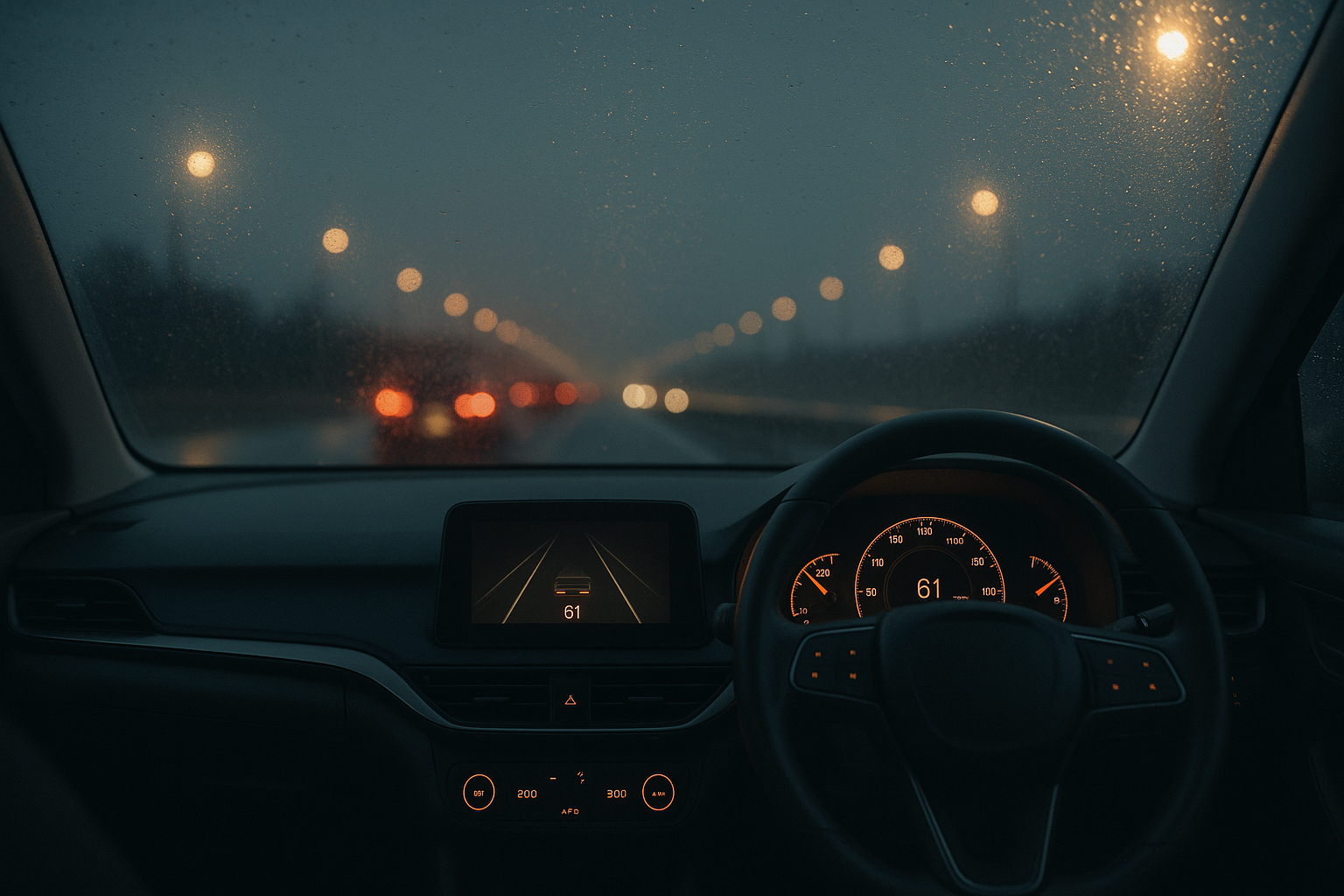
Rain-blurred motorway at dusk viewed through a windscreen; dashboard lights glow amber in an empty driver’s seat — a quiet image of autonomy and time unclaimed.
Autonomy promised freedom. Instead, it gave us metrics.

Every few years a new invention turns up promising to give us time back. The dishwasher did it, then the calendar app, now the self-driving car. Efficiency, they say, is liberation. But the minutes never come home. They’re quietly re-employed: answering messages that weren’t urgent until we saw them, scrolling through news we already half-read. We don’t get more time. It just comes back wearing a different outfit.

Design now speaks the intoxicating language of generosity. We’ll save you clicks. We’ll make it seamless. Lovely words, but they come with a tempo you didn’t choose. The system nudges, reminds, congratulates you on your streak. Even the oven chirps when it’s done pre-heating. Helpful, yes – in the way a personal trainer is helpful when all you wanted was a walk.

Efficiency was meant to hush the world, not make it chatter. Parcels update you mid-journey, cars suggest faster routes, TV apps interrupt the credits to make sure you don’t go off to bed just yet. You start to feel managed by your own apps and appliances. Is it me, or do they all sound slightly pleased with themselves?

Still, there is a deeper promise in all this autonomy. Because the best thing about a self-driving car isn’t speed, it’s permission. The choice to drive when you want to: for rhythm, for presence, for drivers like me who relish the satisfaction of line and camber, and to switch off when you don’t. The long crawl north to the Lakes. The dawn blast to the airport. The late-night, rain-spray-soaked slog home when you’d gladly hand over the wheel and let the motorway unspool while you exhale, watch the window-light flicker, maybe half-doze through an episode of something forgettable. Control should be optional, not constant.

That’s what the technology could be about: selective surrender or a quieter freedom. But for some unfathomable reason, the marketing and product design departments have decided autonomy is best packaged as constant optimisation. That means another dashboard app full of metrics and prompts and juanty reminders. We built cars clever enough to drive themselves, then gave them personalities that never stop talking.

Real luxury now isn’t speed but discretion: the right to decide how long something should take. To drive when you feel like driving. To look out of the window when you don’t. Technology can make both possible.

Convenience promised to return our hours, but mostly it’s taught us to account for them. Every minute feels spoken for. Perhaps the odd thing is how willingly we’ve agreed to it and the peculiar pleasure we take in shaving seconds off tasks we didn’t enjoy anyway.

Maybe the best thing a self-driving car could do is forget the ETA and let us forget, too.

AI: This piece was refined with AI, for the image prompt, tags, excerpt, and a little sub-editing. The ideas, references, and rhythm are mine.

Tagged , , , , , , , , , , , , , ,

Apple focussed on design as their signature

http://www.youtube.com/watch?v=Zr1s_B0zqX0

A series of videos, one presumably a TVC, are a clear indication alongside the WWDC keynote this week that Apple is all about design, designing for people and a slavish attention to quality and purpose. It’s hugely encouraging for those of us in the industry of making [digital] stuff better for people. Even if I don’t particularly like the iOS 7 palette

Tagged , , ,