Author Archives: John Gibbard

The unreasonable consumer

On the 1st April Kara Pernice wrote a satirical piece on the NN/g blog calling on the user-centred design community to switch to creating difficult designs, for the benefit of humanity. I’m sure it was a jolly April Fool for the NN/g to post such an about-turn but in truth there is much we could do to reduce our obsession with making things easier for customers,  listening to their every whim and generally ignoring the realities of human existence in our pursuit of the utopian user experience.

I’ve written and spoken several times about intentional friction. It’s something I passionately believe in. From the smallest poke-a-yoke to the intentional deployment of dark patterns, there is a place for cognitive – even dexterity challenges – in user experience (see William Peng’s post on sign ups) and to deny them is to apply flat earth thinking to our behaviours.

The unreasonable consumer

As these things often do, later I read a great post by Rubuss’ Mark McArthur-Christie on LinkedIn where he mused about a customer service issue many of us have experienced, the customer that is beyond help and satisfaction. It inspired some additional thinking around how we might categorise these personas:

  • The naive dogmatist – a customer who is convinced that there is only one way things should be, often formed of a collection of misunderstood information: consumer rights, archaic business structures or some previously used process. Most likely to say “I know you can give me a discount”, “I know my statutory rights…”
  • The intransigent utopian – a customer that believes that businesses should operate at a loss in order to fulfil every customer whim. Indoctrinated with the mantra that the ‘customer is always right’ and will not yield as they insist that any problem or issue is fixed in their favour regardless of the cost or implications to the business or, for that matter, other customers. Most likely to say “I want to be compensated for my phone calls and be sent a brand new product tomorrow, personally by the Chairman”
  • The confrontationist – Generally spoiling for a fight and actually enjoys the process of battling with front line staff, progressively picking off more senior members of the team until they get to speak to the biggest boss whereupon they’ll continue to shout and begins to sound a little deflated and resentful when solutions are offered. Most likely to say “I’m going to be putting this all on Tripadvisor” and “I have sent my complaint to the chief executive and am waiting outside for them in my car”


In user centred design we have to believe that the user is, by definition, a sacred cow. I’d contend that, although the entire herd are not for the abattoir,  we should at least consider some tactical ignorance. In my second piece on the subject, I will be exploring what it really means to listen to users and not resort to the tropes bandied around by a lazy community of precocious experts.

After 340 days of running you won’t believe what this local man discovered.

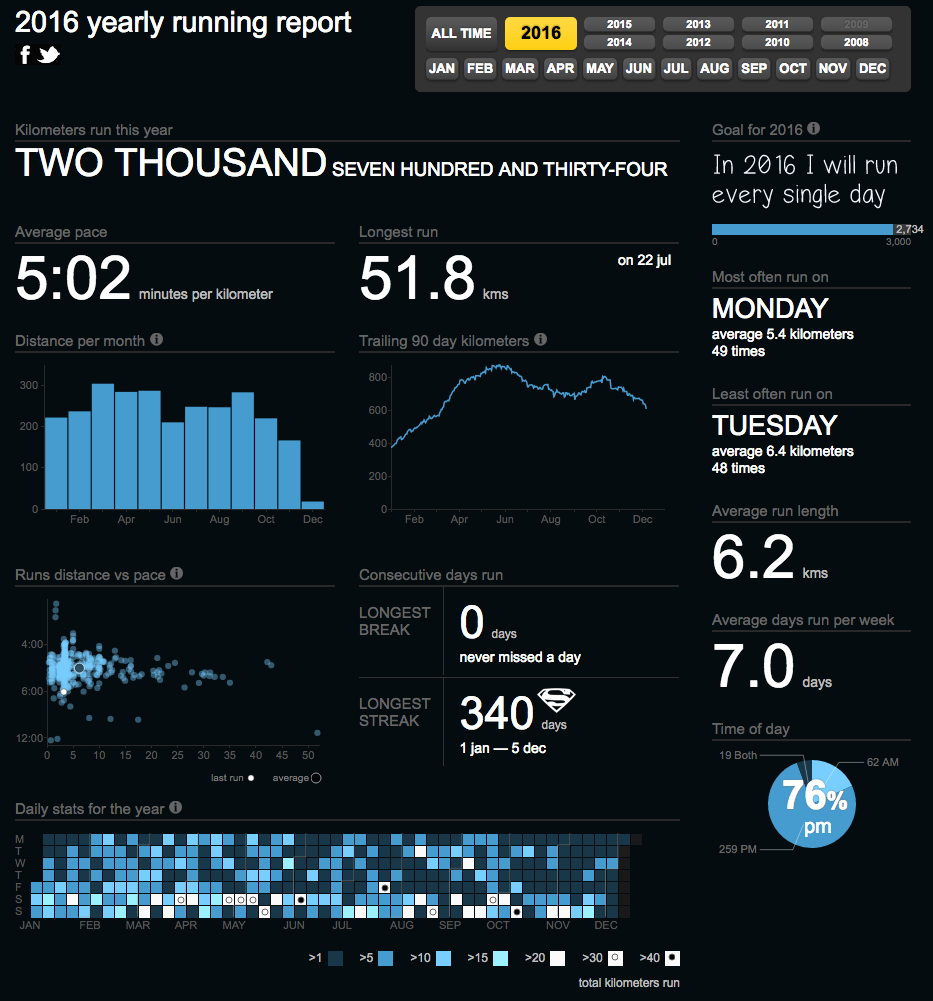
An chart summary of my year in running

I ran for 340 consecutive days before injury called time.

Yesterday I didn’t run. When I started out on January 1st this year I knew that whatever happened I’d be writing this post at some point. I’d have a body of runs to reflect upon, I’d have things I’d learned, I’d have a new level of fitness, a Strava record and a few Instagrams to show. Of course, I’d hoped I’d be writing it on 1st January 2017, not 25 days earlier.

As a runner in the age of ‘the quantified self’ and, dare I say it in a society that encourages it, I have become as fixated as anyone on the outcome. We’re hard-wired to value completion, if we didn’t where would we be? The pyramids might lie unfinished, Mona Lisa unpainted, the Apollo rockets unfired. Dialling back the hyperbole, this very human evolutionary trait has exerted its powerful influence on my desire to run every single day.

There were many days when a run was the last thing I wanted to do. The obvious reasons abound; cold, dark, wet, tired, hungry. There were nights that I ran in spite of emotional and logistical stress: I ran when Jo thought I wasn’t, I ran when I should have been home sooner, I ran the night after my son came home from a trip to A&E while Jo put him to bed. I’m not proud of the subversion, the missed moments with family nor the inevitable upset over mixed priorities.

But I am proud of the process. As time wore on I began to feel that the effort of making time every single day to plan ahead, get kit in the right place and at least a two-mile route to run meant that I could demonstrate to the many many people who say “I haven’t got time” that you really do. You don’t need to run every day of course and that’s not the point, the point is that two miles are not a difficult proposition when you’re asking for just 20 minutes a day.

Switching from that outcome focus and returning to the process, I’d like to highlight a few of the things I learned and developed along the way. In the plan for 2016 were two marathons, Stockholm and York. Although Stockholm wasn’t until June it did guide my efforts in the first months of the year. I tried to supplement the daily commute runs with the odd mid-week longer run and a long slow run at the weekend. Commute runs were reasonably quick efforts with bags which quickly had an impact on my shorter faster runs. parkrun times were consistently lower than before and I found my slow long run pace had got quicker even though effort remained the same. My most consistent high volume weeks were through the spring. The old commute run to and from Tabernacle Street was straightforward and effective. Combined with my simple work ‘uniform’, the months just ticked by in a largely positive fashion. I was surprised that the niggles came and went without developing into anything. My long-standing patellar tendon issues eased and I just kept going. Weight dropped off, not by design but by simple nutritional deficit. More on that later. Stockholm was a great race, hugely enjoyable and one I’ll look back on fondly. I felt I could even have gone a little quicker but the summer was still young and York was on the horizon. I had some great runs over the summer. Three fast timed miles at the City mile and Arethusa miles, joining Martin and Liz Yelling for my first super long day down on the South West Coast Path (SWCP) and then, later in the season, more SWCP running with Jo.

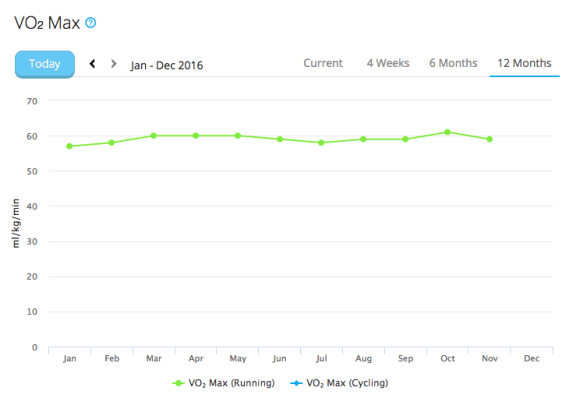
The hills, the mile speed and the strength work I did on those runs combined with some new routes around Surbiton had serious benefit. In fact, the need to find new routes really was a benefit. I found myself plotting by distance and exporting these to my watch, following unfamiliar roads and trails throughout Surrey and SW London. I got very familiar with the Thames Path all the way to Windsor or up to Battersea,  and occasionally beyond. I doubt I’d have done this without some desire to break away from the monotony of the commute runs. By the late summer and autumn, I was sufficiently focussed on York, albeit with lower weekly totals than the spring training block. I remember my final dawn-start long training run through Epsom and Esher that finished with a 5k parkrun and topped off a massive week for me. I ran a race I was really proud of (a PB 3 12′ 50″) and came off the back of it with a 18:32 parkrun PB and a VO2 max estimated at 61 ml/kg/min in October.


vo2-max

A plot from Garmin’s estimated VO2 Max during my runstreak


Looking back I wonder whether that’s where it really ended. Although I felt fast and was running injury free I didn’t really have a target in mind for the final three months other than finish. 2 miles (3.22k) every day. As a consequence, I resigned myself to a commute run most nights and the weekly totals plummetted. Injuries typically occur after a change in training; a volume or intensity spike, a change of surface or other environments. In my case, the move to a new office location meant my run back to Waterloo was shorter, faster and downhill most of the way. It was also now entirely dark and involved notably more kerbs, junctions and slow-moving pedestrians. This meant I was juddering to a halt from speed a lot more than the old (still frustrating) route from Tabernacle Street. I was slamming down hard off the kerbs and putting shearing and twisting forces through my ankles more like a midfielder than a runner. Added to that (and hindsight bias is strong at this point) I ignored a low-level niggling plantar fascia problem for several months.

The net result was an angry Achilles after a long run along the towpath in trail shoes. I thought it was just some soreness due to the conditions and shoes but it didn’t ease and I didn’t give it enough attention with NSAIDs, ice and massage. I saw my daily commute as an easy run, unaware of the more unconventional impact it was having. It hurt to run that route yet I could manage a comfortable easy loop at home and do an ordinary slow parkrun. But on Monday night I ran back to the station and early on felt a stabbing pain unlike the usual irritation. I carried on but with 800m or so left to run I jarred it again and i knew I couldn’t bear weight on it, there and then I knew it was over.

Presumptively I’d booked Liam for the Tuesday evening and had hoped that i’d wake up that morning feeling that seeing him in the evening would mean he’d just be helping me to release some tension and I’d have managed a run in the day. But no. It just wasn’t an option, I had pain all day just walking and found myself wincing each time I climbed or descended stairs. The prognosis isn’t bad. Recovery should be straightforward with a decent regimen of slow and heavy resistance work after the acute inflammation has eased. Liam supports active recovery so I expect to be able to jog lightly soon enough and as I write this 48 hours later there isn’t pain walking. The biggest injury (apologies for the rather obvious cliche) is in my mind.

I’ve taken a lot from being part of and reading about Martin’s failed SWCP run earlier this year. The lengthy post-mortem on Marathon Talk and on his blog have helped put this kind of personal challenge in perspective. It will always smart that I fell short but writing this now and reflecting on what I taught myself over the period is fantastic.

  • I’ve run more than ever – but I know I can do even higher weekly distances in future.
  • You can run on rest days, as long as you run at markedly lower intensity, lower volume or both.
  • Speed work has a huge benefit. Regular endurance work has a huge benefit. If you can work both into your schedule you will move beyond your ‘local maximum’.
  • There are very few days and very few environments where you can’t get a run in. It requires prediction, planning and a tolerance for what constitutes a run.
  • You don’t need a tonne of kit. I wore two-three pairs of shorts and the same number of technical shirts. I did burn through at least three pairs of Adidas adios boosts but I bought previous season models and used Vitality discounts to keep these purchases under £100 each time.
  • Foul weather running is grim but nothing you experience in the non-mountainous UK is a reason not to run.
  • It helps to have a wife who runs and running buggy. Tolerance from my son and empathy for my behaviour from Jo and our son was hugely beneficial.
  • It helps having colleagues and an employer who support your lifestyle. Not being on-time, wearing running kit in the office, being a Strava Wanker can be irritating. Dare just let me be and, even occasionally, celebrated what I was doing.

So with my evenings a little calmer, my commute a little longer and my VO2 max a little lower, I can settle into a few weeks of planning what 2017 might hold. There’s precious little point sharing my present thinking here as it’s just as likely to be different tomorrow. There is the small matter of the British Indoor Rowing Champs on Saturday with my old University crew mates for which I have not prepared, not rowing a single stroke before the day. After that I know my motivations are in several directions: vanity to gain weight and muscle mass, strength and flexibility to protect against injury more, pleasure to enjoy running again at a variety of intensity, volume and environment and finally a few soft PBs that need some attention (as well as some hard ones too).

It was a long post, as much (more?) for me than for you, dear reader, but I hope valuable to some in various ways.

All the Strava data
My Smashrun visualisations showing trailing averages, intensities etc.

Tagged , , , , ,

The Trip 2017: where next?

We’ll be off again in 2017. We’ll be going SW it seems. Take a look at this post (and the summary of our October 2016 homage to The Trip).

thetrip2016homage's avatarThe Trip: a 2016 homage

As the dust settles and the bright autumnal days descend into a more wintry gloaming, the only remedy is to start planning the sequel. It won’t be Italy, or Spain. As discussed in my earlier post, Italy is a less achievable facsimile. And Spain, the destination of the completed but un-aired third series, is entirely unknown.

It’s time to be brave. Original to a point but clearly derivative and domestic.

It’s an uncontroversial view to say that The Trip has a proven formula. Road trip + picturesque locations + fine restaurants and accommodation + a cultural (literary) thread. Surely that formula can be applied to any number of locations in the UK. It is not entirely subjective to say that the UK is blessed with beautiful landscapes, fine dining and a rich cultural narrative. It is perhaps also no coincidence to postulate that these things combine most happily in areas…

View original post 381 more words

Hipping Hall and The Angel at Hetton

It has been a feature of the hotels and accommodation up here that the central heating is cranked up to a level that would be banned as torture under the Geneva Convention. Still ravaged by sicknes…

Source: Hipping Hall and The Angel at Hetton

Holbeck Ghyll

and so we entered, met by a small man in a box room

Source: Holbeck Ghyll

Cartmel and Greta Hall

From now on The Trip gets a little truncated. I have never been good at maths but I know that six into four won’t go. Some divergence from canon is necessary. So today began at Bashall Eaves …

Source: Cartmel and Greta Hall

The Inn at Whitewell

With the best intentions of leaving at 40 minutes earlier, it will come of no surprise to any who know us well that we pulled away at 9.10am. Slipping with remarkable ease through the Surrey rush h…

Source: The Inn at Whitewell

The Trip: setting off

It’s not just me that writes stuff about me. Here’s my twin brother writing about something properly interesting that we’re doing next week.

thetrip2016homage's avatarThe Trip: a 2016 homage

I suppose the idea began the first time I saw The Trip, inasmuch as it started from an idle thought  along the lines of “I’d like to do that one day”. The first time I saw it was on its first airing in the UK, on BBC2, back in the autumn of 2010. Life was different then. Two years before I had my first child, four years before my second. Another series has taken Steve and Rob to Italy (2014) and, as I write, they are on location filming the third series in northern Spain.

From time to time it came back to me. The movie version on a transatlantic plane in 2011. The second series broadcast in Spring 2014. Passing mentions in interviews, podcasts and articles. A Children In Need sketch. A lingering memory of a particular impression that cried out to be retold or shared on…

View original post 1,061 more words

Protected: Wardrobe minimalism, changes for 2016/7

This content is password-protected. To view it, please enter the password below.

Tagged , , ,

Pound Cost Averaging: Why investors and investment houses should learn from runners.


14178886934_4f3626173f_z

Make the most of the downhills in your investment strategy (Alexis Martín, Flickr)


Analogies can be hit and miss, but that doesn’t stop me from deploying them almost constantly in conversation. Because running is such a significant part of my life, there has been a tendency to see much of the work I do through the lens of physical activity and effort proves to be highly relatable in many service journeys.

Thanks to my one-time boss and good friend Darren, I was engaged in a conversation on Facebook recently pertaining to investments. With an undulating landscape of financial predictions, the chat was about how your unsophisticated public investor might make the right decisions about how much to invest and when.

Darren highlighted the strategy of Pound Cost Averaging, something I wasn’t aware of and which can be described thusly

The basic idea behind pound-cost averaging is straightforward; the term simply refers to investing money in equal amounts at regular intervals. One way to do this is with a lump sum that you’d prefer to invest gradually–for example, by taking £1,000 and investing £100 each month for 10 months. Or you can pound-cost average on an open-ended basis by investing, say, £100 out of your paycheque every month. The latter is the most common method; in fact, if you have a defined contribution pension plan, you’ve probably already been pound-cost averaging in this way.

Source: Morningstar

Now, that’s one way of essentially distributing an investment over time to spread the risk, prevent you getting carried away trying to read the market but keeping you ‘in the zone’ of investing when you might not feel like it.


Aside
There’s good evidence that it’s a very sensible strategy, albeit one that is not at the aggressive end of possible returns. Writing with refreshing candour in  The Spectator in November 2015 Louise Cooper highlighted how such a simple approach is a solid antidote to the lack of expertise that Fund Managers really have.


Now, what I’d like to see – and what interested me about Darren’s comments – was the potential to flex these regular contributions in line with the market’s movements. This is where the analogy really begins.

As a long-distance runner, the absolute best thing you can learn in an event like the marathon is pacing. You want to distribute the effort across the race and there’s some really good literature to support it. No course is completely flat and this means you have to modify the effort to match the gradient, you ease off a bit on the uphill and, within reason, make some benefit on the downhills. Using Heart Rate as a guide you might aim for a consistent effort of 165 BPM, keeping that constant on hills means dropping pace, on the downhills your heart is under less load so you can speed up a bit. Recently the website Flying Runner allowed you to create a minute-per-mile pace band that reflected the slight modifications you’d make throughout the race depending on the gradient or effort required.

Now consider investing, let’s say you want to invest £10,000 this year. You can trickle that out evenly across the year in £833.33 increments, assuming a flat market. But what if you wanted to follow the FTSE and say invest a little more when the market is on a downturn and invest a little less when it’s climbing? Doing so would make the most of the market movement but keep you within a framework that spreads the load.

There are issues with this approach of course: a period of consistent decline might over-stretch a finite investment pot, so if I put £850 in for the first 4 months of the year then I’ve used up more of my £10,000 but with no guarantee that I’ll make it up if the market doesn’t subsequently ascend. That’s a crucial difference. In the marathon, we know the profile and the distance of the course in advance and can plan how much to scrub off or add on to our pace with the gradients and the total distance predetermined. That said, this is a longer play than a marathon and a decade of investing this way is sure to see the amounts even out. The problem then becomes setting a monthly amount that you can afford: For example setting hard maximum investment and a hard minimum that is reviewed each year according to salary changes.

The second issue is fees and logistics. The sad truth is that nobody appears to be setup to allow the public to effortlessly invest in this manner. Often each investment incurs a commission thereby wiping out the gains if you’re making 12 of them per year. Additionally, no provider appears to offer automatic modifications that track the market gradient against your personal tolerances [happy to be corrected], although Share Centre certainly support a savvy customer doing it themselves. Evidently, there’s nothing to stop one doing it oneself with a spreadsheet and a diligent approach to calling in or going online to tweak the figures. Does this constitute a direct example of where Big Finance is theoretically working against customer behaviour by penalising us through regulatory-inflicted charges? Is it an example of an opportunity that could be exploited by FinTech, able to quickly build a front-end to an investment vehicle that is aligned to plausible customer behaviour? Well, until I can find a service to meet my desired approach I’ll just have to work on my own Google Spreadsheet and work towards the release of the first endurance-inspired investment strategy.  Given that the Brexit marathon starting pistol has just been fired, perhaps now is the time to, caveat emptor, give it a go?