Tag Archives: garden design

The cult of the worthy garden

In The Times yesterday, as we descend into a storm-filled few days of autumn, there was a little glimpse of Spring ’26: the line-up for the RHS Chelsea Flower Show in May. Britain’s annual proof that we can still grow things even if we can’t quite govern them. Every year the press release reads a little more like a mindfulness pamphlet, hope, resilience, healing through nature. May’s line-up is depressingly familiar: Parkinson’s, asthma, gynaecological cancer – each of course exquisitely planted, each designed to make one feel faintly guilty for not being ill yourself (or worse, triggering the health anxiety you fight almost daily).

This is far from a dig (!) at the designers. They’re extraordinary – and the reason I return year after year. Some of the most inventive visual thinkers and horticultural artisans in the country. You could hand them a brief about midlife ennui and they’d produce something quietly transcendental. But notwithstanding this world-class craft, the culture that surrounds them (the commissioners, sponsors and curators, the gushing BBC scripts for reverent narrators describing the “healing”) rather wrings the joy out of horticulture. And, I might argue, severs the connection from our own plots where we aren’t putting in corten steels laser-etched with messages from sympathy cards sent to Grandma when Grandad died.

For the last decade, Chelsea has sounded less like a flower show and more like a group therapy retreat funded by Coutts and serving South African rosé. Every garden, sine qua non, must mean something. Every sponsor must emote through the plant list and recycled-paper design statement. The law firms are at it too, Corporate Britain has discovered mortality and it must keep workshopping it.
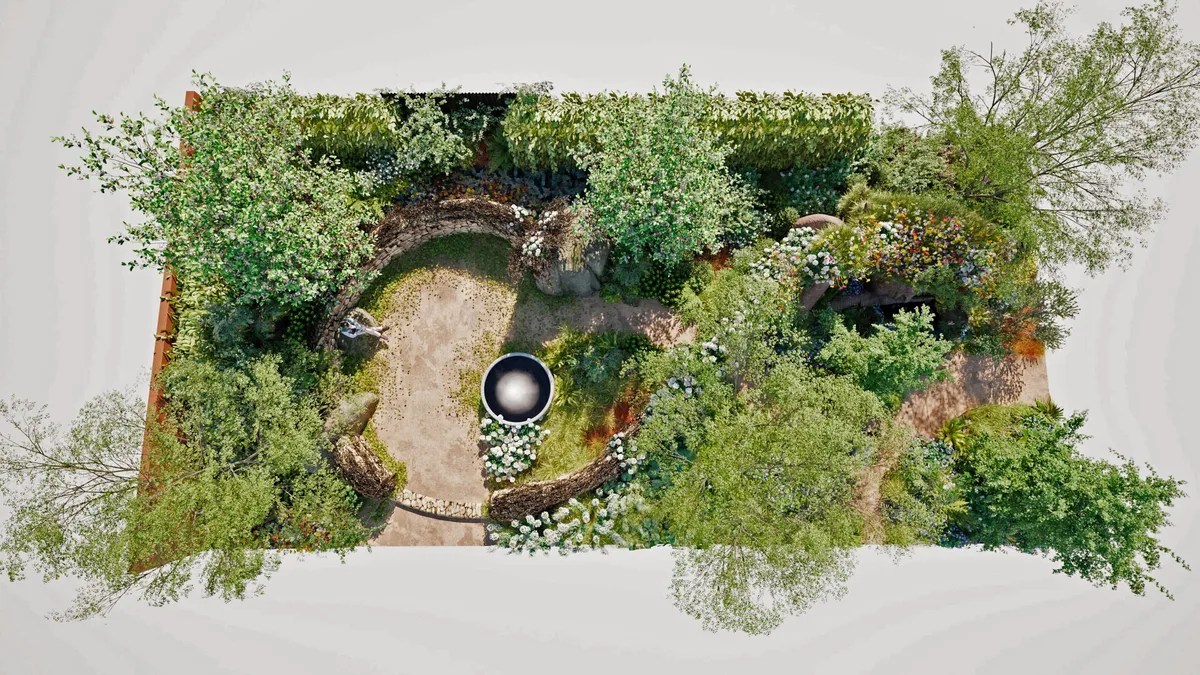
Aerial view of the Campaign to Protect Rural England – On the Edge show garden designed by Sarah Eberle for the RHS Chelsea Flower Show. The design features a circular, sunken seating area bordered by curved dry-stone walls, a reflective black water bowl at its centre, and densely planted perimeters of trees, shrubs, and wildflowers in green and white tones. The layout creates a naturalistic, enclosed sanctuary with winding paths and layered planting that evoke the edge of a woodland or coastal landscape.
Particularly looking forward to Sarah Eberle’s return to Main Avenue — one of the few 2026 show gardens with a brief that feels refreshingly light of touch.

Of course, a sombre brief needn’t make a sombre garden. Most of these designers still find moments of light and sometimes even laughter amid the gravity, that’s their genius, natch. But the problem is saturation. When every garden carries a diagnosis, the cumulative effect is numbing at best and quietly oppressive at worst. You can admire the craft, the planting, the colour, and still feel the weight of mortality pressing against the rope fence. One or two gardens about illness are moving; a dozen and it starts to feel like palliative care with mottled sunlight. The tragedy therefore isn’t in the planting, it’s in the packaging. Even when a designer finds joy, the institution rushes in to label it therapy.

Ten years ago (and perhaps I misremember) you might have had one or two charity gardens, their presence was powerful precisely because of that juxtaposition. Now almost every plot is tied to a medical condition, social cause or climate anxiety. The messaging has become so homogeneous it borders on satire: “healing,” “hope,” “resilience,” the RHS bingo card of benevolence. The poignancy cancels itself out among a cacophony of good intentions, white noise amid the frothy borders and swept pavers.

Of course these causes matter; it’s simply that the monoculture of worthiness leaves little room for unfettered joy. The very people (RHS members and the paying public) say it outright in the comments: “God forbid we could just have lovely, liveable gardens.” Others confess they no longer bother going, the crowds, cost and piety becoming too much of a hurdle to clear just to enjoy the flora. It makes one wonder whether the charities have done a cost-benefit analysis on being yet another earnest voice in a field of them.

A while back I wrote about human-centred garden design, the idea that landscapes should serve the people who live in them, not the narratives imposed upon them. I still believe that. But the pendulum has swung from self-expression to self-help. Designers stopped building for themselves, only to start building for someone’s trauma instead. The irony is that true human-centred design, the kind practised by Zetterman, Pearson, Wilkinson or Nordfjell, already is healing, precisely because it doesn’t insist on it. Their shared language of calm geometry, natural materiality and measured restraint gives people space to feel, rather than instructing them what to feel, elegant evidence that joy and contemplation can coexist without a press release or a prime-time TV walkthrough to explain it. A well-made garden gives you peace without telling you you’re broken.

Every so often, something still slips through, a garden like 2025’s Monty’s Radio 2 Dog Garden plot, joyous, affectionate, full of warmth, and you remember how good Chelsea can be when it drops the self-consciousness and simply revels in life.

If I were a bank or a law firm with money to spend, I’d commission rebellion: a garden about the thrill of travel, the dynamism of the next generation, the sheer optimism of growth. Not a metaphor. Not a manifesto. Just a riot of clever planting that exists because it can.

Because all beautiful gardens are healing. They always have been. They don’t need to say they’re healing; they just are. And that’s the point the RHS seems to have forgotten – that beauty itself is the therapy. If the great British flower show can’t find joy in flowers any more, if every petal must carry a moral story, then perhaps it’s not resilience we need, but relief.

Come on, RHS. Lighten up.
Tagged , , , , , , , , , , , , , , , , , , , ,

A National Arboretum for the Victims of Covid19

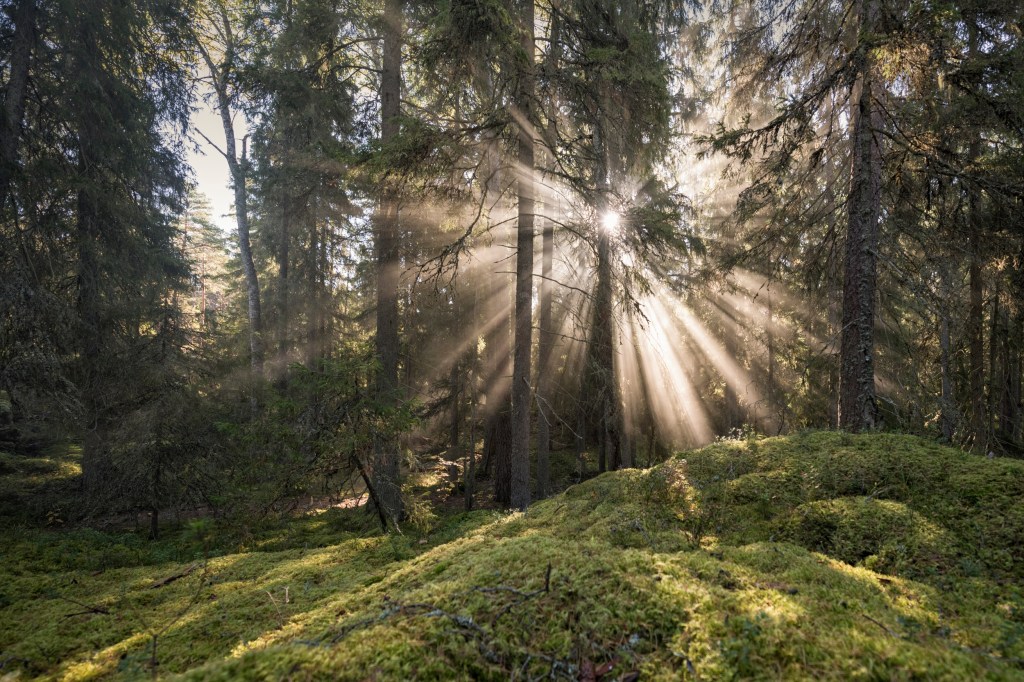
An image of a  mature woodland with the sun breaking through pine tress

The loss of life attributable to Covid19 is astonishing, taken even in the United Kingdom as of May 22nd 2020 the death toll in hospitals alone exceeds 36,000 [source: Gov.uk]. It is unwise to talk about the exactness of these figures, the level of ‘excess mortality’ and so on, at this stage this is an indication that since the first death was recorded in the UK, there are a tens of thousands of families who have lost a loved one, friends and colleagues who are mourning. 

Comparisons with seasonal infections are facile and unhelpful, this is by any measure an extraordinary sombre international crisis. In the midst of the pandemic with only glimmers of hope, it is easy to assume this would never be forgotten, it will always be a keenly-felt loss. The immediacy of the event will pass, of course, and with increasing distance from the daily press briefings, the front-page photographs, ascending graphs and the echoing claps, the salience of the losses will fade. In some ways this is longed-for. We all want to be through the finish line (as if such a thing will exist) the pandemic consigned to a historical account of 2020. 

Naturally, this does not erase its permanent effect on many of us and most emphatically on those that have or will experience the death of a loved one. To this end, I have proposed that we remember them in a time-honoured and sustainable way. I propose the creation or extension of a national living memorial, through the establishment of an arboretum (def: a collection of trees) or National Forest. 

Each victim, howsoever defined, would be marked with a native species tree, their plot identified precisely with GPS and registered. These plots could be augmented with a digital map where, with agreement from relatives, they could be enriched with a photograph and their name

The practicalities
The National Memorial Arboretum, Staffordshire have preemptively issued a statement concerning their position, based on their existing criterion for the memorial to be related to “those [that] have suffered or made sacrifices for others”, and as such:

[the criterion] would mean we could not accept a memorial for those who have lost their lives to this terrible disease, it is our belief that the service and sacrifice of our NHS and our key workers could be recognised with a memorial within our grounds. We would therefore welcome an application from an association/ charitable body or government department with funds to create and maintain (in perpetuity) a memorial for this special cohort of people at the Arboretum.

Though this perhaps rules out the use of the existing site, it seems feasible nevertheless to consider a unique and new forest is planted. Based on the density of planting around 2000 trees per hectare, this would equate to an area of about 0.2 sq/km for 40,000 trees. A full square km of land would accommodate significantly more trees (assuming one plants several for each victim to account for possible loss/thinning) and the associated paths, landscaping and site infrastructure. All these figures are napkin calculations but serve to demonstrate that the proposal need not demand a vast parcel of land. Although getting well ahead of myself, it strikes me that a site somewhere in the geographical centre of the UK would feel appropriately accessible. For an example of how brilliantly this can be executed, one need only look at Glenn Howells Architects’ work to support the existing National Arboretum and in that spirit, an open competition from landscape architects and designers seems entirely appropriate.

Photo Credit: Rob Parrish

Whilst this may have readers nodding along in agreement, I hope it does, I am at a loss as to how to move the idea beyond my own musings.

Petitions

My original petition was rejected by the Government portal due to similarity with existing petitions (which didn’t exist at the time I submitted it!) so although we can sign these..

  • Commission a Memorial Plaque to honour and remember UK victims of the Covid-19 [ Petition ]
  • A memorial for NHS, care, allied professionals, who die as a result of COVID:19 [ Petition ]

.. the specifics of the living memorial are not specified and one is specific to key workers.

I and others remain unconvinced about the efficacy of other non-government petition platforms which can so-easily be dismissed (evidence, slightly more positive evidence) and therefore I’m unsure of the next move. It strikes me that support from the public, organisations, press, media and public figures should be gathered and if this gains momentum then gathering this through Change.org or similar.

Any advice, support or direction is gratefully appreciated, like, share, retweet and re-post with energy, please.

UPDATE: Dec 2020. London’s rather underwhelming proposal is a re-plant of areas on the Olympic park with 32 trees.

Tagged , , , , ,