People talk about the joys of parenting. First steps, packed lunches, school performances, the weird drawings you pretend to understand. What they rarely mention is the dread. The background hum of terror that flickers on whenever a child coughs a few too many times. Or sleeps oddly still. Or says their leg “feels funny.” That quiet panic sitting in the corner of the room like damp on a November afternoon.
It’s not fashionable to admit this. You don’t see it on Reels. Especially when the culture is busy telling child-free adults to live their truth, offering thoughtful monologues about staying free and unencumbered. Greg James did exactly that recently — perfectly sane, perfectly kind reflections about whether parenthood is the right path for him. He talked warmly about being an uncle, getting on with kids, imagining he’d be a good dad. All very decent.
But nothing prepares you for the way your insides rearrange themselves once you’re responsible for someone small. You can like children, adore your nephew, help with homework, coach, babysit, buy the really good Lego — but I honestly believe there’s a gear that only unlocks when the child is yours. The quiet, unasked-for dread that trails you through the supermarket aisles and the commute. The catastrophic thinking that sprints ten steps ahead at the first sniffle or tummy ache. The sense that the universe has handed you a priceless vase made of exquisitely fragile glass and told you to “relax.”
I’ve lost hours to it. Days, if I’m honest. A single offhand story about a young lad collapsing on a football pitch — the first sign of a major tumour — and I’ve carried it around like a stone in my coat pocket for two years. I don’t know the family. I don’t need to. The narrative lodged itself anyway, ready to surface whenever my son rubs his head or our daughter looks paler than usual. Health anxiety works like a Google search with SafeSearch off: one stray suggestion and you’re already halfway to the bleakest possible conclusion.
It’s the availability heuristic, of course, but knowing the term doesn’t blunt the feeling. Same with turbulence. You can memorise every statistic about aviation safety and still grip the armrest like an Edwardian widow the moment the plane shudders. Parenting has that same quality. Logic quietly steps out for air.
You try to counter it. Rituals. Breathing techniques. The practical stuff. You read thoughtful columnists finding comfort in the rhythms of Christian worship (not belief exactly, more a kind of inherited spiritual muscle memory from school services, weddings, funerals) and you wonder if you’ve missed something. I’m not a man of faith, not in the sturdy, reassuring sense, and every so often that old question returns: how could any benevolent force allow the worst things that happen to children? I know there are theological answers. They don’t sit easily. They feel like plaster over a crack that goes straight through the brickwork.
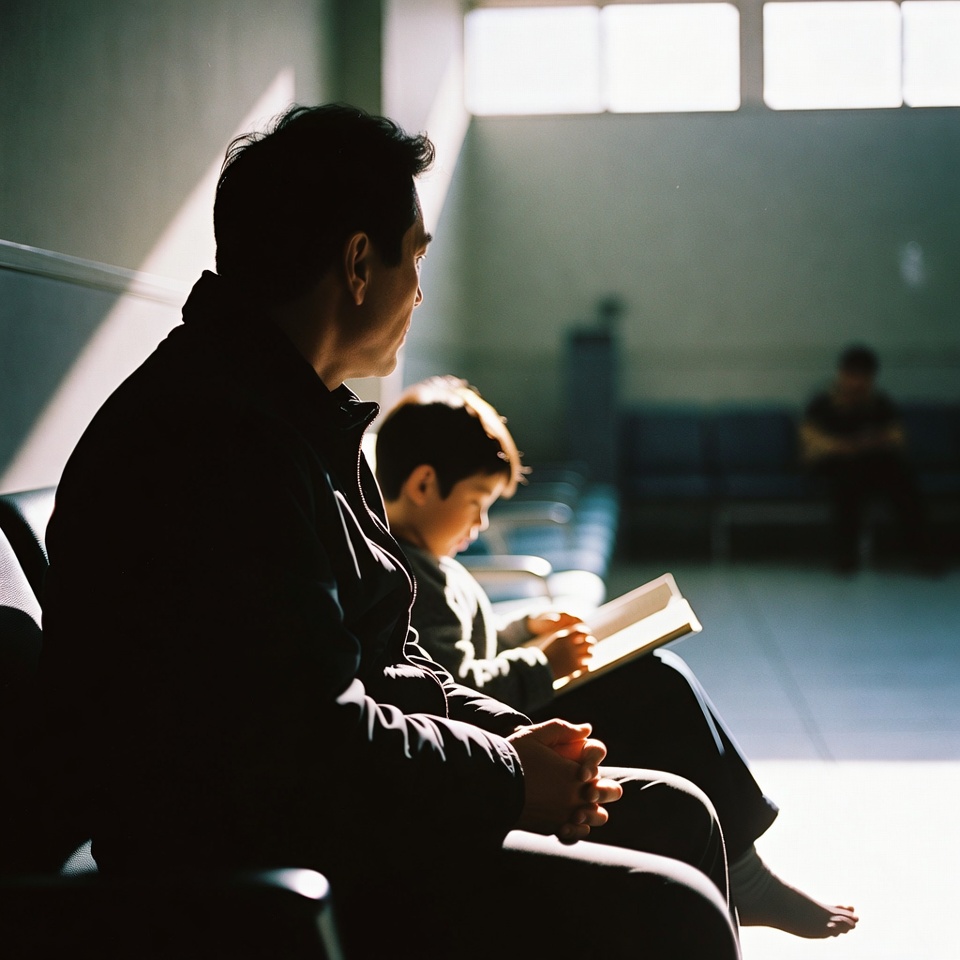
Recently we were back in a hospital waiting room with one child for something we’re told is routine, an abundance of caution, probably nothing. But the body doesn’t care about disclaimers. It has already sprinted ahead, cataloguing every dreadful story it can dredge up. I don’t resent the responsibility. I resent the helplessness. The lack of agency. The fact that all the care, all the planning, the good diets and parkruns, all the love and vigilance in the world don’t grant any guarantees.
What surprises me is how little this gets mentioned. Parents will talk about sleepless nights with toddlers, about juggling schedules, about the occasional primal scream behind a closed door (par for the course on parenting social media) but the terror stays unspoken. Maybe it feels melodramatic to name it? Maybe naming it makes it real. Maybe everyone assumes they’re the only one who thinks like this, when in reality every parent in the GP’s waiting room is conducting their own private risk assessment.
Still, beneath the panic, there’s a quieter truth. The fear exists because the love exists. It isn’t noble. It isn’t poetic. It’s just the cost of being wired into a relationship with no off-switch. Fragile adults raising even more fragile children, and nothing — be it logic or optimism — changes the basic terms.
But the edges can be softened. Some people reach for faith. Others learn to zoom out, pull the camera back to 0.5 and get the wide angle; the school run, the lunches, the scuffed shoes by the door. Some develop attentional control: noticing a catastrophic thought without sending the cavalry after it. And some simply get better at living alongside the dread in the same way you live alongside the awareness that life, in all its glory, is temporary.
What helps, oddly enough, is admitting the feeling exists at all. Saying it plainly. Not for sympathy, just to release the valve. The terror doesn’t vanish, but it loses some of its force. It becomes something you can look at in daylight rather than a shape pressing at the edges of the mind.
When we walked into the hospital, I felt all of it again, the dread, the borrowed anecdotes, the tabloid tragedies, the absurd certainty that one raised consultant’s eyebrow can become catastrophe. And yet, watching him twizzle his hair while he read his book, bored already, asking whether we can get a McDonald’s afterwards, the fear hushed. Not gone. Just quieter. That’s the closest thing to optimism I can manage right now: the idea that joy still insists on showing up, even on the days when the worry is thick enough to taste.
Perhaps that’s the whole reflective acceptance of parenting, neither dread, nor love, nor helplessness in isolation, but the odd equilibrium where all of it sits together, swirling, while your child smiles an asks if they can have a burger.
Ai: Ai took my original draft and helped me tighten up some of the more ragged bits. Then I used it to sort out some tags, an excerpt and generate an image to accompany the piece. Yes, it might have suggested some em dashes —. The thoughts are understandably entirely mine.
 John Gibbard
Absent Dads, Absent Truth
The Mayor of London has been urged to “champion relatable, positive male role models” to stop boys being radicalised online, which is exactly the sort of thing you suggest when you’ve already decided not to talk about the real problem.
Instead of facing the collapse of family structures and the chronic absence of fathers in too many boys’ lives, we get a proposal for an information campaign. A Toolkit. A few posters. Maybe Southgate can record a reassuring YouTube video.
Apparently, the hope is that if we churn out enough branded content about ‘healthy masculinity,’ it will somehow fill the gaping hole left by Dad never being there at all. As if boys are just a design challenge, a user group to be nudged away from extremism by better comms.
Of course, and I can’t stress this enough, some fathers should not be in their children’s lives at all. Where there is violence, cruelty or fear, absence is protection. A boy and their mum are better off fatherless than poisoned by a man who teaches him that domination is love. No argument there. None.
But that’s not the majority story.
The real crisis is the steady normalisation of fathers absenting themselves, through neglect, indifference, casual abandonment, and the refusal of politicians to say so, for fear of sounding judgmental.
You don’t fix fatherlessness with a toolkit.
But modern politics is allergic to root causes. Safer to pretend it’s a branding issue. Safer to talk about awareness, feelings, “positive role models.” Anything except the one thing that actually matters: Dads. Ordinary, everyday Dads, who stay, love, protect, and teach, often imperfectly, but crucially.
Until then, you can print all the Toolkits you like and put out the PowerPoints in a special school asssembly. The boys will still go looking for their fathers, and if they don’t find them at home, they’ll find them online.
And that won’t be Gareth Southgate.