I’ve been on a career break since November. For the first time in years, I’ve moved at the same speed as my own community. I’ve dropped off at Scouts and nursery, sat in waiting rooms for doctors and dentists, queued at the post office. I’ve watched the builders’ vans come and go, the Micras pull up with cleaners, the conversations in cafés and allotments and playgroups unfold in a hundred different tongues and tempos. And yes, I’ve got older. My parents are reflecting. And I’ve started to reflect too.
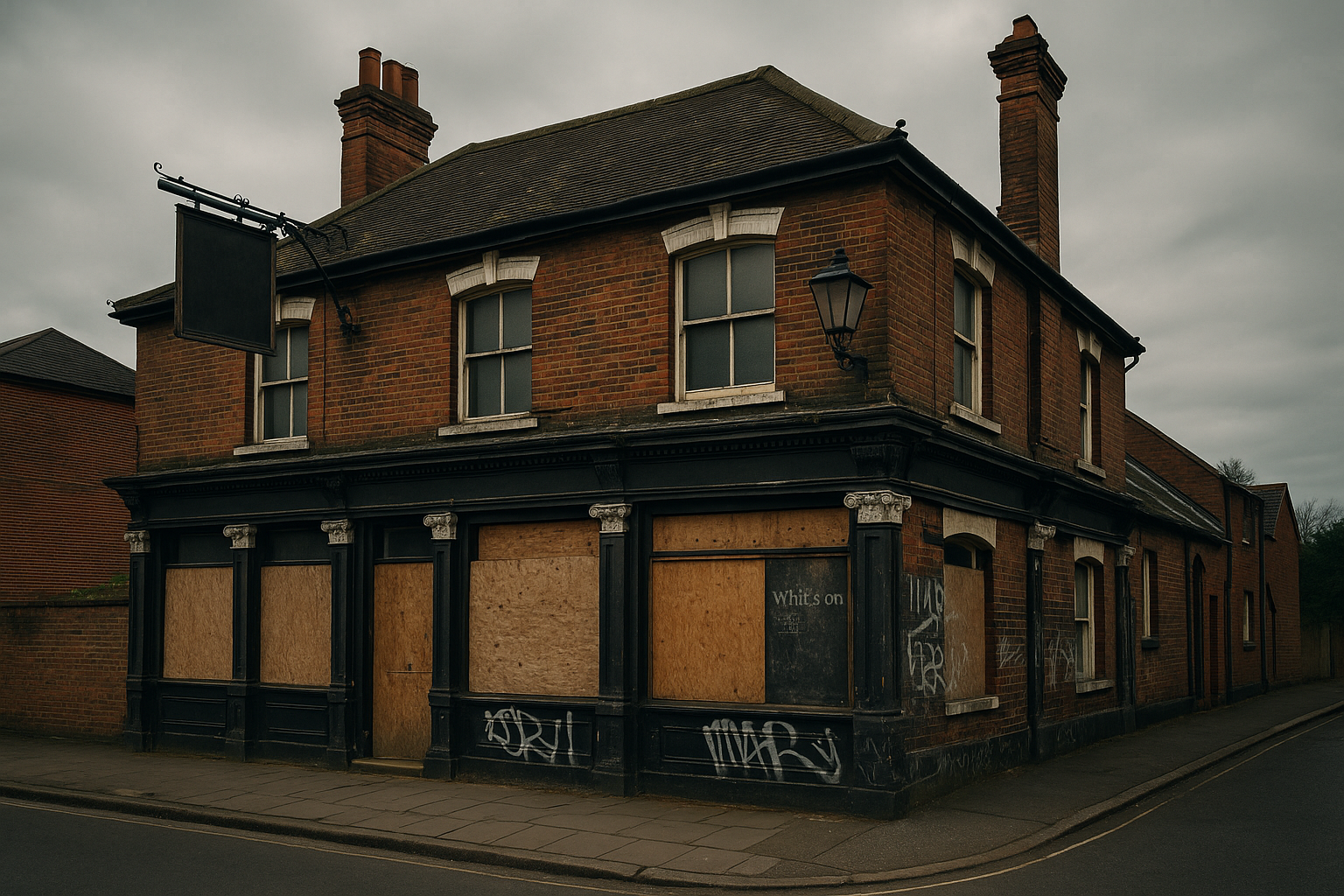
It starts with something you didn’t realise you’d miss. A sandwich from my old Fitzrovia café favourite, The Daley Bread, warm, under a fiver. The musty tang of a church hall where the windows rarely get opened. A pub that had been quietly open for 140 years, now covered in armoured window shutters and graffiti, but still with the chalkboard ‘What’s On’ by the front door, clinging on like it remembers something.
None of these moments ever asked to be remembered. That’s why they lasted.
When Queen Elizabeth II died, something snapped. Not just a reign, but a rhythm. Not of empire or deference, but of expectation, that the fabric of everyday life, the England of hedges and hymn books and heat-damaged laminated menus on brittle café tables, would hold. That continuity, once taken for granted, would continue.
Now, I’m not sure it has.
At the end of winter, I felt it most clearly in the waiting room of Teddington Memorial Hospital. A red-brick Edwardian building with high ceilings and cloudy glass, whose entrance still hums with a kind of institutional memory. But the waiting room felt… unfamiliar. Around me, a few families who might have stepped out of my childhood. And many more who hadn’t. Different languages, cadences, faiths, mannerisms. No hostility. Just a disconnection. Like arriving late to a meeting and realising everyone else has a different perspective.
And yet, a month or so later I sat in my old school hall at BGS surrounded by seventy mostly grey-haired Old Boys in suits and sang Auld Lang Syne, said grace, and reminisced about our headmaster’s pipe smoke, the tuck shop, and flinging cheese triangles at the walls. Despite our best intentions, I doubt this traditional dinner will be remotely the same in ten years’ time.
That isn’t about race, or even nationality. It’s about rhythm. What felt legible once, now feels opaque. I know that what felt predictable to me may have felt excluding or limited to others. But predictability, even flawed, creates cultural ballast.
I grew up in Wormshill and went to school in Rodmersham, a Kentish village with fewer than 40 pupils. The building was Victorian, the sort that smelt faintly of floor polish and instant, milky coffee. It had a scullery where knees would be patched and cabbage boiled. Thursday nights meant karate club in an old church in Sittingbourne; Sundays were Sunday school. Tuesdays were cubs at the village hall. At camps, we drank weak squash and sang around the fire with an eccentric leader belting out “Ging Gang Gooley”. We had birthday parties at the Beefeater. You got a balloon and a home-made cake and it was all unremarkable. It was meant to be. That was the point.
The pub on the high street smelled of cigarettes and damp bar towels when you walked past on a Saturday morning aged eight. It was still there with the same name when you went in at sixteen. Still there when you came back from uni at twenty-one.
Now, nothing sticks. Even that sandwich shop I loved in the 2010s, The Daley Bread in Fitzrovia, staffed by a lovely working-class London couple, is long gone. Probably turned into something pop-up and forgettable. I don’t so much miss the sandwich. I miss the assumption that it would be there tomorrow.
We’ve replaced endurance with churn. A coffee shop lasts two years if it’s lucky. Pubs close, reopen as “The Lemongrass Thai”, then vanish. Housing estates arrive with names that pretend something was saved, The Pines, Mill Way, The Courtyard. Everything designed to sound like memory without having any.
Some of the erasures feel personal. A genial old neighbour in a 1930s local authority house who clipped his borders with quiet pride and watered the pavement in summer won’t be replaced. There are almshouses in Thames Ditton still holding a kind of timewarp grace – wind chimes, bird feeders, Zimmer frames at the door. But these are remnants, not structures. Continuity lives there, but only in hospice.
It’s why I comment frequently on planning applications now. Not because I think nothing should change. But because the way, and velocity, with which things change feels so incurious. The Café Rouge in Esher (formerly the Orleans Arms) will inevitably be demolished and replaced with another brushed-steel block with clip-on balconies and a vape shop at the bottom. The building was tired, of course it was, ‘nothing special’, unless you happened to have met your spouse there, or cried into a pint after the races at Sandown, or, as I recall, sat with Jo and picked over a difficult argument. Soon its memory will be preserved only in the awkward bend of the pavement.
Polyapes Scout Camp, still rich with woodsmoke and wild scrub, is next. Hemmed in by housing developments that promise a “landscape-led vision” and end with a private driveway named after a tree that never grew there.
Even when reuse is done well, it’s never quite secure. The gym I (should) go to in Long Ditton occupies an old waterworks. You can still feel the ghosts of its past—the workers crossing the cobbles (still visible on the pavement entrance) with rolled-up sleeves. But places like this feel like a reprieve, not a precedent.
Some say it was always thus. That even in 1982, people mourned the loss of the corner shop. Maybe. But they mourned loss. We’re mourning speed. Things didn’t use to disappear before you’d had a chance to learn the barista’s name. A shop might close. But it didn’t become a poke bowl kiosk, then a dog-groomer, then a boarded-up shell all in one electoral cycle.
We don’t inherit places anymore. We iterate them.
Even our rituals have thinned. Colleagues don’t go to the pub after work; they go to the gym. They don’t marry in church with tailcoats and hymns; they book a morning at the registry office, then host a party at a hotel. No criticism. But it means that when the pub closes, or the Scout hut is converted into flats, nothing stands in its place. The cultural function simply vanishes.
Even COVID didn’t give us a unifying story when we thought it would be our 39–45. It could have bound us. It didn’t. We emerged resentful, atomised, and uncommemorated. There are no statues. No ceremonies. Just a sense that it happened, we handled it badly, the pan-banging was cringeworthy, and we’d all rather not mention it. A shared trauma, now quietly redacted.
And yes, there’s the harder part to say. The part you can’t raise without sounding like a closed curtain twitching. I walk through Sittingbourne, Surbiton, or Kingston, or Esher and I don’t recognise what I hear. The shouting of Eastern European builders. The clipped conversations of families I don’t know how to read and who aren’t there for post-office queue small talk. Not hostile. Not impolite. But sharp-edged. Voices I can’t quite tune into—not the words, but the mood beneath them. What feels like cultural drift to me may well feel like arrival to someone else. But it’s the lack of overlap I notice most.
I’ve worked with plenty of diverse people who are diligent and decent and warm. But I still feel unmoored. Because the culture I knew wasn’t defined by skin or origin, it was defined by shared grammar. The knowledge they grew up listening to the same music, eating the same crisps, watching the same Saturday night TV and playing the same games in the park. A tempo. A way of being in public. That’s gone.
And with it, something unspoken: the idea that England could remember itself.
And anyway, it’s not just the voices, it’s the way people move through the world. The delivery riders who weave between cars in summer heat, knees flapping under handlebar skirts, bundled in puffer jackets like it’s February. The SUV parents who inch through the school run with all the urgency of an urban tank convoy, it boils my piss that not one of them waves a bloody thank-you when you let them through. And the vape-sucking driver in the pickup, lunging up onto the kerb to grab six cans of Monster from the Co-Op, to hell with the sight-lines, the pushchair, or the old fella on his walking frame.
There are still traces. Churches with rusted gates and ageing choirs. Pubs with Monday quiz nights and hand pumps. Allotments. Scout groups. Carol services. Street parties with bunting and that weak squash. But they feel more like re-enactments than institutions. More like memory theatre than civic rhythm.
We thought we’d miss the buildings. It turns out we miss the punctuation. The pauses, the greetings, the knowing what came next. When that goes, it’s not just a different place, it’s no place at all.
If your pub still has a snug, go. If the Scout group needs a hand, turn up. If your church still lights candles, show your face. Wave a thank-you if the car waits for you in a gap. If there’s a planning notice on the thing you loved, write the objection. Even if it’s ignored.
Because otherwise, the last trace of it all will be a street name. Something vaguely commemorative. Almshouse Mews. The Glebe. The Old Vicarage Place.
And no one will remember what they meant.
 John Gibbard