Tag Archives: cultural critique

The cult of the worthy garden

In The Times yesterday, as we descend into a storm-filled few days of autumn, there was a little glimpse of Spring ’26: the line-up for the RHS Chelsea Flower Show in May. Britain’s annual proof that we can still grow things even if we can’t quite govern them. Every year the press release reads a little more like a mindfulness pamphlet, hope, resilience, healing through nature. May’s line-up is depressingly familiar: Parkinson’s, asthma, gynaecological cancer – each of course exquisitely planted, each designed to make one feel faintly guilty for not being ill yourself (or worse, triggering the health anxiety you fight almost daily).

This is far from a dig (!) at the designers. They’re extraordinary – and the reason I return year after year. Some of the most inventive visual thinkers and horticultural artisans in the country. You could hand them a brief about midlife ennui and they’d produce something quietly transcendental. But notwithstanding this world-class craft, the culture that surrounds them (the commissioners, sponsors and curators, the gushing BBC scripts for reverent narrators describing the “healing”) rather wrings the joy out of horticulture. And, I might argue, severs the connection from our own plots where we aren’t putting in corten steels laser-etched with messages from sympathy cards sent to Grandma when Grandad died.

For the last decade, Chelsea has sounded less like a flower show and more like a group therapy retreat funded by Coutts and serving South African rosé. Every garden, sine qua non, must mean something. Every sponsor must emote through the plant list and recycled-paper design statement. The law firms are at it too, Corporate Britain has discovered mortality and it must keep workshopping it.
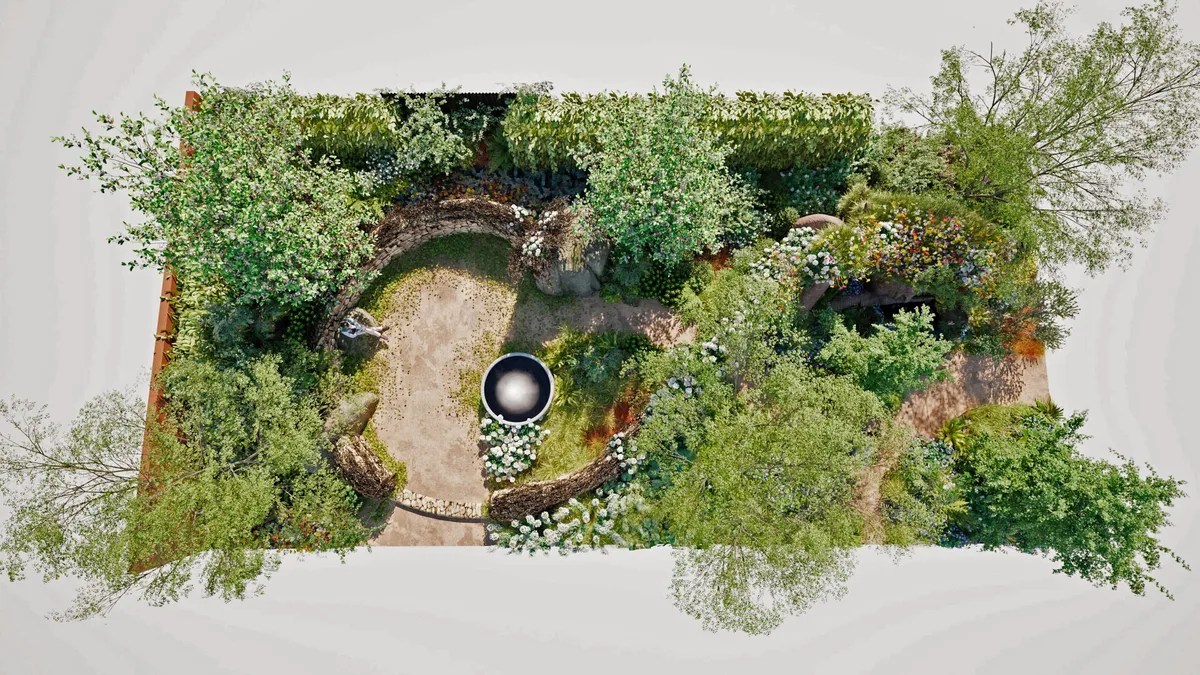
Aerial view of the Campaign to Protect Rural England – On the Edge show garden designed by Sarah Eberle for the RHS Chelsea Flower Show. The design features a circular, sunken seating area bordered by curved dry-stone walls, a reflective black water bowl at its centre, and densely planted perimeters of trees, shrubs, and wildflowers in green and white tones. The layout creates a naturalistic, enclosed sanctuary with winding paths and layered planting that evoke the edge of a woodland or coastal landscape.
Particularly looking forward to Sarah Eberle’s return to Main Avenue — one of the few 2026 show gardens with a brief that feels refreshingly light of touch.

Of course, a sombre brief needn’t make a sombre garden. Most of these designers still find moments of light and sometimes even laughter amid the gravity, that’s their genius, natch. But the problem is saturation. When every garden carries a diagnosis, the cumulative effect is numbing at best and quietly oppressive at worst. You can admire the craft, the planting, the colour, and still feel the weight of mortality pressing against the rope fence. One or two gardens about illness are moving; a dozen and it starts to feel like palliative care with mottled sunlight. The tragedy therefore isn’t in the planting, it’s in the packaging. Even when a designer finds joy, the institution rushes in to label it therapy.

Ten years ago (and perhaps I misremember) you might have had one or two charity gardens, their presence was powerful precisely because of that juxtaposition. Now almost every plot is tied to a medical condition, social cause or climate anxiety. The messaging has become so homogeneous it borders on satire: “healing,” “hope,” “resilience,” the RHS bingo card of benevolence. The poignancy cancels itself out among a cacophony of good intentions, white noise amid the frothy borders and swept pavers.

Of course these causes matter; it’s simply that the monoculture of worthiness leaves little room for unfettered joy. The very people (RHS members and the paying public) say it outright in the comments: “God forbid we could just have lovely, liveable gardens.” Others confess they no longer bother going, the crowds, cost and piety becoming too much of a hurdle to clear just to enjoy the flora. It makes one wonder whether the charities have done a cost-benefit analysis on being yet another earnest voice in a field of them.

A while back I wrote about human-centred garden design, the idea that landscapes should serve the people who live in them, not the narratives imposed upon them. I still believe that. But the pendulum has swung from self-expression to self-help. Designers stopped building for themselves, only to start building for someone’s trauma instead. The irony is that true human-centred design, the kind practised by Zetterman, Pearson, Wilkinson or Nordfjell, already is healing, precisely because it doesn’t insist on it. Their shared language of calm geometry, natural materiality and measured restraint gives people space to feel, rather than instructing them what to feel, elegant evidence that joy and contemplation can coexist without a press release or a prime-time TV walkthrough to explain it. A well-made garden gives you peace without telling you you’re broken.

Every so often, something still slips through, a garden like 2025’s Monty’s Radio 2 Dog Garden plot, joyous, affectionate, full of warmth, and you remember how good Chelsea can be when it drops the self-consciousness and simply revels in life.

If I were a bank or a law firm with money to spend, I’d commission rebellion: a garden about the thrill of travel, the dynamism of the next generation, the sheer optimism of growth. Not a metaphor. Not a manifesto. Just a riot of clever planting that exists because it can.

Because all beautiful gardens are healing. They always have been. They don’t need to say they’re healing; they just are. And that’s the point the RHS seems to have forgotten – that beauty itself is the therapy. If the great British flower show can’t find joy in flowers any more, if every petal must carry a moral story, then perhaps it’s not resilience we need, but relief.

Come on, RHS. Lighten up.
Tagged , , , , , , , , , , , , , , , , , , , ,

Life’s Too Short to Scrape the Lurpak. But Maybe That’s the Point

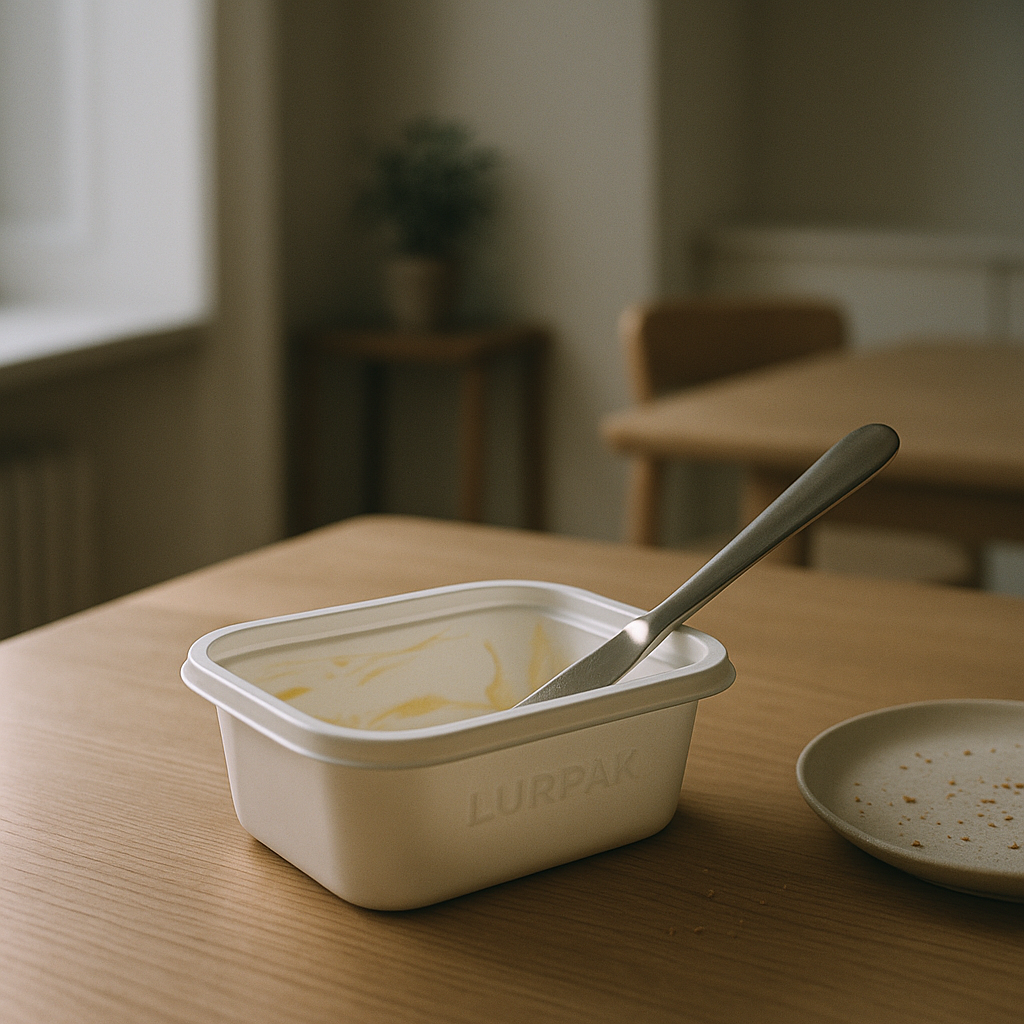
A nearly empty white Lurpak butter tub with a stainless steel knife inside sits on a light wooden kitchen countertop. Beside it is a small ceramic plate scattered with toast crumbs. Soft daylight falls from the left, casting gentle shadows across the minimalist, muted interior with wooden furniture and a blurred potted plant in the background.
Life’s too short to be buttering existential crises out of a plastic tub.

This morning I found myself scraping the bottom of a Lurpak tub.

A white, gently bowing receptacle with just enough residual butter to tease the knife, but not enough to make it worth the effort. And yet, there I was: wrist contorted, scraping sideways, skimming over craters of cold margarine laminate, determined to liberate one last smear.

For toast.

I paused, mid-scrape, and felt the creeping absurdity of it all. Why do we do this? This frugal choreography. This dignified desperation. Is it habit? Shame? Some Protestant hangover of moral rectitude that equates waste with weakness?

Or is it worse than that, is it training?

A kind of domesticated eco-asceticism, learned not out of genuine conviction but out of decades of thinly veiled moral instruction. Don’t waste. Save scraps. Rinse your yoghurt pots. Aspire to net zero in all things, including pleasure. Butter, it turns out, is not neutral.

I don’t want to be the kind of man who scrapes the last dregs of butter from the corners of a tub. It feels small. Slightly emasculating. A man reduced to margarine management. And yet, aren’t these the very values we claim to admire? Moderation. Responsibility. The quiet dignity of thrift.

There’s a strange modern tension here: the aesthetic of abundance, paired with the rituals of restraint. Middle-class frugality presented as virtue. A lifestyle of minimalism, yes, but premium minimalism. We don’t waste Lurpak because it costs £4.50 a tub. Because we bought the “Spreadable” version as a treat and now feel complicit in dairy decadence.

But scratch deeper and it’s not really about the butter at all.

It’s about effort. It’s about where we place it. We pour our energies into small, containable acts of domestic diligence because the larger systems feel untouchable. We cannot fix politics, housing, the climate, or the cultural entropy of our time, but by God, can we finish a tub of butter.

And maybe that’s OK. Maybe part of surviving modern life is choosing the scale at which we can still act meaningfully, however trivial it seems. Scraping the butter is absurd. But so is most of life, and at least this kind of absurdity ends with warm toast.

Still, I didn’t finish it. I threw the tub away, started a new one, and felt a small thrill of liberation.

No one applauds the man who knows when to stop scraping. But they should.

Tagged , , , , , , , , , , , , , , , , ,

Why do parents hate Bing?

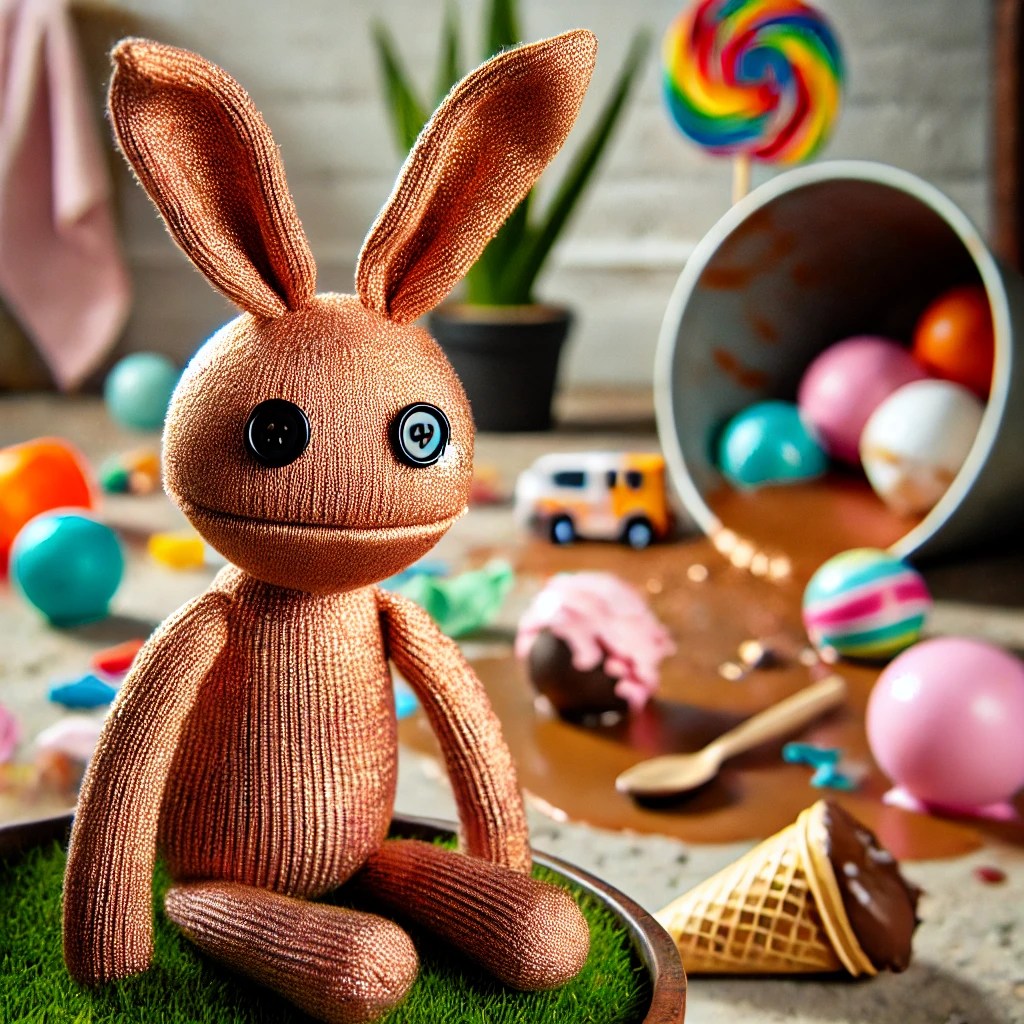
A copper-colored sock puppet with big button eyes and upright bunny ears sits serenely on a tiny patch of grass, seemingly unbothered by the absolute toddler-fueled chaos behind it. The background is a disaster zone—spilled chocolate, melting ice cream, scattered toys, lost balloons, and a toppled bucket of who-knows-what. Despite the carnage, the puppet remains in perfect zen mode, as if it's mastered the art of parenting-induced inner peace.
When everything is falling apart around you, but you’ve accepted that Bing is just… Bing.

It’s 5:47 AM. You’ve been wrenched from sleep by a tiny, sticky hand slapping your face. Your crime? Not waking up before the toddler. Bleary-eyed, you stumble downstairs, pop on Bing in a desperate bid for ten minutes of peace, and – congratulations! – you’ve made a terrible mistake.

Because Bing is not a break. It’s emotional guerrilla warfare disguised as children’s television. A relentless cycle of mild disasters, narrated by pure, undiluted toddler whinge. And parents, trapped in its slow, syrupy clutches, are left questioning their life choices.

At first, Bing seems like a sweet, low-stakes show about a rabbit child navigating the small traumas of everyday life. And that’s true, if by “navigating,” we mean “flailing headlong into catastrophe over incidents as minor as a dropped ice cream.”

Developmental psychologists call this emotional mirroring: a way for toddlers to see their own feelings validated on screen. Lovely in theory. In practice, it means you, the long-suffering adult, are subjected to twenty full minutes of Bing catastrophising about a balloon. Or yoghurt. Or the unbearable injustice of having to share.

Toddlers see themselves. Parents see a replay of their actual Tuesday morning. We don’t need Bing to remind us how excruciating it is when a small, irrational dictator loses their mind over the wrong-coloured spoon. We were there. We lived it. We cleaned up the spoon-related carnage. We need a break.

Enter Flop, Patron Saint of Impossible Patience

Then there’s Flop, Bing’s eternal, unnervingly calm carer. If you’ve ever thought, I should be more like Flop, congratulations. You are now burdened with a brand-new source of parental guilt.

Because Flop never sighs. Flop never raises his voice. Flop watches Bing make the same godforsaken mistake for the seventeenth time that week and responds only with gentle understanding.

If I reacted to my child smearing peanut butter into their hair with a serene “Ah, peanut butter. It’s no big thing,” I would be swiftly clubbed to death by my fellow parents.

Flop isn’t a role model. He’s a fantasy construct of saintly patience. And he is the reason so many of us sit, seething in the glow of CBeebies, knowing in our hearts that we will never achieve his level of Zen.

Meanwhile, Bing makes a mess. Bing refuses to listen. And yet, nothing happens. No time-outs. No firm words. No hint of consequence beyond a gentle discussion of feelings.

The Cult of Gentle Parenting

This is intentional. Bing is built on a constructivist approach to learning, where children explore mistakes safely, absorbing the lesson without fear of punishment.

Lovely, right?

Sure. Except in real life, when a toddler empties an entire box of cereal onto the floor while maintaining furious eye contact, they need more than a kind discussion about oats. They need to help clean it up. They need to understand that some mistakes have consequences beyond personal emotional growth.

At the very least, they need to stop f-ing smirking.

The Bing Paradox: Well-Made, Deeply Infuriating

To be fair, Bing isn’t some half-baked accident of children’s television. It’s an Emmy-winning, heavily researched, beautifully animated show, based on books by Ted Dewan and shaped by years of child psychology expertise.

Mikael Shields, the guy who helped bring us Teletubbies and Wallace & Gromit, says Bing is meant to teach emotional resilience. And model conflict resolution. For parents.

Which is all very admirable.

But here’s the problem. We don’t particularly want a lecture in emotional resilience when we’re one rabbit crisis away from pouring a large Waitrose red.

That’s what Bluey gets right. It respects both the toddler and the exhausted adult watching alongside them. It gives us light and shade. It offers moments of humour and self-awareness, winking at the reality of parenting while still making space for childhood wonder.

Bing, on the other hand, commits so fully to the toddler experience that it leaves parents stranded, silent, passive witnesses to yet another yoghurt-related meltdown. And while that’s certainly realistic, it’s not exactly soothing.

Just The One Episode, Yeah?

So no, parents aren’t wrong to loathe Bing. It’s not just the whining, or the flailing, or the slow, excruciating dissection of minor toddler crises.

It’s that Bing asks us to relive our own parenting nightmares without offering us an ounce of relief.

Another Bing-induced crisis and I’m invoicing CBeebies for psychological distress.

AI disclosure: This post used AI to help generate the image, select blog tags, craft the excerpt, and sub-edit the text to match my tone of voice.

Tagged , , , , , , , , , , , , , , , , , , ,