Category Archives: running

The Gym Is Not What It Used to Be. And Neither Are the People In It

There was a time when the gym was a pure place. A functional place. You went in, suffered, left. The weight machines were occupied by normal people doing normal things: lifting the weight, putting it down, moving on with their day.The stretching area was a low-ego sanctuary, where the post-menopausal women and men with questionable knees could collectively ignore one another while attempting to salvage some basic mobility.

That was ten years ago.

Now? Now the gym is a stage. It is a theatre of performative masculinity, a TikTok production set, a social experiment in misplaced confidence.

The Era of The Sub-Influencer

There is an insidious new species of gym-goer. You know the type. Not quite an influencer, not quite anonymous, just self-important enough to believe the world needs to see their Romanian deadlifts from three slightly different angles.

They do not train for anything, as such. They train for content. Their tripod is their training partner. You now have to navigate not just the people in the gym but also their carefully-curated camera angles, lest you accidentally wander into someone’s life-changing fitness transformation montage.

Their workouts too are a nonsense. Not a single compound movement in sight. Just an infinite sequence of variations, each with a brand-new wrist strap configuration.

And because they’re influencing, they’re not moving quickly.

Nobody Uses a Machine for Less Than 20 Minutes

There was a time when people would finish a set, wipe the bench, and fuck off. That time is gone. Now, a single incline bench is home to one man, his girlfriend, three resistance bands, a mini tripod, a protein shaker, and the ghosts of everyone else who once hoped to use it.

The three-set rule? Dead. What we have now is nine micro-sets, interspersed with two-minute reflection periods, a quick check of the pump in the mirror, and a series of deeply unsettling vocal self-affirmations.

Children. There Are Children Here.

3 PM.

Thursday.

This is not a time when schoolchildren should be anywhere but school.

And yet, they are here, occupying space, dressed like extras from a Love Island spin-off, attempting to bench weights they have no business even looking at. They should be in PE class, but it seems that PE class has relocated to Nuffield Health, Surbiton.

You watch two 19-year-old men in socks sparring in the functional training zone, boxing gloves on, common sense fully off. You make eye contact with a woman in her 50s trying to do some basic hip mobility exercises in the same area, and there is a mutual understanding. This place is no longer for us.

The Gym Is Now a Financial Illusion

One might assume that a gym with an entry fee north of £80 a month would filter out the worst excesses of the Gen Z energy drink economy. That it would be an enclave of working adults, former athletes, people with mortgage agreements, herbaceous borders and creaking joints.

It is not.

It turns out this Nuffield is part of the modern financial miracle, wherein a generation of people who claim they can’t afford rent somehow have active subscriptions to HelloFresh, Netflix, Gymshark, MyProtein, and a £17-per-day vape habit.

And Yet, I Still Go

I could leave. I could accept that this is no longer my world. That I have been phased out. That the gym, once a place of quiet suffering, is now an open-plan ego festival.

But I won’t.

Because I refuse to let a man in a Under Armour hoodie filming himself doing isometric curls be the reason I surrender my back mobility.

So I stretch, awkwardly, in the corner.

And I endure.

Because I was here first.
Tagged , , , , , , , , , , , , , , ,

Asics Overcomplicates the Runner’s Journey

What’s worse than realising your favourite running shoe has finally given up the ghost? Watching someone else avoid that realisation for 18 months and risk an almost inevitable injury as the shoe disintegrates before our eyes. That someone, in this case, is the mother of my children, and the dearly departed in question is her much-loved, overworked Asics Gel-DS Trainers. Those shoes have put in a hell of a shift. Thousands of kilometres on pavements, parkruns, and everything in between, and she’s been putting off replacing them because Asics, in their infinite wisdom, decided to discontinue them. Ironic, really, considering they now offer what seems like an ever-expanding collection of new models that are aligned to a hundred sub-genres of our sport.

So, armed with determination and a misplaced sense of optimism, I ventured onto the Asics website, thinking, “How hard can it be to find a suitable replacement?” Fool. Absolute fool.

What followed was not so much a straightforward shopping experience as a complex game of hide-and-seek with 100+ models of women’s running shoes. I began narrowing things down: size 5.5—okay, now we’re at 80 options. Neutral pronation—down to 54. Road running—down to 46. Surely, at this point, I’d found a clear path. Instead, I was still faced with an onslaught of variants. The Metaspeed, for example, comes in Edge+ and Sky+ (for stride runners and cadence runners, respectively). Then there’s the Nimbus with a Platinum version, because apparently, even running shoes need luxury trims these days. Add in the Cumulus GTX, Lite-Show, and Noosa Tri, and it quickly started to feel like I’d stumbled into Asics’ fashion line instead of a practical search for neutral road shoes.

The Asics Maze
Even after filtering, I was still staring at something like 46 items. Surely, price could help narrow things down? Not quite. More expensive didn’t necessarily mean better, and so using price as a guide only added to the confusion. Was the extra cost because of space-age tech, or was it just a fancy colourway? No way to tell.

Take the Metaspeed and Superblast—both at the top end of the price range. Are they substantially better than the Gel-Pulse or Magic Speed? It depends on what you’re after. The pro models may have carbon plates and advanced cushioning, but that doesn’t mean they’re always the right choice for someone looking for a lightweight, fast shoe for 10k runs.

In the world of running shoes, price can mean anything—or nothing at all. Sometimes minimal, no-frills shoes can be cheaper simply because they don’t have much in them. Other times, pro-level shoes are expensive for performance reasons. Either way, price is a poor guide to what’s actually suited to you.

The Absurd Complexity of Asics’ Product Strategy
By this point, I was beginning to wonder who Asics had in mind when they designed this labyrinth of choice. Surely, even they must know that offering this many variants doesn’t create more positive choices—it just creates more confusion. I’d managed to reduce my options to 10 models across 16 variants, but there was still no sign of the shoe closest to the Gel-DS Trainer—the GT-2000. Apparently, Asics decided it belongs in the “stability” category, even though it offers nearly the same stability, weight, and cushioning as the Gel-DS. So there it sat, hidden in plain sight.

From a product strategy perspective, this is inefficient at best and counterproductive at worst. Developing, marketing, and maintaining so many similar models must be both expensive and confusing for the customer. Asics are doing a fantastic job of overwhelming the very people they’re trying to help, all while bloating their own production processes.

Fixing the Problem
So, what’s the fix? It’s not rocket science. What they need is a simplified, user-friendly approach that doesn’t leave customers feeling cognitively drained before they’ve even tied their laces.

Let’s start with better filters. The current system is too blunt. Instead of “road” or “neutral,” how about additional more useful filters like “lightweight,” “minimal cushioning,” or “designed for 10k runs”? Filters that speak directly to the practical needs of runners would make the entire process far more intuitive.

And, of course, an AI-powered product recommender would go a long way. Imagine inputting a few key details—distance, surface, weight preferences—and getting a personalised recommendation that actually fits your needs. No more second-guessing whether the Metaspeed Sky+ is right for you or why the GT-2000 doesn’t even show up. Other industries have embraced AI to simplify decision-making, and there’s no reason Asics can’t do the same.

Finally, streamlining the product range. Asics just doesn’t need so many variants of the same shoe. And when you consider they’re competing with the likes of Nike, Adidas, Hoka, and others, all with their multiple model variants chasing the same customer, it makes even less sense. Simplifying their product line would not only help the consumer, but it would also cut their own operational costs. Less clutter, more clarity—it’s a win-win.

In Summary
In the end, trying to replace the Gel-DS Trainer wasn’t just about shoe shopping—it turned into a case study of how not to design a user journey. Asics, with their 100+ models and endless variants, have created a labyrinth that even seasoned runners struggle to navigate. And in doing so, they’ve not only alienated customers but also made their own operations less efficient.

What Asics needs is a return to basics: a simplified product range, a streamlined user experience, and filters and tools that actually reflect the way runners think and shop. Less focus on obscure variants, and more on clear, understandable options that meet practical needs. An AI-powered recommender and better faceted filters are two easy steps to fix this.

Because, let’s face it, nobody should need a flowchart to buy a pair of running shoes. In a world where brands like Asics are meant to help runners perform better, they have forgotten the most basic rule: make the choice simple—and let us make the running bit as hard as we like.

Tagged , , , , ,

Pilgrim40 +7

IMG_0582

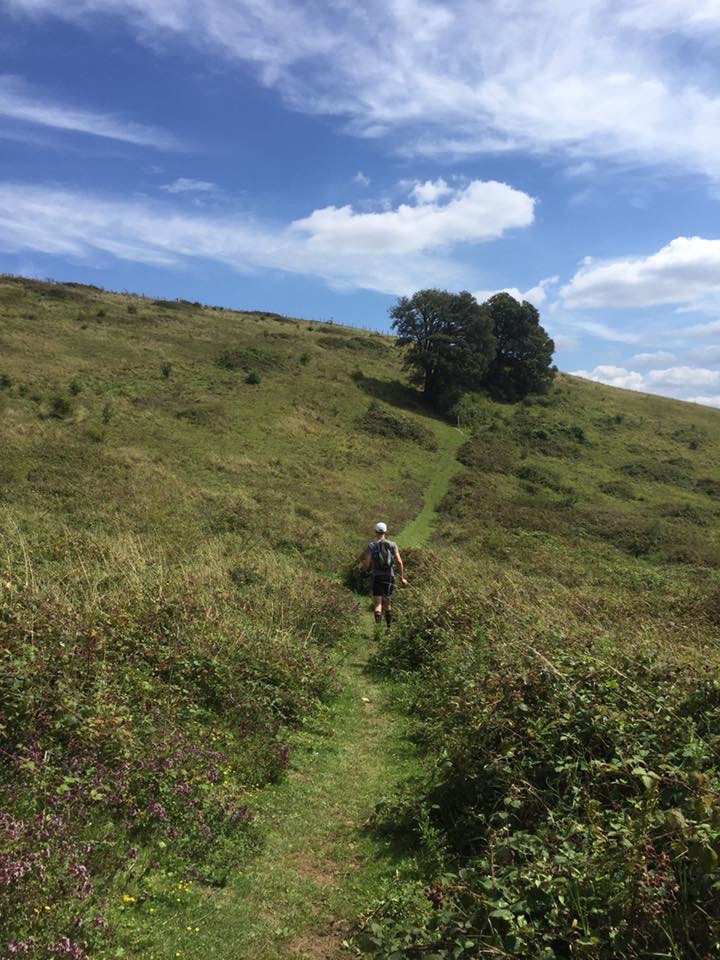
Me, approaching Hollingbourne on the North Downs Way. Credit @run_mama_kate 

“This time last week” has been ping-ponging around in my head for the past few days as my body and mind process the peculiar week of running I completed on Saturday afternoon, 12th August. Since that moment, when I touched the gate of Canterbury Cathedral I’ve sent the tracker back, reduced my intake of ibuprofen (more on that later), archived the hectic Facebook group, commuted and sat and slept in innumerable painful positions.

I’m not sure I’ve got the audience or compulsion to relive the whole week here on the blog, I documented each day on Strava and if you’d like to explore my painful summaries then here are the direct links:

  • Day 1 – Winchester to Farnham … Strava | 54.8km
  • Day 2 – Farnham to Dorking … Strava | 39.8km
  • Day 3 – Dorking to Sevenoaks (ish) … Strava | 30.9km
  • Day 4 – Sevenoaks to Rochester … Strava | 34.8km
  • Day 5 – Rochester to Wormshill … Strava | 31.9km
  • Day 6 – Wormshill to Canterbury … Strava | 42.4km

Total distance covered: 234.9km (would be +16km if we’d not had to cut short Day 3). Total ascent 4046m elapsed time (includes stops on Day 1, not on subsequent days) 30hrs 24mins.

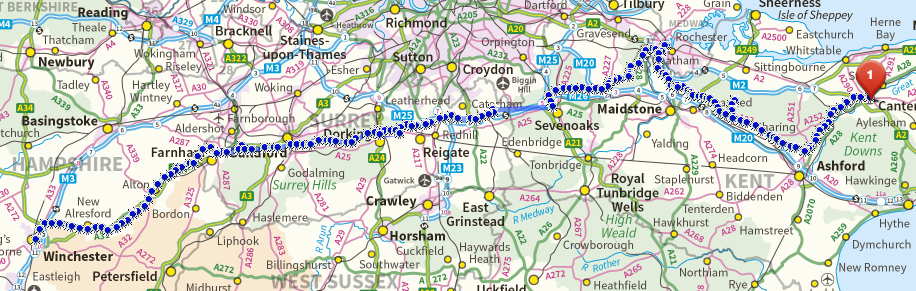
The route followed the St. Swithun’s Way to Farnham and then the North Downs Way (NDW) to Harrietsham where I detoured to Wormshill. The following day we dropped back on to the North Downs Way to pick up the Canterbury branch. It did intersect with the assumed ‘Pilgrim’s Way’ but stuck to the waymarked National Trail. I will certainly complete the Dorking to Sevenoaks section at some point, probably next spring, having missed the final 16km due to some horrendous and borderline dangerous weather. I may also try and do the NDW Canterbury-Dover-Canterbury loop at some point too, just to scratch that itch.


screenshot-live.opentracking.co.uk-2017-08-14-12-58-24

The OpenTracker trace of the route


Next week I’ll be seeing Liam Grimley at Elevate to understand the longer term implications of the run on my body which has taken a lot longer to deal with the overuse injuries I picked up than I expected (although I’ve hardly done all the right things since I took my Adizeros off last Saturday). I will say this, I’m annoyed with myself that I’ve ended up quite broken and unable to use (in the foreseeable future) the fitness that I earned on the trip. It is, however, nice to clear the running diary a little and focus on a sensible and managed recovery to be fit for Maverick Oxfordshire in October. I was aware that I used a lot of ibuprofen (never exceeding daily dosage) in the days of the run itself and am keen to give my renal system a break from that, but doing so has meant a lot of painful walking and offloading/overcompensating making the recovery a bit demoralising.

I would add one thing, and that’s a simple observation that it wasn’t quite as much ‘fun’ as I was expecting. I’d had in my mind the thought that it would be difficult to start each day and there would be some logistical gripes (there were) but I had expected to be able to find myself scooting along thinking ‘isn’t England pretty’ and ‘aren’t I lucky to be able to do this?’ Whilst those thoughts do indeed find their way into one’s self conscious, they are mere mayflies in comparison to the more persistent droning of ‘when is this stoney bit coming to an end?’ ‘my ankles are actually on fire’ and ‘those mixed nuts are rattling around a lot in my rucksack’. There is much of the NDW that is on tree covered ridges and the sweeping escapement views are transient until the Kent sections, although much of it is beautiful and familiar it was only really the Rochester to Canterbury parts that stood out – the weather was just too gloomy and miserable in the Surrey sections. In many ways the day did feel like a job that needed to be done and in running with other people you spend a lot of time zoning in to their conversation – particularly when it becomes the best way to deal with the overwhelming distance and discomfort. Ask me again in P40 +70 days and I’m probably going to be in a miserable winter mood and reflecting much much more positively on what is still, a highly memorable and self-fulfilling week of running.

I suppose that’s it, for a short while. Probably about time I posted some work stuff too. Running did at least strengthen a few thoughts there, if nothing else.

Official thanks: Accommodation, I was supported with bag drops and overnight stays at Mecure Winchester Wessex, Hogs Back Hotel Farnham, Bovey Cottage (Betchworth) Dorking, Best Western Donnington Manor Sevenoaks, Golden Lion Wetherspoon Rochester. I was tracked by OpenTracking thanks to James Thurlow and Rob Marriot, I used SiS electrolyte and caffeine gels, Adidas Adizero 3 shoes and ran in a mix of Bjorn Borg and Adidas kit.

Personal thanks: Jo & Theo, Mum, Dad, Richard, Vicki and their families, Anita and David. Wise heads and motivation: Martin Yelling, Darren Cornish, Anna Smith-James. Finally, the essential support runners: Jon Brombley, David Blackman, Mark Norris, Matt Andrews, Vicky Cooper, Kate Pitts, Richard, Vicky and Beryl Gibbard, Master Prowle and Mark Thomas.

Tagged , , , , , , , , , , , , ,

#Pilgrim40 Run

A short update

Monday 7th August I’ll be visible on this link, thanks to the guys at OpenTracking as I run from Winchester to Canterbury over the next 6 days.

There’s more on the Pilgrim 40 Facebook Group.

  • It’s not for charity, there’s no money being raised.
  • It’s principally just me running, I will be joined by friends and family along the route.
  • I’m doing it because I reach 40 in September and thought I’d prove something to myself.
  • I’m hoping to work out what that something is by the time I reach Canterbury.
  • I don’t actually know the total distance, I’ve never added it up.

I’ll update my Facebook, Twitter and Instagram throughout the week.

Ends.


After 340 days of running you won’t believe what this local man discovered.

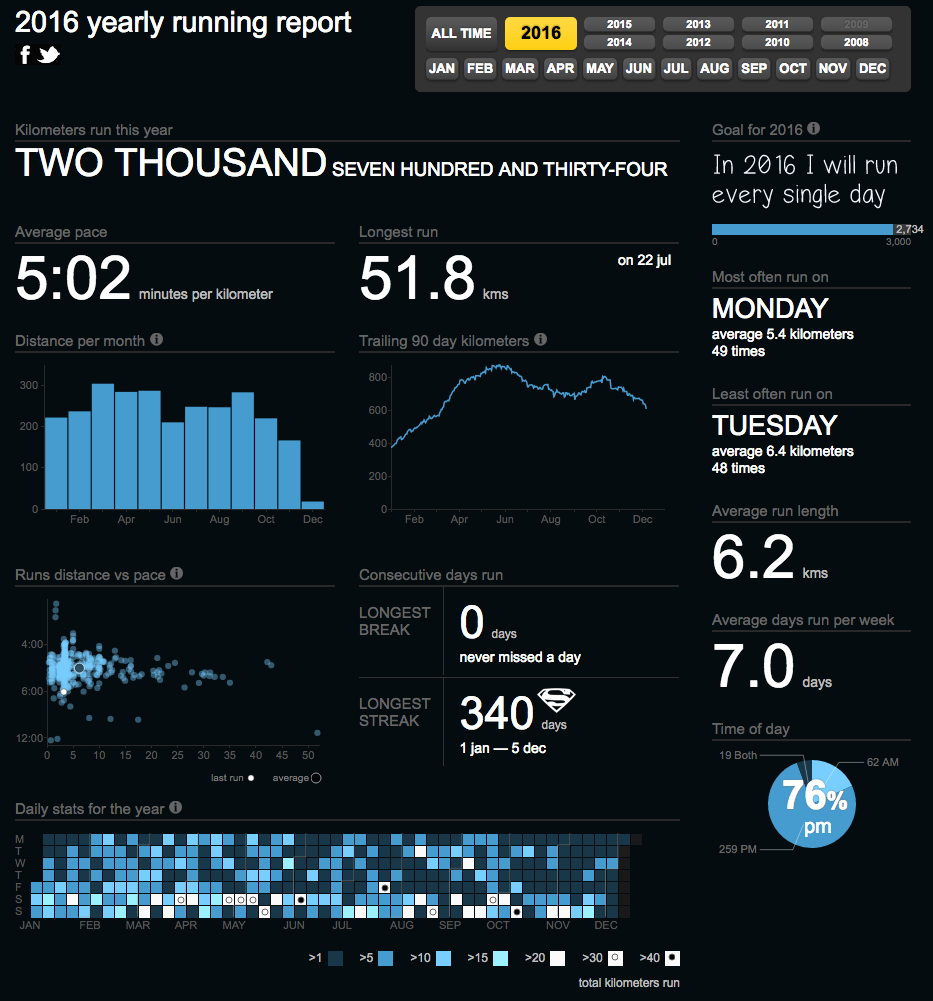
An chart summary of my year in running

I ran for 340 consecutive days before injury called time.

Yesterday I didn’t run. When I started out on January 1st this year I knew that whatever happened I’d be writing this post at some point. I’d have a body of runs to reflect upon, I’d have things I’d learned, I’d have a new level of fitness, a Strava record and a few Instagrams to show. Of course, I’d hoped I’d be writing it on 1st January 2017, not 25 days earlier.

As a runner in the age of ‘the quantified self’ and, dare I say it in a society that encourages it, I have become as fixated as anyone on the outcome. We’re hard-wired to value completion, if we didn’t where would we be? The pyramids might lie unfinished, Mona Lisa unpainted, the Apollo rockets unfired. Dialling back the hyperbole, this very human evolutionary trait has exerted its powerful influence on my desire to run every single day.

There were many days when a run was the last thing I wanted to do. The obvious reasons abound; cold, dark, wet, tired, hungry. There were nights that I ran in spite of emotional and logistical stress: I ran when Jo thought I wasn’t, I ran when I should have been home sooner, I ran the night after my son came home from a trip to A&E while Jo put him to bed. I’m not proud of the subversion, the missed moments with family nor the inevitable upset over mixed priorities.

But I am proud of the process. As time wore on I began to feel that the effort of making time every single day to plan ahead, get kit in the right place and at least a two-mile route to run meant that I could demonstrate to the many many people who say “I haven’t got time” that you really do. You don’t need to run every day of course and that’s not the point, the point is that two miles are not a difficult proposition when you’re asking for just 20 minutes a day.

Switching from that outcome focus and returning to the process, I’d like to highlight a few of the things I learned and developed along the way. In the plan for 2016 were two marathons, Stockholm and York. Although Stockholm wasn’t until June it did guide my efforts in the first months of the year. I tried to supplement the daily commute runs with the odd mid-week longer run and a long slow run at the weekend. Commute runs were reasonably quick efforts with bags which quickly had an impact on my shorter faster runs. parkrun times were consistently lower than before and I found my slow long run pace had got quicker even though effort remained the same. My most consistent high volume weeks were through the spring. The old commute run to and from Tabernacle Street was straightforward and effective. Combined with my simple work ‘uniform’, the months just ticked by in a largely positive fashion. I was surprised that the niggles came and went without developing into anything. My long-standing patellar tendon issues eased and I just kept going. Weight dropped off, not by design but by simple nutritional deficit. More on that later. Stockholm was a great race, hugely enjoyable and one I’ll look back on fondly. I felt I could even have gone a little quicker but the summer was still young and York was on the horizon. I had some great runs over the summer. Three fast timed miles at the City mile and Arethusa miles, joining Martin and Liz Yelling for my first super long day down on the South West Coast Path (SWCP) and then, later in the season, more SWCP running with Jo.

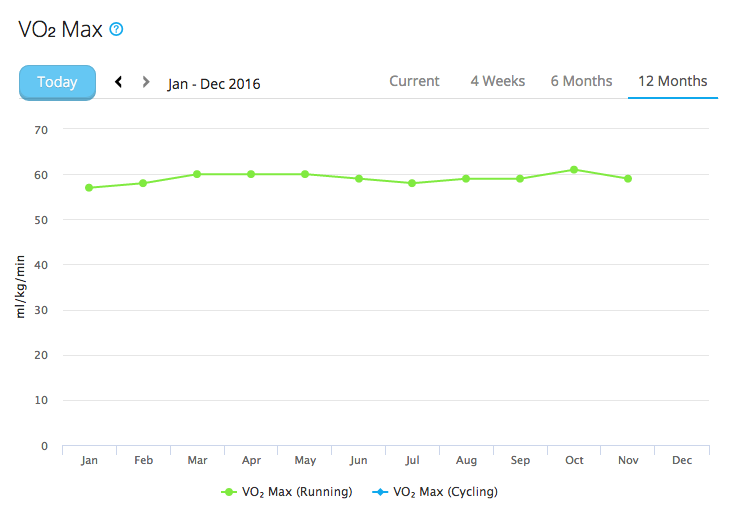
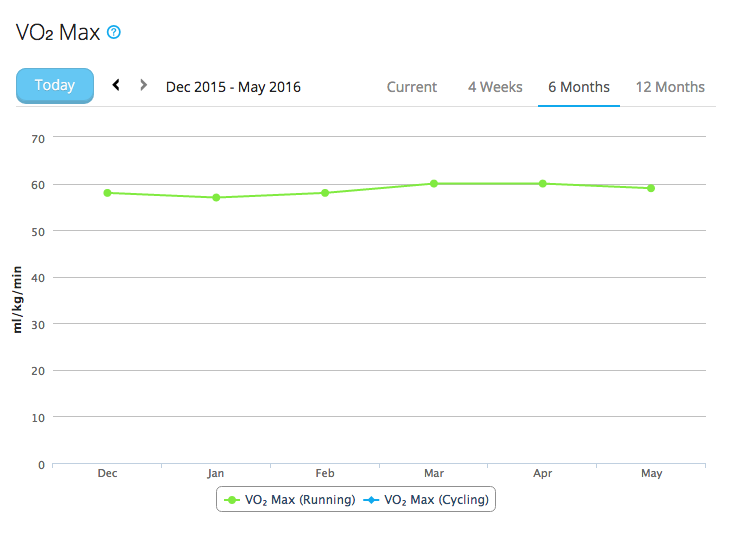
The hills, the mile speed and the strength work I did on those runs combined with some new routes around Surbiton had serious benefit. In fact, the need to find new routes really was a benefit. I found myself plotting by distance and exporting these to my watch, following unfamiliar roads and trails throughout Surrey and SW London. I got very familiar with the Thames Path all the way to Windsor or up to Battersea,  and occasionally beyond. I doubt I’d have done this without some desire to break away from the monotony of the commute runs. By the late summer and autumn, I was sufficiently focussed on York, albeit with lower weekly totals than the spring training block. I remember my final dawn-start long training run through Epsom and Esher that finished with a 5k parkrun and topped off a massive week for me. I ran a race I was really proud of (a PB 3 12′ 50″) and came off the back of it with a 18:32 parkrun PB and a VO2 max estimated at 61 ml/kg/min in October.


vo2-max

A plot from Garmin’s estimated VO2 Max during my runstreak


Looking back I wonder whether that’s where it really ended. Although I felt fast and was running injury free I didn’t really have a target in mind for the final three months other than finish. 2 miles (3.22k) every day. As a consequence, I resigned myself to a commute run most nights and the weekly totals plummetted. Injuries typically occur after a change in training; a volume or intensity spike, a change of surface or other environments. In my case, the move to a new office location meant my run back to Waterloo was shorter, faster and downhill most of the way. It was also now entirely dark and involved notably more kerbs, junctions and slow-moving pedestrians. This meant I was juddering to a halt from speed a lot more than the old (still frustrating) route from Tabernacle Street. I was slamming down hard off the kerbs and putting shearing and twisting forces through my ankles more like a midfielder than a runner. Added to that (and hindsight bias is strong at this point) I ignored a low-level niggling plantar fascia problem for several months.

The net result was an angry Achilles after a long run along the towpath in trail shoes. I thought it was just some soreness due to the conditions and shoes but it didn’t ease and I didn’t give it enough attention with NSAIDs, ice and massage. I saw my daily commute as an easy run, unaware of the more unconventional impact it was having. It hurt to run that route yet I could manage a comfortable easy loop at home and do an ordinary slow parkrun. But on Monday night I ran back to the station and early on felt a stabbing pain unlike the usual irritation. I carried on but with 800m or so left to run I jarred it again and i knew I couldn’t bear weight on it, there and then I knew it was over.

Presumptively I’d booked Liam for the Tuesday evening and had hoped that i’d wake up that morning feeling that seeing him in the evening would mean he’d just be helping me to release some tension and I’d have managed a run in the day. But no. It just wasn’t an option, I had pain all day just walking and found myself wincing each time I climbed or descended stairs. The prognosis isn’t bad. Recovery should be straightforward with a decent regimen of slow and heavy resistance work after the acute inflammation has eased. Liam supports active recovery so I expect to be able to jog lightly soon enough and as I write this 48 hours later there isn’t pain walking. The biggest injury (apologies for the rather obvious cliche) is in my mind.

I’ve taken a lot from being part of and reading about Martin’s failed SWCP run earlier this year. The lengthy post-mortem on Marathon Talk and on his blog have helped put this kind of personal challenge in perspective. It will always smart that I fell short but writing this now and reflecting on what I taught myself over the period is fantastic.

  • I’ve run more than ever – but I know I can do even higher weekly distances in future.
  • You can run on rest days, as long as you run at markedly lower intensity, lower volume or both.
  • Speed work has a huge benefit. Regular endurance work has a huge benefit. If you can work both into your schedule you will move beyond your ‘local maximum’.
  • There are very few days and very few environments where you can’t get a run in. It requires prediction, planning and a tolerance for what constitutes a run.
  • You don’t need a tonne of kit. I wore two-three pairs of shorts and the same number of technical shirts. I did burn through at least three pairs of Adidas adios boosts but I bought previous season models and used Vitality discounts to keep these purchases under £100 each time.
  • Foul weather running is grim but nothing you experience in the non-mountainous UK is a reason not to run.
  • It helps to have a wife who runs and running buggy. Tolerance from my son and empathy for my behaviour from Jo and our son was hugely beneficial.
  • It helps having colleagues and an employer who support your lifestyle. Not being on-time, wearing running kit in the office, being a Strava Wanker can be irritating. Dare just let me be and, even occasionally, celebrated what I was doing.

So with my evenings a little calmer, my commute a little longer and my VO2 max a little lower, I can settle into a few weeks of planning what 2017 might hold. There’s precious little point sharing my present thinking here as it’s just as likely to be different tomorrow. There is the small matter of the British Indoor Rowing Champs on Saturday with my old University crew mates for which I have not prepared, not rowing a single stroke before the day. After that I know my motivations are in several directions: vanity to gain weight and muscle mass, strength and flexibility to protect against injury more, pleasure to enjoy running again at a variety of intensity, volume and environment and finally a few soft PBs that need some attention (as well as some hard ones too).

It was a long post, as much (more?) for me than for you, dear reader, but I hope valuable to some in various ways.

All the Strava data
My Smashrun visualisations showing trailing averages, intensities etc.

Tagged , , , , ,

Protected: Wardrobe minimalism, changes for 2016/7

This content is password-protected. To view it, please enter the password below.

Tagged , , ,

Pound Cost Averaging: Why investors and investment houses should learn from runners.


14178886934_4f3626173f_z

Make the most of the downhills in your investment strategy (Alexis Martín, Flickr)


Analogies can be hit and miss, but that doesn’t stop me from deploying them almost constantly in conversation. Because running is such a significant part of my life, there has been a tendency to see much of the work I do through the lens of physical activity and effort proves to be highly relatable in many service journeys.

Thanks to my one-time boss and good friend Darren, I was engaged in a conversation on Facebook recently pertaining to investments. With an undulating landscape of financial predictions, the chat was about how your unsophisticated public investor might make the right decisions about how much to invest and when.

Darren highlighted the strategy of Pound Cost Averaging, something I wasn’t aware of and which can be described thusly

The basic idea behind pound-cost averaging is straightforward; the term simply refers to investing money in equal amounts at regular intervals. One way to do this is with a lump sum that you’d prefer to invest gradually–for example, by taking £1,000 and investing £100 each month for 10 months. Or you can pound-cost average on an open-ended basis by investing, say, £100 out of your paycheque every month. The latter is the most common method; in fact, if you have a defined contribution pension plan, you’ve probably already been pound-cost averaging in this way.

Source: Morningstar

Now, that’s one way of essentially distributing an investment over time to spread the risk, prevent you getting carried away trying to read the market but keeping you ‘in the zone’ of investing when you might not feel like it.


Aside
There’s good evidence that it’s a very sensible strategy, albeit one that is not at the aggressive end of possible returns. Writing with refreshing candour in  The Spectator in November 2015 Louise Cooper highlighted how such a simple approach is a solid antidote to the lack of expertise that Fund Managers really have.


Now, what I’d like to see – and what interested me about Darren’s comments – was the potential to flex these regular contributions in line with the market’s movements. This is where the analogy really begins.

As a long-distance runner, the absolute best thing you can learn in an event like the marathon is pacing. You want to distribute the effort across the race and there’s some really good literature to support it. No course is completely flat and this means you have to modify the effort to match the gradient, you ease off a bit on the uphill and, within reason, make some benefit on the downhills. Using Heart Rate as a guide you might aim for a consistent effort of 165 BPM, keeping that constant on hills means dropping pace, on the downhills your heart is under less load so you can speed up a bit. Recently the website Flying Runner allowed you to create a minute-per-mile pace band that reflected the slight modifications you’d make throughout the race depending on the gradient or effort required.

Now consider investing, let’s say you want to invest £10,000 this year. You can trickle that out evenly across the year in £833.33 increments, assuming a flat market. But what if you wanted to follow the FTSE and say invest a little more when the market is on a downturn and invest a little less when it’s climbing? Doing so would make the most of the market movement but keep you within a framework that spreads the load.

There are issues with this approach of course: a period of consistent decline might over-stretch a finite investment pot, so if I put £850 in for the first 4 months of the year then I’ve used up more of my £10,000 but with no guarantee that I’ll make it up if the market doesn’t subsequently ascend. That’s a crucial difference. In the marathon, we know the profile and the distance of the course in advance and can plan how much to scrub off or add on to our pace with the gradients and the total distance predetermined. That said, this is a longer play than a marathon and a decade of investing this way is sure to see the amounts even out. The problem then becomes setting a monthly amount that you can afford: For example setting hard maximum investment and a hard minimum that is reviewed each year according to salary changes.

The second issue is fees and logistics. The sad truth is that nobody appears to be setup to allow the public to effortlessly invest in this manner. Often each investment incurs a commission thereby wiping out the gains if you’re making 12 of them per year. Additionally, no provider appears to offer automatic modifications that track the market gradient against your personal tolerances [happy to be corrected], although Share Centre certainly support a savvy customer doing it themselves. Evidently, there’s nothing to stop one doing it oneself with a spreadsheet and a diligent approach to calling in or going online to tweak the figures. Does this constitute a direct example of where Big Finance is theoretically working against customer behaviour by penalising us through regulatory-inflicted charges? Is it an example of an opportunity that could be exploited by FinTech, able to quickly build a front-end to an investment vehicle that is aligned to plausible customer behaviour? Well, until I can find a service to meet my desired approach I’ll just have to work on my own Google Spreadsheet and work towards the release of the first endurance-inspired investment strategy.  Given that the Brexit marathon starting pistol has just been fired, perhaps now is the time to, caveat emptor, give it a go?


Tanda Predictions for Marathon Times

With the Asics Stockholm Marathon just a few weeks away it’s time to take stock of a few things in my running year.

Although not documented on this blog, I’ve set myself a challenge of running every single day this year (at least 3.2k – two miles in old money). This was loosely inspired by Advent Running and the Tracksmith poster, but the origins are neither here nor there. So far I’ve hit it.

Doing a challenge like that has naturally impacted my traditional marathon build-up. I’ve followed a Garmin plan this time around and on rest days I’ve just done light runs but other than that I’ve tried to stick to tempo or threshold training on the selected session days. The big ‘but’ of all this has been the effect it’s had on my overall quality of session: tempo runs are often on tired legs, intervals are not even harder to complete and the long runs in recent weeks have seen some incredibly slow pace and high heart rates.

To make sense of this, or at least allow me to predict what this might all mean for Stockholm I have been fretting about the long runs in particular. In recent weeks, I’ve hit 32.1, 35, 31.1, 33.6 km each weekend. I’ve done 5 runs over 30k this year and a further 5 over 20k. All of which is much more than I’ve done in the past but I’ve been intentionally running them slower. I’ve tried to stick to Zone 2 Heart Rates, under 140bpm which means around 5:10-5:40 pace per km. It should feel easy but after a while it does fatigue you regardless and it begins to hurt as I run more heavily by slumping into slower cadences and mentally I struggle with the discipline of keeping the HR low especially now the days are 15-20 degrees warmer than those first runs of the year.

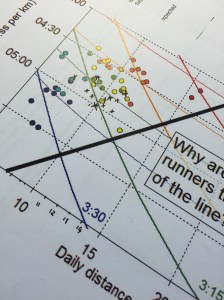
Today I stumbled across the Tanda discussions from Christof Schwiening‘s blog which I found via Charlie Wartnaby and the sub 3hr Facebook Group. I printed out this graph and started to plot my weekly distance against average pace to see where I sit. Fortunately, Strava’s log page gives me the weekly duration and distance figures so I did a few calculations on bane.info and plotted 12 weeks’ worth of data. To my amazement it had me sitting along the 3hr 15′ contour and, given the strength of this model, I’m quite encouraged by that.


IMG_5033

Black x marks indicate my training weeks


There’s no question that the long runs have really frustrated me, on the days I’ve run slow I’ve wondered how I could even run at paces I was comfortable at in 2015, 2012 and 2011 for the full distance. But then this year I’ve also hit a parkrun PB of 19:03 and regularly go sub 3:45 on my commute runs and in interval sessions. My Garmin VO2 max has been as high as 60 and is currently hovering at 58/59. So I’m fit and, touch-wood, largely injury free. A niggling sciatic nerve, a bit of gluteus numbness and some hints of ITB all might flare up on the day but equally, could not, and if they don’t? Well, to hit 3:15 would be a dream and put me firmly on the road of my 5-year plan to sub 3 with a good opportunity to go quicker in York in October. However, that means averaging 4′ 37″ /km for the entire race and that is a pace which I exceeded for just 25 minutes on Sunday (after 2 hrs 20 mins of slower running). Even with adrenaline and a lighter few weeks ahead I’m not sure I’ve got that in me, and that in itself is a revelation: physiologically the data says I should be able to do it, but my own sense of perceived effort says it’s not.

screenshot-connect.garmin.com 2016-05-16 19-15-52.png

I’ve got time to set that goal, create the pace band and work out what I’ll go at. Keeping an eye on the temperature (average 18 C) and wind on the day will have a bearing but when you’ve spent a fair amount of coin flying out there, hotels and food, do you really want to risk having 4 hours of hell on the road because you took a risk and went out at a punchy pace?

On the 4th June, we’ll know…

Tagged , ,

UK Running events: Are the fees excessive?

I decided some time ago that I wouldn’t ever compete in my most local of races, the Garmin Kingston Run and the Lidl Kingston Breakfast Run. These events cover the route that I run most often and it just seemed silly to pay £28-34 to cover the same paths I cover each week for free. That was a rational decision and although I thought it was expensive, it was more in the context of it being local and familiar rather than a moral comment on the rising cost of races, after all, £34 was for a 20 mile course, so £1.70 per mile or 24p a minute [see below].

It planted a seed in my mind. That seed germinated last year when the cost of the Winter Run was announced. This is just a 10k run and the price soared to an eye-watering £40. Ok, Ok, I thought, it’s London passing some of the busiest and most secure environments in the country and it’s for charity and they’re putting on a fake snow machine and ‘free polar bear hugs’. So, perhaps, the £4.50 per km cost [£1.13 per minute at 6’26” mile (4’00” /km) pace] can be justified. I’m not going to enter obviously but somebody might.

Then last month the little seedling grew another few cm when I received an invite for the Vitality West London 10k. £40 plus a £2.40 booking fee. What on earth are they talking about? This time there was no snow being promised, no bears and the charity bit is optional (albeit reducing the cost if you do). It’s getting ridiculous.

Milton Keynes Marathon cost me £40, London in 2012 was about £35 from memory. At London you can understand the cost – this is a race having to pay high fees to attract the world’s very best runners. London Marathon provide security, medical and logistics support to hundreds of thousands of people across one of the most expensive and congested cities in Europe. With most people finishing in 4 hours or so it works out at a quite generous 15-20p per minute (less if you include the pre and post race support), that’s £1.50 per mile or thereabouts.

The marathon is over four times the length of the 10k; Now you’d assume some costs are fixed and others based on mileage and there are going to be economies of scale, with that in mind the fact that the Vitality West London 10k is the same cost as one of the World’s top Marathons just seems a little excessive doesn’t it?

Breakdown of event costs

I know I need more detail. I have to understand what proportion of the race fee goes on which elements of event support. I want to know for these pricey commercial events (even with their veneer of charity fundraising):

  • What proportion of the support is offered on a volunteer basis?
  • What fees do St John Ambulance charge and the various chip-timing systems?
  • When drinks are provided, is this at cost to the manufacturer or is it a wholesale buy?
  • What about ped barriers, gantries, baggage transport/storage, signage?
  • How about professional fees, local authorities and insurances?

Now, here’s the crux, how does the experience differ – in real terms – to the more spit-and-sawdust events? Admittedly some of these are not on closed roads, but to many runners the difference between a regional city/town marathon and club-organised event is predominantly a case of baggage handling, signage and goody-bags. The distance is the same.

Change in event prices over time

How has the cost of the UK’s top-tier closed-road events changed in the past 20 years (Great North Run, London Marathon, Edinburgh Great Winter Run). Do you know what you paid for one of these events in the distant past?

Are key event costs rising or falling? Of those items listed above, some of these must surely have benefitted from technology and efficiency savings?

Some example race prices
(assuming my current race pace)

Provider Closed Roads Distance (km) Typical time (min) Cost (full) per km per minute
Winter Run (London) Human Race YES 10 40 £45.00 £4.50 £1.13
West London 10km Vitality YES 10 40 £42.40 £4.24 £1.06
Great British 10km Vitality YES 10 40 £50.00 £5.00 £1.25
Bath Half Vitality YES 21.08 90 £43.00 £2.04 £0.48
Reading Half Vitality YES 21.08 90 £38.00 £1.80 £0.42
Virgin London Marathon London Marathon YES 42.16 210  £35.00 £0.83 £0.17
Kingston Breakfast Run Human Race PARTIAL 13 52 £28.00 £2.15 £0.54
Kingston Breakfast Run Human Race PARTIAL 26 110 £31.00 £1.19 £0.28
Kingston Breakfast Run Human Race PARTIAL 32.3 140 £34.00 £1.05 £0.24
Great Winter Run (Edinburgh) Great Run YES 5 19 £21.00 £4.20 £1.11
Great North Run Great Run YES 21.08 90 £53.04 £2.52 £0.59
Bedford Half Bedford Harriers NO 21.08 90 £20.50 £0.97 £0.23
Halstead Marathon Halstead Road Runners PARTIAL 42.16 210 £33.50 £0.79 £0.16
Sittingbourne 10km Rotary Club NO 10 40 £14.00 £1.40 £0.35
Bullock Smithy Hazel Grove Scouts PARTIAL 56 660 £30 £0.54 £0.05

What do you think? Are race prices a fair reflection of the organiser’s effort? Is it fair to compare such ‘different’ events?

Bear in mind that the runners’ fees are not the only income source at several of these events. Sponsors contribute and charities are often charged significant fees to have spaces for runners and their own tents at the event (e.g. Great North Run).

Other perspectives

By contrast, here’s a BBC News piece about how obstacle events (ugh, don’t get me started on this particular craze) are increasing in popularity and how they leave organisers out of pocket at least initially.

A Guardian assessment on race prices from March 2015 – the comments on this piece are revealing. 

I’d love to have a race director’s view – can you give us a breakdown of costs in terms of a percentage of where race fees go? For a brief insight, Marathon Talk episode 300 had some details on the scale of logistics behind the Bournemouth Marathon Festival (multi-distance) event.

Tagged , , , , ,

Evoking the spirit of running, two short films.

Those of us in advertising and marketing know that communications often resonate strongest when there is an emotional connection. Something about a message or the way that it’s presented that evokes the primal or limbic response.

Only one of these films is really an advert, and even then you could argue it’s a brand film. Both, however, are absolutely brilliant at reminding me of what it feels like to run and why the bloody hell I do it. Autumn is a cracking season for running. A few weeks ago I ran in the early morning through Windsor Great Park. The sort of run that was so steeped in English history it was almost a parody of itself. I ran through Windsor, past the tremendous, perfect, castle and down through the mists and mellow fruitfulness to the Great Park. In utter silence and solitude I shared the empty dewy paths with only deer for km after km. It was one to hold in the memory banks for years to come.

It reminded me of the video Julia Bleasdale and her partner shot in Bushy Park last winter. A park still technically in Greater London and yet from the shots you could be forgiven for thinking it was in a great rural idyll. Julia’s latest effort is even grander and even more inspiring. It’s not as familiar to me as Bushy of course but what wouldn’t make someone aspire to run this free than this glorious two minutes of high definition drone footage?

By contrast, Tracksmith’s effort draws us back to the turning season. Stealing us for a season of cross-country, this vision of picturesque, smokey New England is about as far from the cross-country I remember as a boy as it’s possible to get. Photogenic, fit and breathless athletes grace the well-considered shots with muffled sounds and an thoughtful narrative. Nothing’s made me want to get up early and run as much as this film.

In a world of athletics dominated by conversations of unnatural performances and Instagram feeds drowning in thousands of lurid neon boys and girls in their active wear, it’s so great to find two bits of creativity that speak to me about why and how I run.

Julia Bleasdale, Switzerland, August 2015 videos.

Tracksmith, Ode to Cross Country, Fall campaign 2015

Tagged ,