Tag Archives: lagom

The Doughnut Is the Point

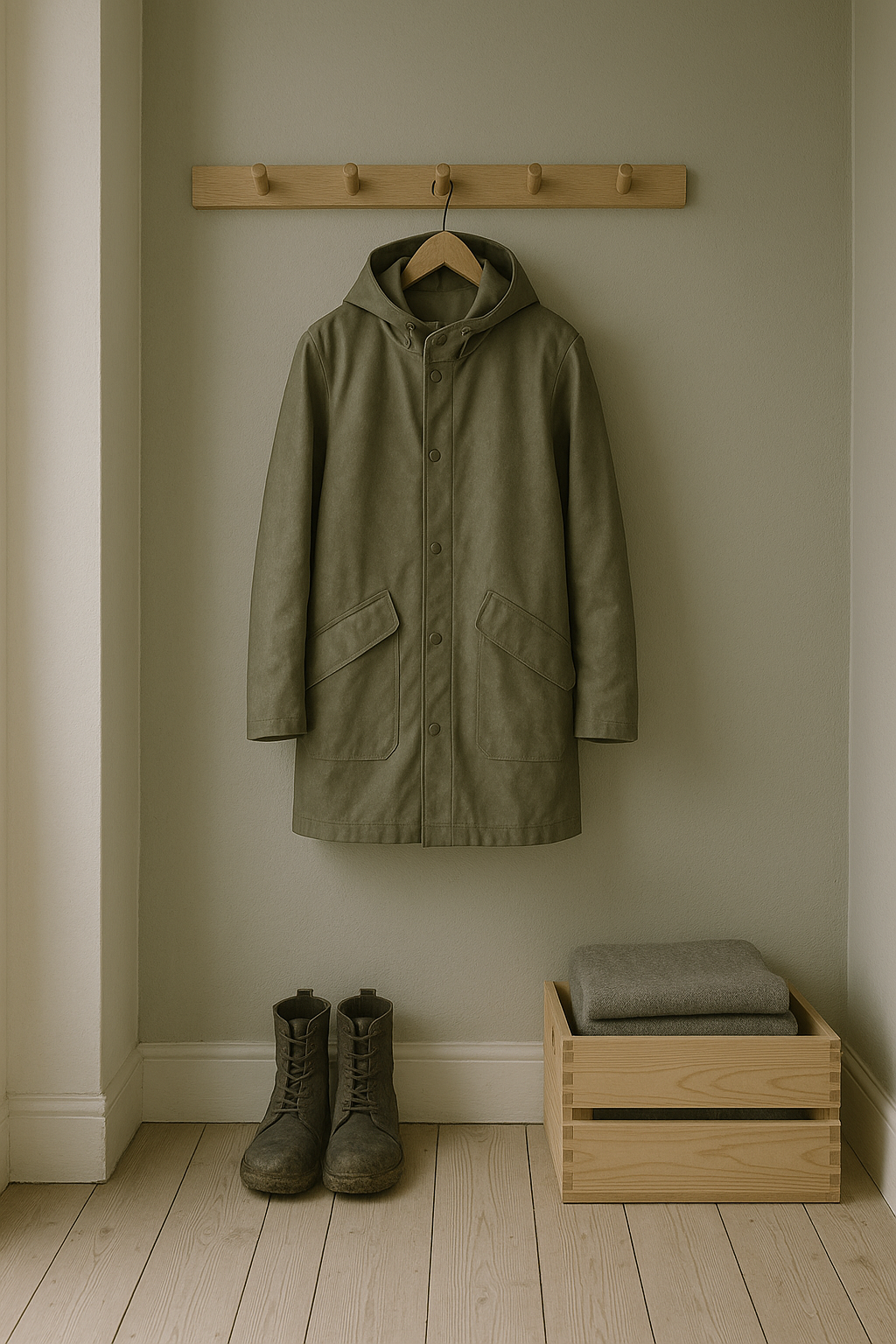
A pale Scandinavian hallway with a single raincoat hanging and boots below, lit by soft daylight. Calm and quietly intentional.

There’s a jacket hanging by the door in my house that I haven’t cleaned in two winters. A Stutterheim. Patina-stained cotton lining, scuffed hems, smells faintly of trains home. It’s not there for effect. It’s there because it does the job, and does it well. Keeps me dry, holds its own in a cold wind, and feels like continuity. Like something I’d pass on.

I think about that jacket sometimes when I work on digital products.

Because that jacket belongs in the doughnut. Not the jam-filled kind, the one drawn up by economist Kate Raworth. A model for living that rejects the old story of perpetual growth. (Aside: I came across Kate after listening to her talking with Wendell Berry on an old Start The Week. I’d gone on a recommendation from a friend to listen to Wendell Berry but it was Kate’s words which stood out).

In her diagram, the inner ring marks the essentials everyone should have access to: housing, education, dignity. The outer ring is the ecological ceiling: carbon, biodiversity, planetary boundaries. The goal is to stay in the middle. A safe and just space for humanity. Not too little. Not too much.

If that sounds like the Swedish concept of lagom, it is, except Raworth turns the cultural instinct into an economic framework. Lagom is what you feel in a table spread done right. The doughnut is how you design a city, or a system, to honour that logic at scale.

I like that the analogy might be in the Scandi larder: leftovers, carefully labelled. No waste, no lack. Just enough. The doughnut was already there, sitting quietly behind the knäckebröd.

And it maps cleanly onto UX.

The inner ring is what users genuinely need: clarity, trust, human-scale interaction. The outer ring is where the harm begins: deceptive patterns, compulsive loops, the kind of design that counts your seconds, not your needs. The good space, the space between, is where most digital products ought to live. Few do.

I’ve sat in rooms where product success was measured in taps and minutes. “More engagement,” someone would say, as the design team quietly recalibrated the interface to make it just sticky enough. I once worked on a platform where the proudest achievement was a spike in repeat logins. But when you zoomed out, those logins weren’t signs of confidence, they were symptoms of anxiety. People checking their accounts too often, not because the experience was smooth, but because the world wasn’t.

The real win would’ve been a design so clear, so calmly informative, so self-contained that users didn’t feel the need to check at all. But that wouldn’t have shown up on the dashboard. So we built noise instead. Goodhart’s Law anyone?

Doughnut thinking asks: what if we stopped designing for addiction and started designing for enough?

That principle runs through how I live. I’m not a minimalist, but I edit constantly. I favour things with integrity, materials that soften over time, ceramics that stack properly, garden tools that can be sharpened and passed on. When I write, I do so in iA Writer not because it’s clever, but because it clears the room. No distractions. Just text, gently weighted. A space with boundaries. A space that respects my focus. The writing comes better that way, less like performance, more like sorting the drawers in your head.

Same goes for the shelves at home. They hold only what earns its place. Books we’ve read. Things we actually use. Jackets that walk. Nothing there for the feed. Just our curated, persistent things.

Raworth talks about moving from extractive to regenerative economies. I think homes can be regenerative too, giving back emotionally, energetically, even ecologically, if you can. They absorb chaos. Offer rhythm. Ask less from you over time.

What does that actually look like?

There are just enough chairs for the family and the odd visitor. You can find a corkscrew without rummaging. There’s PIR lighting that flicks on as you walk from the landing to the bathroom at night. The house soaks up the mess. Fewer decisions when you’re tired. You can sit down without having to clear a pile of crap off the sofa. You can find your bloody keys.

It offers rhythm because your day moves more smoothly. And it asks less of you because it doesn’t make you work just to function.

My old boss used to moan that he couldn’t do a simple task at home because, to do that, he first had to find the tool. To find the tool, he had to get into the garage. He couldn’t get into the garage because the door was jammed. And on it went. That’s the opposite of regenerative. That’s a house that’s extracting energy from you just to stand still.

I wrote recently about the psychology of our stuff—the emotional residue it carries, the complexity it adds, the space it quietly swallows. The art of owning less isn’t about minimalism. It’s about clarity. About asking not ‘is this useful?’ but ‘is this mine to carry?’ That same lens applies here. Whether it’s a shelf, a digital feature, or a mental habit, we need to ask: is this giving something back? Or is it just squatting in the system?

And if that principle holds for homes, it can hold for digital spaces too. Interfaces, when well-designed, have the same potential, not just to serve, but to settle. To restore a little order. To give back time, attention, clarity. The question in both cases is not just what they contain – but how they behave when no one’s watching. Do they hold their shape under pressure? Or do they reveal they were only ever designed for the demo?

That’s what I try to bring into my UX work. Not scale for its own sake, but structure. Not novelty, but fidelity. In one recent project, we reduced a sprawling mass of order summary calculations by half. It had grown lopsided: multiple totals, stacked qualifiers, contradictory line logic. It looked thorough but made people pause. Double-check. Drop off.

We didn’t cut because someone asked us to. We cut because the excess wasn’t helping anyone. The business didn’t love it at first, there was concern we’d sacrificed transparency. But the users did. Completion held. Conversion held. No one missed the clutter.

You don’t need to call it Doughnut Economics. You don’t even need the diagram. Just ask: is this too much, or just enough? Is it serving someone, or keeping them circling?

I’m learning the same rules apply emotionally. The inner ring is what I need to function: rhythm, ritual, some quiet between the noisy pulses of family life. The outer ring is burnout, distraction, the endless need to ‘improve’. If I stay within those boundaries, wake early, behave deliberately, write when the coffee’s still hot – I do better work. I’m a steadier father. Less reactive. More intact.

We’ve built systems that confuse excess for success. But maybe the most humane thing we can do now is not build something. Or build something simpler. Or design the thing so well it doesn’t need us anymore.

Like the coat. You don’t notice it most days. But when the rain starts, you’re glad it’s there. And when you finally pass it on, it still fits someone else.

This piece was refined using AI. I used it to generate the image prompt, the tags, the excerpt, and to help sub-edit the copy while keeping my tone intact. The ideas, references, and rhythm are mine. The tools just cleared the room.

Tagged , , , , , , , , , , , , , ,

Listen less, observe more. Human-centred designers must ask deeper questions

One of the most oft-repeated tropes of human-centred design is that we must pay attention to a person’s needs. These needs are often said to be identified through the observation of past behaviour. In digital (whatever that means these days) this is typically through the gathering of usage data. Sit in any pitch or briefing and it won’t be long before someone starts talking about dwell times, form drop offs and so on an so forth. Often a well-meaning ‘user experience’ staffer will pipe up about the need to develop personas, and a marketeer will add “based on our segmentation of course!” “of course!” they reply. Data is incontrovertible.

Really, businesses don’t like anecdotes. They’re not keen on stories (even if the managers are consuming books on storytelling and the engineers are developing use cases), so they rely on the known knowns – how people are using their site or service. It’s this, they say which informs us how people will use our experiences in the future.

I’m unconvinced. Increasingly I find myself resisting the temptation to read much into past behaviour. The empirical psychologist in me knows that, to be a predictor of future behaviour, fellow researchers have come to some agreement that there really are quite strict conditions for this to be the case:

  • The behaviour has to occur rather often (i.e. it’s high frequency).
  • The prediction is most accurate if based on a short time frame.
  • The predicted situation must be a close match for the past situation that the observation was made from.
  • The behaviour must not have been influenced by negative or corrective feedback.
  • The person must be unchanged and, finally,
  • The person must be generally consistent with their behaviours.

That’s quite a set of experimental conditions to maintain. Consider this, if your customer bought from your site or interacted with your brand once before, can you honestly assume that they will meet all those conditions on their return visit? Even with high-traffic repeat visits I’d contend that there’s sufficient variance to make predictions at the very least, wobbly. Add in a timeline of a few weeks or months (like financial services sites, for example) and your prediction is looking essentially worthless.

Demographics are not behaviours
Quite apart from the predictive past performance within your own brand experience, what does this mean in terms of inferring behaviour from others’ actions? One of my bugbears is the regurgitation of segmentation and demographic-led personas. Passed on from media buying and market research these exhibit the classic failure of data vs. insight, that is they offer no illumination. As an identical twin who shares the same postcode, age, socio economic group and racial profile as my brother, the lazy marketeer assumes I have the same needs and behaviours as he. Though there is some cross-over, there is much that is also different and to paint with broad strokes is to miss the kind of detail in human-centred design that creates real breakthroughs. Repeat after me: demographics are not behaviours.

In 2016 where profiling and polling were shown to be so woefully ineffective at determining voter action (c.f. Brexit, Trump), isn’t it time we took a long hard look at the way in which we interrogate and model human behaviour? Fortunately some are doing this and we might look to important contexts like criminology, where they are identifying the desistance curve as offenders age and applying Bayes’s theorem to calculate offenders’ likely behaviour.

Will it rain today?
Where this leaves us is in the area of accuracy. Ultimately, as Rory has asserted in the past, analogous to our weather forecasting, we’re getting better at predicting short term behaviours but still a long way off high-fidelity predictions for weeks and months ahead. What’s helped Dare and other progressive human-centred design teams is looking at what are the stable traits of human behaviour and, furthermore, rigorously considering what is the relevance and integrity of data that forms the inputs of our predictions; we should never draw general conclusions from specific observations and it is this inductive reasoning that plagues our profession.

Nate Silver’s seminal ‘Signal and the Noise’ is undeniably popular and his models had much early success but criticisms begin to be levelled quite fairly when attempts are made to model personal and social behaviour not financial markets. I wonder if, dear reader, you’ve read Taleb’s “Black Swan“? (If you have I wonder if you read all of it? I’ve met few people that have and if you’re like me you found it’s autobiographical style impenetrable, obfuscating and bombastic. Even the Wikipedia summary suffers a similar fate) in short Taleb makes the same point, we care way too much about the inputs to our black box of analysis and truthfully understand very little of what’s going on in incredible complex systems. Taleb also points us at another user-centred design bear pit: the narrative fallacy. We construct user journeys, use cases and flows in narratives that serve to over emphasise what we think we know and bring with them all the confirmation bias of author and reader combined. How often do we still read that it’s important we design brilliant experiences that delight? You’ll see testimonials plastered on the walls of Customer Experience Officers’ offices and headline grabbing responses from frontline staff going above and beyond, and yet research has shown for some time that exceeding some expectations does no more for loyalty than a comprehensive approach to meeting most of them. But it’s just such a nice story isn’t it?

I don’t believe that the way human-centred designers unquestionably use the tools our industry have been using for the last 20-odd years gets us to great solutions.

I believe we need, like Khaneman did, to take the lessons from Taleb and stir in even more psychology, evolutionary psychology.

The answers are in our past, our prehistoric past
I’ve found comfort in developing an approach based on two seminal statements on consumer behaviour: The late David Ogilvy’s famous quote questioning the value of market research: “people don’t think how they feel, they don’t say what they think and they don’t do what they say.” and further Theodore Levitt’s “People don’t want to buy a quarter-inch drill, they want a quarter-inch hole“. I would go one step further than Levitt and suggest that they want to hang that shelf that their spouse has been hassling them about so they can unlock a little more affection. Our modern age skulls house stone age minds and, as far as I’m concerned, a ludicrously overlooked truth is that we are a species that was for a very very long time motivated by procreation, the next meal and the next opportunity to rest. These basic needs of simple satisfaction surely form the basis of our the vast majority of our motivations and when we understood the roots of our behaviour we begin to unlock some truly creative solutions to our clients’ problems (there’s a reason everyone’s talking about Lagom and Hygge, simple satisfaction is incredibly human). We don’t get there by asking our customers this stuff, we get there only through anthropology and ethnography level observations: facial coding, eye tracking, galvanic skin response, neuromarketing. I’ve yet to see a CV where a UXr tells me they’re fascinated in anthropology or they’re fluent in FACS taxonomy, when I do I’ll hire them.

Research and analysis like this doesn’t come cheap and it doesn’t come quickly but tools like iMotions and IBM Watson have the potential to do for behaviour modelling what supercomputers have done for weather forecasting. Interpretation by inquisitive and analytical strategists that are comfortable asking ‘5 whys‘, doing field observations and contextual inquiries will guide us far better than fire hosing strategy and Ux teams with web analytics. To be clear, I am not dismissive of the role of usage data, I simply insist that it augments a broader collection of data gathered from IRL observations and a contextual understanding of human behaviour.

Bury the cliches
Henry Ford never said he didn’t listen to customers (I happily correct anyone who regurgitates the Faster Horse quote), Schiller never said Apple don’t do customer research (rather they do deep ethnographic studies and are ferociously tracking observed behaviour). I’m not saying we won’t learn from customer behaviour but rather, in order to get us to innovative, creative human experiences and behaviour change we must go beyond a facile and shallow observation of customer segments. We must build intelligent teams, use tools and encourage methodologies that give us the time to build upon the evolutionary roots of human behaviour and, whilst doing so, accept that our view extends no further than the horizon, we are powerless to know if it will snow next Christmas.

In a future post I will explain why I believe an automated approach to predicting and ‘optimising’ human behaviour through so-called personalisation offered by web platforms is not helpful at advancing our online experiences.

Tagged , , , , , , , , , , ,